Years before the war in the Persian Gulf, executives in boardrooms across Japan were discussing a development they feared posed a growing risk to Asia’s energy supplies.
The global trade in liquefied natural gas, the supercooled fuel that underpins power generation across Asia, was hardening into a duopoly. Just two nations — the United States and Qatar — were poised to account for the vast majority of supply growth by 2030.
Anxiety was high in Japan because it’s the largest L.N.G. importer behind China. The concern was that a market dominated by two powerful suppliers could disadvantage buyers and leave Japan vulnerable should either pillar falter. The United States was viewed as politically unpredictable, especially after the Biden administration paused permits for new export facilities in 2024.
And Qatar sat in one of the world’s most volatile regions.
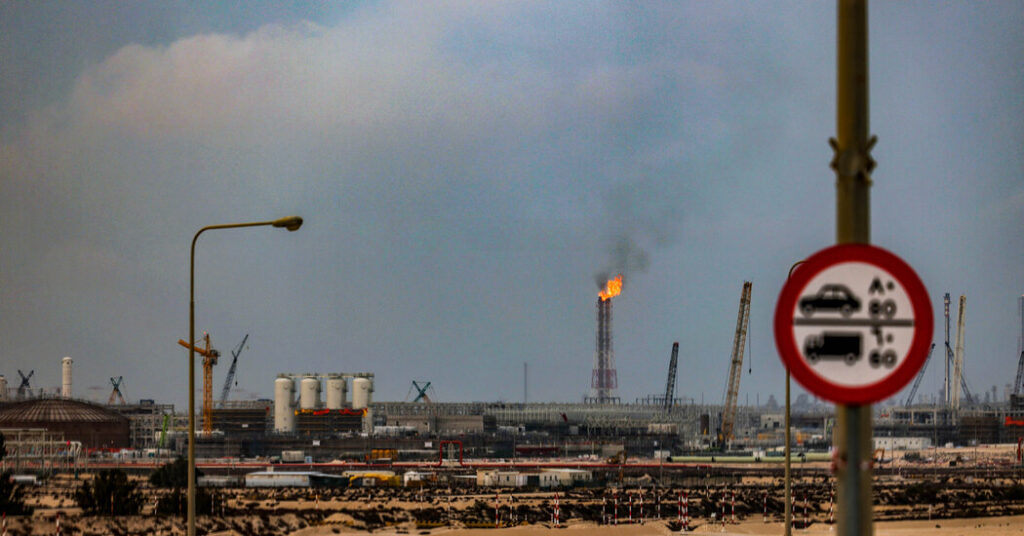
In February, those fears were realized. That month, Iran blocked the Strait of Hormuz, the waterway through which Qatar ships virtually all of its L.N.G. to the rest of the world. Two weeks later, Iranian strikes hit Qatar’s Ras Laffan L.N.G. hub, inflicting damage that could take years to repair.
The disruption immediately knocked about a fifth of global L.N.G. supply off the market. In Asia, the destination for most of Qatar’s exports, gas prices skyrocketed. Pakistan, Bangladesh, India, Singapore and Taiwan were among those in Asia getting anywhere from a third to nearly all of their L.N.G. from Qatar. The rug had been pulled out from under them.
It is easy, in hindsight, to say countries should have been better prepared, said Henning Gloystein, a managing director for energy at Eurasia Group, a political risk research firm. Yet significant energy supply disruptions occur virtually every decade, he said, and the industry’s growing reliance on just two suppliers had created a structural vulnerability.
“The industry was too concentrated,” he said. “Now, of the two big players, half are out of the market.”
Carved Out of the Desert
Qatar’s ascent to the top of the global L.N.G. industry began in 1992 when Chubu Electric, a Japanese utility, was scouring the globe for the four million metric tons of liquefied natural gas needed to fuel a new domestic power plant.
Finding traditional suppliers tapped out, Chubu turned to Qatar, then an oil-dependent nation mired in debt. Though sitting atop the world’s largest natural gas field, Qatar needed enormous investment to build the infrastructure required to liquefy gas for export.
For Qatar, the Japanese supply deal was transformative. The contract enabled the country to secure international bank loans needed to construct its first L.N.G. trains — the giant industrial processing units that liquefy gas.
From there, Qatar became a primary supplier in a rapidly expanding global market. Around the world, industrialized nations increasingly viewed natural gas as a critical bridge fuel, helping them move away from the more carbon-intensive coal while building toward a future powered by renewables. The worldwide demand for L.N.G. surged to more than 220 million metric tons by 2010, up from 55 million in 1990.
North of Doha, the Qatari capital, the authorities built Ras Laffan, an industrial city that today contains more than 100 square miles of gas-processing and liquefaction infrastructure. Visitors permitted inside the heavily guarded complex describe it as a dizzying labyrinth of steel rising from the desert.
The L.N.G. boom propelled Qatar’s annual economic growth above 10 percent for years. By 2006, Qatar had surpassed Indonesia to become the world’s largest L.N.G. exporter, a distinction it comfortably held for much of the past two decades.
Fracking Boom Takes America
In the United States, policymakers spent much of the early 2000s fearing the country was running out of domestic gas and building enormous import terminals. But starting around 2008, hydraulic fracturing and horizontal drilling helped unlock immense resources previously trapped in shale.
The refinement of those technologies transformed the United States into a major exporter. Across the Permian Basin and the Marcellus Shale, new gas projects fed terminals in Texas and Louisiana that liquefied natural gas for shipment to Europe and Asia.
Throughout the 2010s, the U.S. fracking boom incited public backlash over issues like contaminated groundwater and gas leaks, but the L.N.G. surge carried forward as regulators refrained from halting permits for large and lucrative export projects. By 2023, the United States had overtaken Qatar as the world’s top exporter.
Around the same time, the duopoly was also being cemented as rivals receded. Russia’s plans to expand its gas sector were stalled by Western sanctions. Australia saw production plateau amid tightening environmental regulations and domestic supply mandates. Legacy Southeast Asian exporters such as Malaysia and Indonesia began consuming more of their own gas at home and exporting less.
That left two countries — Qatar and the United States — to divide an expanding global market. Both embarked on major production expansions. In 2019, Qatar announced plans for new wells and L.N.G. trains that would nearly double its export capacity by 2030.
Meanwhile, a new wave of projects sprang up along the American Gulf Coast that the U.S. Energy Information Administration expects will more than double American L.N.G. export capacity by 2029. By the end of the decade, Qatar and the United States are expected to control about half of the world’s total supply.
This dynamic has raised red flags in Japan for years. With the market increasingly concentrated in just two countries, importers faced the risk of sudden supply disruptions or the wielding of exports as geopolitical leverage. Japan has sought to diversify its liquefied natural gas portfolio, leaning heavily on Jera, a joint energy venture between two of the country’s biggest electric utilities, created in 2015 in part to achieve the scale needed to secure a broader array of supply lines.
Rise of a Near Monopoly
Now, one of the two global pillars of L.N.G. supply has been hobbled, with the Strait of Hormuz shut and Qatar unable to export. Even if the waterway reopens, production is likely to remain impaired for years because of structural damage at Ras Laffan. The expansion project, already behind schedule, is also likely to face further delays.
Countries heavily dependent on Qatar are struggling. Pakistan, which gets nearly all of its L.N.G. from Qatar, is enduring power blackouts. Vietnam and India are rationing gas and reverting to coal-fired generation. Even wealthier countries such as Singapore, which relies on Qatar for roughly a quarter of its L.N.G. imports, have issued sweeping energy-conservation guidelines.
American officials have sought to seize the moment. At an Asian energy forum in Tokyo in March, Interior Secretary Doug Burgum used the Middle East energy crunch to pitch U.S. suppliers. “We have energy to allow for prosperity at home, and the ability to sell energy to friends and allies across the Pacific,” Mr. Burgum said. Now, he told gathered business and government officials, “You don’t have an alternative.”
In reality, while American companies are racing to bring new export capacity online, those efforts will fall far short of offsetting the near-term loss of Qatari gas. Even after the strait reopens, supplies are likely to remain tight for years.
Parts of Asia are likely to continue rationing power. Eurasia Group’s Mr. Gloystein also expects a rush to diversify supply lines, with producers in countries like Australia, Norway and Canada scrambling to bring additional output online as quickly as possible.
Qatari production will eventually recover, but for the next few years, the industry is likely to shift from a duopoly-like structure toward one dominated by the United States, Mr. Gloystein said. “The U.S. will play a very, very dominant role.”
For gas importers already concerned that American energy exports could be used as leverage in trade disputes and diplomatic negotiations, the prospect is troubling. “That’s a very legitimate concern, which I think will reappear in the next two years,” Mr. Gloystein said.
River Akira Davis covers Japan for The Times, including its economy and businesses, and is based in Tokyo.
The post The U.S.-Qatar Domination of Gas Left the World Dangerously Exposed appeared first on New York Times.