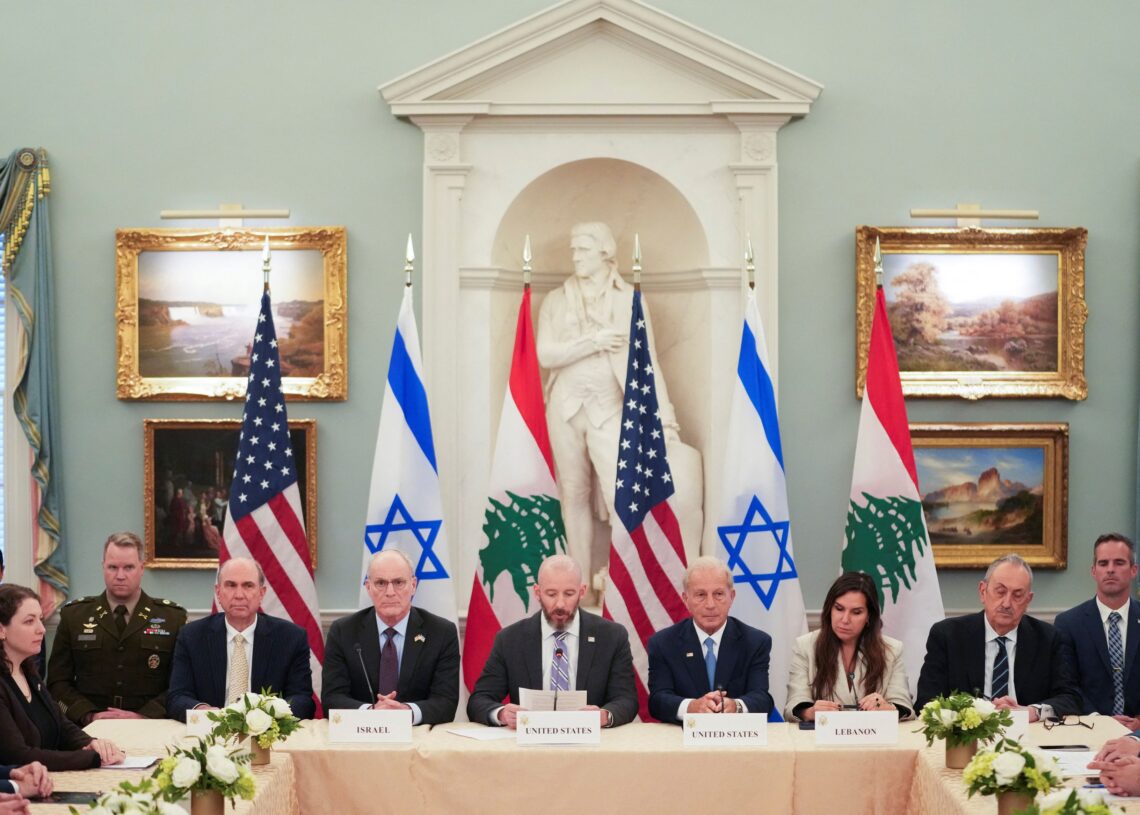
JERUSALEM — Hezbollah quickly rejected a ceasefire deal announced on Wednesday by Israel and Lebanon, leaving the possibility of continued fighting in a theater that holds implications for President Donald Trump’s negotiations with Iran.
Although the deal was described as a ceasefire, its negotiation process did not include Hezbollah, the powerful Iranian-backed militant group that has been locked in bitter fighting with Israeli forces since March. The new agreement, mediated by the United States, calls for Hezbollah to stop firing on Israel and to leave southern Lebanon while the Lebanese military comes in to take control of newly established “pilot zones” free of any non-state armed groups — namely, Hezbollah.
The deal also does not appear to extract significant concessions from Israel and would give its military the freedom to bomb Hezbollah targets in southern Lebanon and in Beirut if it does not pull out of the south.
In a speech Thursday, the Hezbollah leader Naim Qassem denounced the deal as a “farce,” saying it would effectively split southern Lebanon from the rest of the country and hand “freedom to the Israeli enemy to kill in Lebanon.”
“We have given no commitment to anyone,” Naim said as he urged the Lebanese government to call off talks with Israel and demanded Israel’s full withdrawal from Lebanese territory. “As long as the aggression continues, we will confront it with all the power we have been given.”
On Thursday morning, hours after the deal’s announcement, fighting raged on as Israel conducted three strikes near the southern town of Nabatieh. In another indication that Israel did not intend to stop hostilities, the Israel Defense Forces issued a public warning urging Lebanese civilians to not travel south of the Zahrani River, citing ongoing operations targeting Hezbollah.
Israel and Hezbollah have traded attacks since an initial ceasefire deal — which also did not include Hezbollah — was announced in April, and Lebanese health officials have said hundreds of people have been killed in that time.
Unlike the April ceasefire, the new agreement includes concrete steps that would transfer to the Lebanese army security oversight in pockets of southern Lebanon from where Israel withdraws. Lebanese President Joseph Aoun told reporters on Thursday that the handover could happen within a day.
Historically, the Lebanese army, which sometimes works alongside Hezbollah, has avoided taking measures that would displace the powerful militant group or antagonize it. If not smoothly executed, the new plan could put the two Lebanese factions in direct confrontation and even risk civil war, analysts say.
In a statement, Israeli Defense Minister Israel Katz said the deal gives Israel the freedom to continue firing and conducting operations on the ground in an area south of the Israeli-demarcated “Yellow Line,” and to strike Beirut, during the initial phase when Hezbollah is expected to withdraw north of the Litani River.
The Lebanese population south of the Yellow Line, which runs about six miles from the border with Israel, will also not be allowed to return home after being displaced by Israeli evacuation orders, Katz clarified.
The broad latitude given to Israel in the agreement “is an expression of the reality we have created in Lebanon so far,” Katz said. “This is a reality that may lead, depending on developments on the ground and our continued uncompromising insistence on the interests of the State of Israel, to a political peace treaty with the state of Lebanon.”
The last time Israel invaded Lebanon, in the fall of 2024, ceasefire negotiations between Israel and Hezbollah became ensnared over the question of whether Israel would maintain freedom of action to strike Hezbollah. After the deal was struck in late 2024, Israel continued low-intensity strikes against Hezbollah for months, citing what it said were furtive efforts by Hezbollah to rebuild its strength in the south, and Israeli ground forces never fully withdrew from Lebanon. War erupted again this spring when U.S. and Israeli forces attacked Iran.
In recent weeks, the fighting in Lebanon between Israel and Hezbollah has threatened to derail Trump’s efforts to secure a comprehensive peace deal with Iran. Tehran has demanded that Israel stop its air and ground campaign in Lebanon, and this week Trump said in a podcast that he made an expletive-laced call to Israeli Prime Minister Benjamin Netanyahu because he felt “perturbed” by Netanyahu “constantly fighting” Hezbollah.
Trump confirmed to the “Pod Force One” podcast on Wednesday that he had called Netanyahu “crazy” and waved him off an invasion of Beirut, but said the two of them maintained a healthy working relationship.
While Trump has been negotiating with Iran, Israel has occupied land equal to a fifth of Lebanon’s territory, displaced much of the civilian population there and threatened to invade Beirut to clear out Hezbollah strongholds. In some instances, the timing of Israeli attacks — such as its massive bombardment of Beirut that killed 357 people on April 8, one day after the U.S. and Iran announced their own ceasefire — appeared to be aimed at undermining Trump’s talks with Iran.
For its part, Iran did not immediately comment on the Israel-Lebanon deal. But its foreign minister, Abbas Araghchi, reiterated on Wednesday the Iranian position that the two battlefronts — the U.S.-Iran war and the conflict in Lebanon — must be linked.
“If Israel attacks Beirut, the result will be the return to war,” Araghchi said in an interview with the Lebanese channel Al Mayadeen. “Either the war stops in both Iran and Lebanon, or it doesn’t stop: neither in Iran nor in Lebanon.”
Qassem Kassir, an analyst close to Hezbollah, criticized the deal for giving Israel too much latitude to continue its attacks and said it risked pitting the Lebanese army against Hezbollah.
“Will Israel commit to a full ceasefire? Will the people of the southern villages be allowed to return … and rebuild their villages? How will the Lebanese army deal with the situation? How will the army deploy in the south?” he asked.
“There are many questions in this agreement, and there are many problems in it,” Kassir added. “The most important thing is that this agreement does not turn into an internal Lebanese conflict.”
But supporters of the deal say that the framework empowers the Lebanese government, which has long been viewed by the United States and Israel as enfeebled and incapable of confronting Hezbollah.
Nabil Bou Monsef, a prominent Lebanese analyst, predicted that Hezbollah would publicly accuse the government of betraying the country but avoid escalation.
“What I expect Hezbollah to do now is a contradicting approach,” he said. “They will raise their voice in denouncement but cool down on the ground to avoid looking like they are the violators of the ceasefire.”
The post Hezbollah denounces Israel-Lebanon ceasefire deal as a ‘farce’ appeared first on Washington Post.