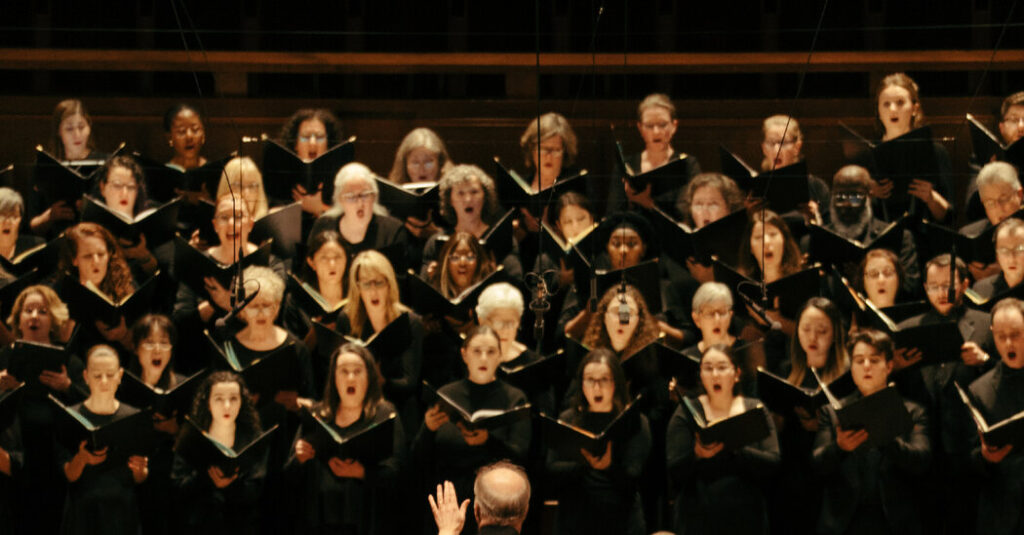
The National Symphony Orchestra is struggling to secure its next season — and working to calm supporters worried about its future — as it faces financial pressures and the temporary loss of its home at the John F. Kennedy Center for the Performing Arts.
Since President Trump took over the Kennedy Center at the start of his second term, the orchestra has seen audiences diminish, artists cancel and key staff members depart. Now, the most pressing issue is Mr. Trump’s plan to close the center for a two-year renovation, a decision that forced the orchestra to find other concert halls for its season starting in the fall.
Taken under the wing of the Kennedy Center in the 1980s amid financial challenges, the orchestra has its budget overseen by the center, which covers its deficit each year.
But for more than two months, the orchestra has been waiting for its budget to be approved by the center’s leadership, led by its board chairman, Mr. Trump. As a result, the orchestra has been unable to secure venues or lock in guest performers, according to three people with knowledge of the organization’s affairs who were not authorized to speak publicly.
The size of the budget request has not been disclosed, but it was $42 million in the fiscal year that ends in September.
Despite the lingering uncertainty, the orchestra’s board released a statement after a meeting on Wednesday in which it expressed optimism that the organization would be able to navigate a difficult period. The statement said it would announce plans for next season “soon.”
“We are confident that, with continued constructive dialogue with center leadership, the orchestra will continue to be able to share its gifts with those in the nation’s capital, and more broadly,” the board members said in the statement. It added that they “fully expect to stage these performances at the center or at other suitable venues depending upon the status of the center’s renovation.”
Instability can be damaging for a performing arts organization that is already contending with yearly operating deficits. A recent judicial ruling only deepened the volatility, putting Mr. Trump’s plan to close the center on hold and prompting the president to suggest he may completely walk away from his leadership role there.
Even as the orchestra’s leadership suggested the problems are manageable, some supporters have said they are worried that the 95-year-old orchestra could find itself stranded, unable to proceed with a full season and unsure of its future.
“What an international embarrassment it would be for the National Symphony Orchestra of the United States to fold — and it’s very possible that could happen,” said Jean Davidson, who left her role as executive director of the orchestra two months ago.
“This is an orchestra that has never played as well as it’s playing now under Gianandrea Noseda,” she added, referring to its music director, “which just makes it even more tragic.”
Representatives for the Kennedy Center did not respond to requests for comment. But officials have said that the closure was devised to secure the long-term future of its artistic programming. Matt Floca, the center’s new executive director, has called it a “once-in-a-generation opportunity to restore and revitalize one of America’s most iconic institutions.”
Last week, Judge Christopher R. Cooper of the Federal District Court in Washington temporarily blocked the closure, ruling that the board had not done its due diligence before approving the shutdown. He also found that the board had unlawfully renamed the institution the “Trump Kennedy Center” and ordered Mr. Trump’s name to be taken off the building within two weeks. A spokeswoman for the center said it would appeal, but one has yet to be filed.
The symphony has long been considered the premier orchestra in the nation’s capital, one known over the years as the “orchestra of the presidents.” After Kennedy’s funeral in November 1963, the orchestra played a post-midnight concert honoring the slain president in an empty Constitution Hall.
After Mr. Trump’s takeover last year, the National Symphony decided to stick with the Kennedy Center even as there was an exodus by other artists and performers. Among those that left is the Washington National Opera, which had been a resident at the center.
But the symphony has struggled to keep its audiences intact.
Internal sales data reviewed by The New York Times shows that from the start of the National Symphony’s current season through the end of April, its classical and “pops” performances have taken in an average of about $55,700 in ticket revenue per performance. The capacity of paying audience members for those concerts averaged about 43 percent.
During the same time period in the 2023-24 season, those performances — buoyed by the appearance of stars such as Maxwell, the R&B singer — took in an average of about $123,700 per show, with the capacity of paying ticket holders averaging about 84 percent.
There were still brights spots in the current season. A program conducted by Joe Hisaishi, the composer behind many of Hayao Miyazaki’s Studio Ghibli films, was a smash hit, selling at 95 percent capacity days before the performances began in mid-May.
Representative Joyce Beatty, a Democrat and ex officio Kennedy Center board member whose lawsuit led to the recent court ruling, has suggested in legal papers that the true reasons for the closure were declining attendance and the exodus of artists.
Kennedy Center officials have denied that, arguing instead that the building needs an “urgent and significant restoration,” pointing to serious water intrusion and outdated equipment.
The closure plan has had major implications for all kinds of performers, as well as behind-the-scenes workers such as stagehands, ticket sellers, ushers and programmers.
Anxieties are swirling among the 90-some musicians in the orchestra, which currently has no concerts confirmed beyond Sept. 12. Performances in the classical music world are often scheduled years in advance, and the National Symphony’s upcoming season would have typically been announced in March or April.
“Anyone familiar with American symphony orchestras would be concerned about the fact that the National Symphony has not announced a season yet,” said Gary Ginstling, a former executive director of the National Symphony, who now runs the Houston Symphony.
Even if the orchestra does build out a season, he said a rotation of venues would pose a major challenge for an arts organization that relies on a loyal and returning audience, including subscription holders. “The lifeblood of any symphony orchestra is its relationship with its audience,” he said.
The orchestra’s board members, donors and staff members are increasingly voicing their concerns.
Some hope judicial scrutiny of a closure might mean the orchestra could continue to play in the building’s grand 2,465-seat concert hall. But Judge Cooper made clear he would not permanently prevent a closure if the board, after deliberating, chose to move forward with its plan.
The delay in the budget’s approval has put alternative halls in Washington at risk of being booked by others. The Washington National Opera’s coming season will be staged at local venues, including at least one — the Music Center at Strathmore, in Maryland — that the National Symphony has been eyeing.
Leonard Slatkin, a former music director for the National Symphony, said in an email that he was scheduled to lead the orchestra for a week in the coming season. However, he said, “I do not know where or what we will play.”
Mr. Slatkin, who led the orchestra for more than a decade, said he met with orchestra members in Washington last week and walked around the center. He said he grew emotional when he reached the famous bronze bust of Kennedy.
“It was all just too much,” Mr. Slatkin said. “Was I ever going to step foot in the building again? What will next season look like for the orchestra?”
In an open letter published in Variety this week, the musician Ben Folds, who quit his role as artistic adviser to the orchestra after Mr. Trump’s takeover began, wrote that the symphony was in “real trouble,” warning that “it may not survive.”
A full picture of the Kennedy Center’s finances since Mr. Trump took over has not yet been disclosed, though tax filings covering part of his tenure as board chairman are expected to be released this year.
Mr. Trump said at a news conference in March that the Kennedy Center had been “literally on the verge of collapse,” portraying himself and his allies as the institution’s saviors. He said the center had raised more than $130 million since he took over. But he suggested that he was not altogether happy with the financial picture, singling out the National Symphony Orchestra and pointing to the center’s role in keeping it financially whole.
“We had an orchestra that lost like 18 million dollars a year, and we — they — subsidize it every year,” Mr. Trump said. “I said, ‘What kind of an orchestra loses 18?’”
Mr. Trump openly appreciates musical theater but does not often mention any taste for classical music, beyond his admiration for Luciano Pavarotti. Though he attended performances of “Les Misérables” and “Chicago” at the Kennedy Center, he has left the symphony to Vice President JD Vance and his wife, Usha Vance, who were booed by audience members last year ahead of a performance of Shostakovich’s Violin Concerto No. 2.
Sheelagh McNeill contributed research.
Julia Jacobs is an arts and culture reporter who often covers legal issues for The Times.
The post Amid Kennedy Center Strife, the National Symphony Faces a Cloudy Future appeared first on New York Times.