British Prime Minister Keir Starmer has condemned the violent protests that erupted over the death of a student who was handcuffed by police after he had been stabbed.
Vickrum Digwa, 23, was sentenced on Monday to a minimum of 21 years in prison for the murder of 18-year-old Henry Nowak, who was killed in an attack in Southampton in December 2025.
Newly released police footage of the incident shows officers continuing to put Nowak in handcuffs despite his pleas that he was struggling to breathe and was injured. Digwa, who is Sikh, had told police he was a victim of a racist attack, an allegation that was later proved false.
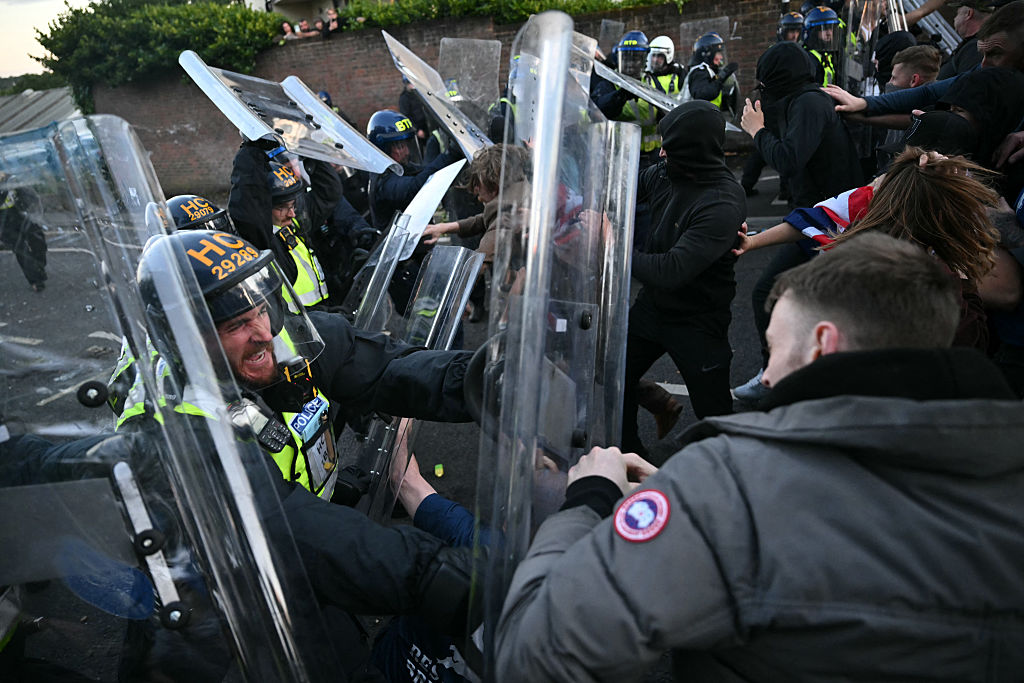
The incident has sparked violent protests in Southampton, resulting in 11 police officers sustaining injuries and damage to property and vehicles.
Starmer on Wednesday acknowledged there are “serious questions to answer, including how accusations of racism informed police thinking,” but emphasized there is “no justification for more violence and disorder.”
Addressing lawmakers in the House of Commons, he said the violent protests were “disgraceful and completely unacceptable.”
The case has also heightened concerns that public anger over the killing and the police response could deepen racial tensions and further polarize debate around immigration and policing in Britain.
Nigel Farage, an ally of U.S. President Donald Trump and leader of the hard-right Reform UK Party that triumphed in recent local elections, claimed the country was living under “two-tier policing” based on ethnicity.
In a social media post, Farage also claimed “the fear of being called racist was greater than dealing with Henry Nowak’s murder” and said “we should respond to this with pure cold rage.”
Starmer staunchly rejected Farage’s comments, highlighting that Nowak’s family had expressed his death should not be “used to create further division, hatred or tension.”
“Exploiting this tragedy to create grievance and division would be wrong in any circumstances, but to do it when the family are expressly saying ‘please don’t’ is unforgivable,” he said in the highly charged Commons session.
The tensions were particularly evident in Southampton, where anger over the case spilled onto the streets on Tuesday night.
Police reported instances of “bottles thrown, makeshift weapons used, damage caused to the homes and vehicles of innocent residents, and threats and violence directed towards our officers.”
“Last night, we made two arrests and that number will rise as those investigations continue,” said Chief Constable Alexis Boon of the Hampshire and Isle of Wight Constabulary. “I know that since the release of the body-worn video footage from the night of Henry Nowak’s murder, there is a desire for answers and accountability, but that must be done in the right way.”
U.K. Home Secretary Shabana Mahmood also condemned the scenes, insisting “there can be no justification for hijacking this tragedy to stir up violence and disorder. Those responsible can expect to face the full force of the law.”
Divisions have been stoked following the release of police bodycam footage earlier this week.
The footage, reviewed by TIME, shows officers arresting Nowak, who had been repeatedly stabbed by Digwa on his way home from a night out with friends on Dec. 3, 2025. TIME is not publishing the video because of its distressing nature.
Nowak, who is lying on the ground as he’s being handcuffed, can be heard telling police “I can’t breathe” and “I’ve been stabbed,” to which one officer replies: “I don’t think you have, mate.”
Police have since said that officers started to perform CPR “within minutes” of interacting with Nowak and that “a pathologist told the court that, tragically, nothing officers could have done that night could have saved Henry’s life.”
Hampshire Police’s Deputy Chief Constable Robert France said: “I am deeply sorry that Henry could not be saved. I am deeply sorry that in the moments he lost consciousness, he had been handcuffed and arrested.”
The Independent Office for Police Conduct (IOPC) is continuing its investigation into the officers’ contact with Nowak. Officers involved in the incident are currently being treated as witnesses.
Sikh community expresses concern amid violent protests
The murder has reignited debate over the legal exemption that allows practising Sikhs in the U.K. to carry a kirpan, a ceremonial blade worn as an article of faith.
The Crown Prosecution Service said Digwa carried two ceremonial blades, describing both as kirpans. The judge, who described the weapon Digwa was carrying as a “large Sikh dagger,” accepted that assessment.
When delivering sentencing remarks on Monday, Judge William Mousley K.C., addressing Digwa, said: “You were sober, but were carrying a large Sikh dagger in a sheath attached to a belt over the outside of your clothing. It is a strict requirement of the Sikh faith to have a knife, called a kirpan, at all times. Generally, this will be a small knife, hidden from view, often on a length of cord and worn around the neck. You had that but, in addition, the large dagger in a sheath.”
He continued: “The privilege extended to practising Sikhs of being allowed to be in public with a bladed article and, particularly in respect of the large dagger, a highly dangerous weapon, easily accessible to the wearer, brings with it huge responsibility.”
However, the Sikh Federation (UK) has disputed that characterization, saying the blade used by Digwa was not a kirpan.
Some prominent right-wing figures, including Restore Britain party leader Rupert Lowe and Reform UK spokesperson Zia Yusuf, have called for the right to carry a kirpan in public to be repealed.
Labour lawmaker Tanmanjeet Singh Dhesi, who is Sikh, has accused those political parties of deciding to “politicize people’s pain, attacking the Sikh community for wearing the kirpan and wanting it banned, even though the kirpan was not used.”
Jas Singh, an adviser to the Sikh Federation, tells TIME there is “a collective feeling of grief, worry, genuine concern and fear” among the Sikh community following the fallout from Nowak’s murder.
The comments being made by right-wing figures are “highly irresponsible and dangerous,” he says.
Singh tells TIME that since Digwa’s arrest in December, he has heard from dozens in the Sikh community who have been targeted with violence and harassment because of their faith.
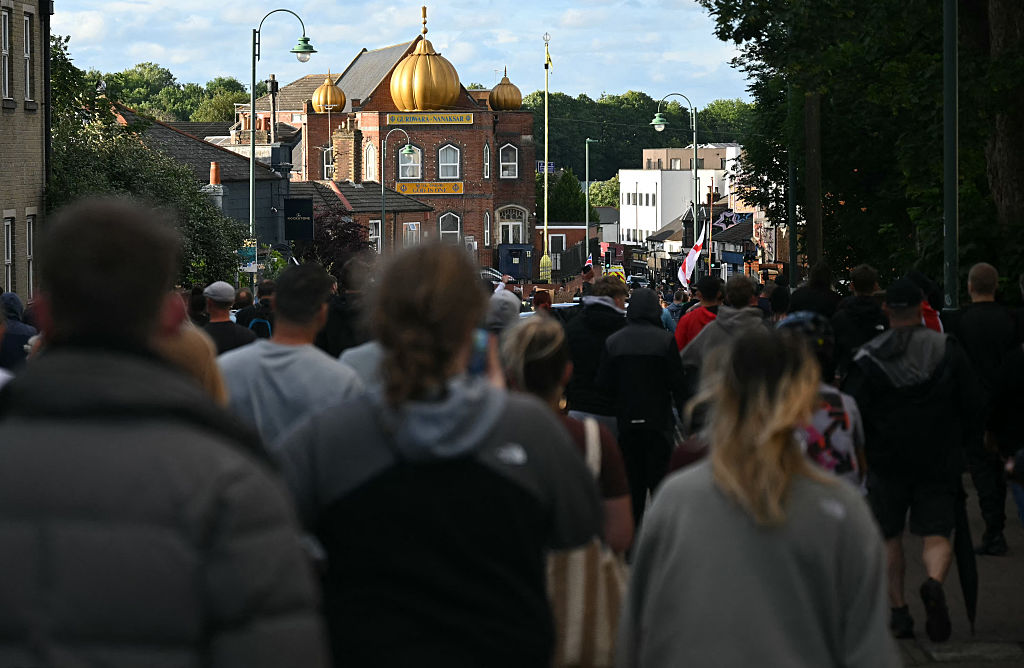
Southampton’s violent protests took place near a local gurdwara, a Sikh place of worship, and Singh is concerned that Sikhs may be targeted in the aftermath.
While Singh welcomed the remarks made by Starmer and Mahmood, he says “short statements are not enough” and is looking for the community to receive “real support.”
The post U.K. Prime Minister Condemns Violent Protests as Police Face Criticism Over Handcuffed Student’s Murder appeared first on TIME.