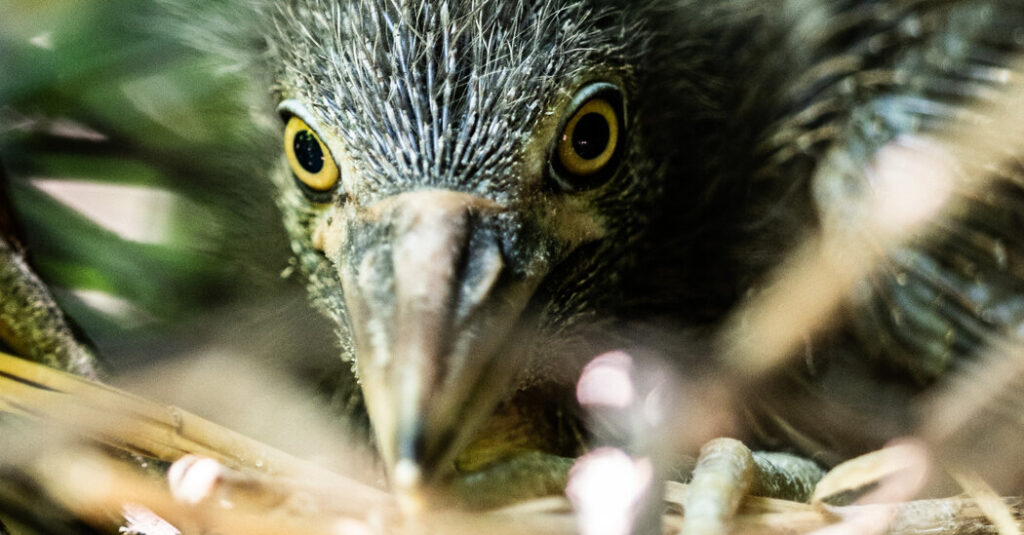
Black-crowned night herons, with their muted colors and distinctive white tendrils, are quintessential New Yorkers. “They are fashionable, they stay out late and they love exploring new places,” said Dustin Partridge, the director of conservation and science at NYC Bird Alliance.
The birds, about two feet tall, have been spotted in Harlem green spaces, along the East River in Queens and on Manhattan’s Lower East Side, where they are rumored to be aficionados of the local rats. When Valerie Wald, a high school teacher, walks to work through Central Park, she enjoys watching their “characteristic behavior of doing absolutely nothing,” she said.
But the popular, stout birds could vanish from New York City in 11 years, going the way of the once-ubiquitous passenger pigeon, according to a new study by NYC Bird Alliance, a nonprofit formerly known as NYC Audubon, and several other groups, including the Cornell Lab of Ornithology and Rutgers University.
Why the herons are disappearing remains a mystery that demands more research, the study concluded. Possible causes include toxins in the water, climate change, human disturbance and predatory creatures.
The news points to the issue of bird loss in general — about a three billion decline since 1970 — across North America. And the New York/New Jersey Harbor area, which has the largest population of nesting herons and egrets in the Northeast, is not immune.
Between 2000 and 2022, there was a 27 percent decline in nesting wading birds in the harbor, which was driven almost entirely by a precipitous nosedive in the population of the harbor’s most common bird, the black-crowned night heron.
The news “could signal a significant ecosystem shift with cascading consequences,” according to the study, which was published on Wednesday in Conservation Science and Practice, a scientific journal focused on biological diversity. The health of the harbor is possibly at stake, the study said.
Because black-crowned night herons are the dominant water bird there, representing nearly half of wading bird nests in recent years, their disappearance could indicate a looming threat for other water birds, as well as other creatures, throughout the harbor.
“We need to remember that if conditions are not healthy for birds, they’re unlikely to be healthy for us,” Amanda Rodewald, an ornithologist at Cornell, said in the 2025 “State of the Birds” report. More than 110 species had lost more than 50 percent of their populations during the last half-century, the report said.
The last time water birds disappeared from the harbor was amid the pollution and habitat loss produced by the Industrial Revolution. But after the passage of the Clean Water Act in 1972, the birds returned. By the late 1990s, 23 percent of all nesting wading birds on the Atlantic coast, from Maine to Virginia, called the New York/New Jersey Harbor home.
The disappearance of black-crowned night herons in such a robust nesting area could mean that the species is at risk throughout the Northeast, Dr. Partridge said. “If we lose New York Harbor, we may entirely lose these birds,” he said.
On a sunny but chilly day in March, two black-crowned night herons roosted on tree branches overlooking the lake in Central Park. As the breeze ruffled their plumage, the birds stood stock-still, save a little chest gnawing.
“They’re a favorite of my followers,” said David Barrett, the founder of Manhattan Bird Alert, a social media feed that posts sightings throughout the city. “They’re big birds that are mostly friendly,” he said, as he peered at them through binoculars. The herons seemed unfazed by the constant stream of power walkers 20 feet away.
In the spring, they breed throughout 20 small, undeveloped islands that are part of the archipelago of New York City, from Goose Island in the South Bronx to Canarsie Pol Island in Jamaica Bay, Brooklyn. The parents fly, loiter and hunt all over town, carrying food from their adventures back to their nesting families.
Fully grown birds are tough and hearty. They use their beaks to stab their prey, which can be anything from frogs to fish to those Lower East Side rats. They don’t frazzle easily, and they hold their ground, often hunched over. They look like feathered, miniature Alfred Hitchcocks.
But the herons are more vulnerable when they are nesting. The wild islands that dot the city’s waterways are threatened by rising seas and human activities, including people visiting the islands to go exploring, which is illegal and can make wading birds sense that nesting in the area is unsafe.
The herons are facing competition from other birds, like double-crested cormorants, for nesting space and the meddling behavior of raccoons, wily and curious animals that destroy nests and eggs while hunting for food.
“Oh no, my favorite mammal in Morningside Park is attacking one of my favorite birds,” said Ms. Wald, the teacher, when she learned of the possible predation.
But there could also be something in the water that is bothering the herons.
Possible pollutants include pesticides, heavy metals such as lead and mercury, and synthetic toxins called PCBs (Polychlorinated biphenyls). As marshes disappear, “previously sequestered pollutants” could be released into the water, according to the new study, which concluded that more research was needed to pinpoint what was making the harbor inhospitable for the herons.
NYC Bird Alliance analyzed data from nest counting throughout the 20 islands between 2000 and 2022. The populations of some species, including great egrets and snowy egrets, increased, possibly because of the Migratory Bird Treaty Act of 1918, which made hunting the egrets illegal.
The drastic decline in the black-crowned night herons and another species, the glossy ibis, eclipsed the increase of egrets, contributing to an overall decline of water birds in the harbor. The glossy ibis is a relative newcomer to the region, having first appeared in the 1960s after migrating from Europe or Africa early in the 20th century. Its loss could be explained by simple natural range contraction, meaning that its population has reached equilibrium.
But it’s the loss of the herons — native New Yorkers — that has biodiversity experts worried. They are an indicator species, which means that they fail to thrive when a pollutant or irritant is present.
“The black-crowned night herons are telling us there is another problem,” Dr. Partridge said. “They are the canary in the coal mine.”
As the team continued its annual visits to New York City’s nesting colonies during the last two weeks in May — the ideal time to count chicks before they outgrow their nests — it was contending with new challenges, including disease and global warming. Last year, the count was canceled because of bird flu. And on the first day of visits this year, the temperature soared to nearly 90 degrees — almost 20 degrees above typical high temperatures for late May — which made conditions too hot for a safe nest count.
Instead, the team conducted wellness checks on the islands, which were full of poison ivy and thorns. Members did a very rough count of the species and the nests they saw. Once again, the number of black-crowned night herons seemed low, although on one island, three grumpy-looking chicks were spotted through a tangle of tree limbs. A representative from the American Bird Conservancy, a nonprofit, installed listening devices to trees, hoping to detect auditory clues about what could be disturbing the birds.
The study recommends better management and protection of the islands where the birds nest and that New York list the black-crowned night heron as “threatened” or “endangered,” a move already made by Maine, New Jersey and Pennsylvania.
Because black-crowned night herons can be found across the globe, they are not covered by the federal Endangered Species Act, which protects animals that are at risk of going extinct worldwide. Some members of Congress are trying to amend the law, which could result in individual states becoming more responsible for conservation efforts.
“State policies and conservation efforts could have a disproportionately larger role for species that don’t recognize state borders,” said Dr. Partridge, who remains optimistic that with the appropriate efforts, the black-crowned night herons can be saved.
“With this discovery, there’s still enough time for us to protect these birds.”
Hilary Howard is a Times reporter covering how the New York City region is adapting to climate change and other environmental challenges.
The post This Rugged New York Heron Is Suddenly Facing Extinction. Why? appeared first on New York Times.