The Trump administration has issued a revised plan to address homelessness that shifts large sums of federal aid from long-term housing to time-limited programs that emphasize treatment for mental illness and addiction.
The plan, which seeks to promote “law and order,” is a scaled-back version of one the administration issued last fall. Congress and a federal court blocked that proposal after critics warned it could send as many as 170,000 formerly homeless people back to the streets.
The administration’s revised plan is still a frontal assault on the longstanding model of homelessness aid known as Housing First. The move is likely to shift about $1.2 billion away from housing programs, with the risk of displacing current tenants. It constitutes the sharpest change in homelessness policy in a generation.
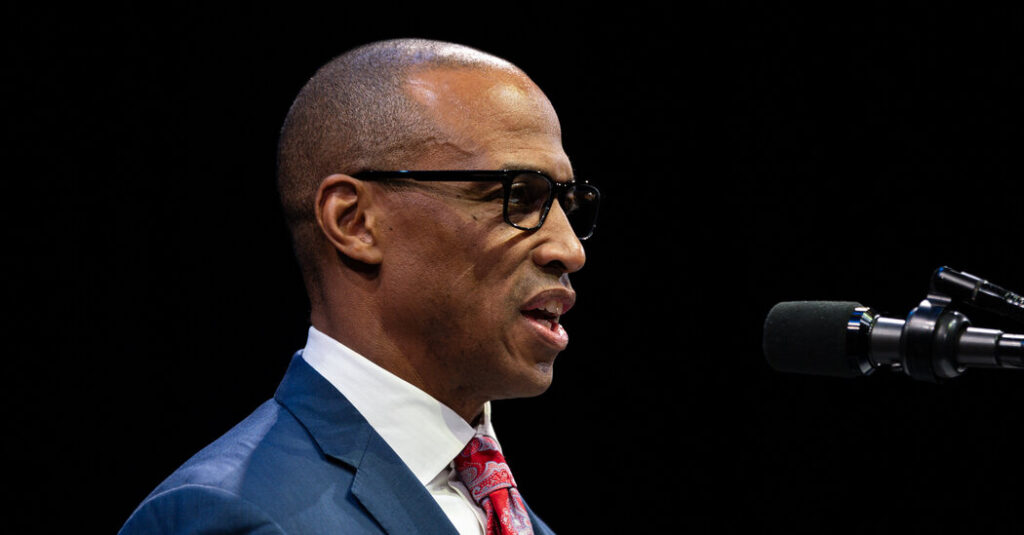
“The ‘housing first’ experiment failed Americans by warehousing the vulnerable without results,” Scott Turner, the housing secretary, said in a statement. “Housing alone will not solve a crisis driven by addiction or mental health.”
Critics argue that the turn away from housing aid, which is likely to draw another legal challenge, puts large numbers of vulnerable people at risk. Some of the money that would be shifted is being used to house formerly homeless people.
“It’s a step back from where the administration was last year, but it will still have the effect of displacing tens of thousands of people and putting up new barriers to assistance,” said David Gonzalez Rice, a vice president at the National Low Income Housing Coalition, an advocacy group that sued over last year’s plan. “The short-term programs they’re promoting have a history of failing to serve the people with the greatest need.”
The change involves the Department of Housing and Urban Development’s Continuum of Care program, which disburses about $4 billion a year to more than 400 local grant-making groups to finance aid to the homeless. For at least 15 years, the program has promoted Housing First programs, which provide long-term housing to chronically homeless people and offer, but do not require, treatment for mental health and addiction.
Proponents argue that the once-bipartisan approach, which has been extensively studied, gets people off the street.
But growing numbers of conservative critics say that Housing First fails to treat addiction or mental illness, crowds out other approaches, instills dependency, and fails to stem the long-term rise in homelessness, as supporters once promised it would. Homelessness has risen about 15 percent since 2007, when current methods of counting began. Supporters of Housing First largely attribute the increase to rising rents and the surge of asylum seekers that began in 2022.
The plan the administration issued last fall would have limited spending on long-term housing programs (often known as permanent supportive housing) to just 30 percent of federal aid, down from current levels of about 90 percent. In promoting a “treatment-first” approach instead, the Trump administration would have shifted billions to short-term programs that require the homeless to work or seek help for mental illness and addiction.
Trump Administration: Live Updates
Updated
- The Trump administration argues for power over a Philadelphia slavery memorial.
- An order shielding the Trump family from I.R.S. audits will remain, Blanche says.
- Rubio suggests U.S. could return to a global vaccine program that Kennedy had withdrawn from.
A federal judge in Rhode Island blocked the effort on procedural grounds, saying it was issued too close to application deadlines to let local groups adapt. But she did not address the argument from critics that the change in criteria violated the law.
Congress then passed a measure requiring the housing department to distribute at least 60 percent of its homelessness aid to long-term housing programs. That is what the new plan requires.
The remaining 40 percent of aid appears largely aimed at so-called “transitional housing” programs, which are limited to two years of aid, with an emphasis on work requirements and treatment mandates.
Devon Kurtz, an analyst with the conservative Cicero Institute, which works closely with the Trump administration, praised the new rules for promoting a greater diversity of local programs. Rules that steered 90 percent of federal funds to housing programs “ossified the system, crowded out anyone who did not do Housing First,” he said. The housing department, he added, “is saying we need to provide different kinds of interventions to people with different kinds of needs.”
But Dennis P. Culhane, a professor at the University of Pennsylvania, argued that policy had shifted to long-term housing long ago because short-term aid, focused on treatment, had proven unsuccessful.
“Research shows that transitional housing is the most expensive intervention and the outcomes aren’t very good,” he said. “Most people leave quickly and don’t complete the treatment.” Without long-term housing aid, he added, “even ‘graduates’ have high rates of return to homelessness.”
Buried in the 128-page plan, released late on Monday, are details that could subtly shift political power among players in the homelessness policymaking world. By demanding that the local groups, called Continuum of Cares, “cooperate with law enforcement to advance public safety,” the rules promote the enforcement of camping bans. The new plan also makes it easier for the groups to combine into statewide entities, potentially bringing independent local groups under the control of governors. And it makes a point of inviting applications from faith-based organizations.
The rules also reward groups that reduce local homelessness, though critics warned that the number of people without housing is often determined by forces outside local programs’ control, such as housing costs, health systems and inequality. Mr. Rice said that such policies could reward communities that drive away the homeless and penalize big cities with large systems to serve homeless people, many run by Democrats.
“The effect could be to shift homelessness funding away from the homeless,” he added.
Mr. Kurtz, the Cicero Institute analyst, praised the housing department for learning from last year’s setbacks and devising a plan more likely to survive legal and political challenges. It includes a footnoted section arguing that the overhaul reflects congressional intent.
“Between the lawsuit and Congress, there have been some guardrails placed on what they can do,” he said. “They’re trying to recalibrate the system with as little disruption as possible.”
Jason DeParle is a Times reporter who covers poverty in the United States.
The post Pushing Treatment, Trump Administration Limits Housing Aid for Homeless appeared first on New York Times.