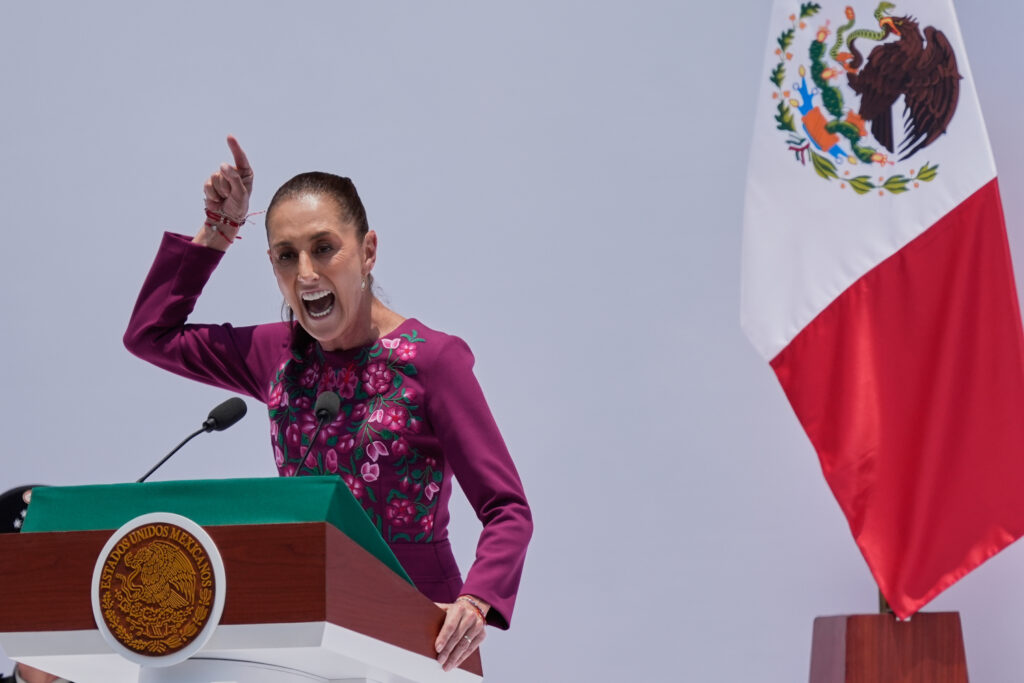
On Sunday, at a rally marking the second anniversary of her 2024 election victory, Mexican President Claudia Sheinbaum delivered the most acerbic and aggressive speech of her administration. She reached back into the past to resurrect her predecessors Vicente Fox, who left office 20 years ago, and Felipe Calderón, who stepped down over a decade ago, blaming the past for every ill of the present.
Once she got to talking about today, however, Sheinbaum swung into denouncing foreign interference in Mexico’s internal affairs, in effect accusing the Trump administration of trying to place its thumb on the scale of Mexican politics. She did all this at the tensest moment in the bilateral relationship in decades. As Mexican columnist Héctor de Mauleón put it, the oven was already burning hot, and Sheinbaum turned up the flame.
Why now?
One answer is that Sheinbaum knows heavier pressure from Washington is coming. A recent meeting with Homeland Security Secretary Markwayne Mullin seems to have ended in open discord, with Mullin demanding that Sheinbaum take concrete action against Mexican politicians already indicted by the U.S. for alleged connections to cartels. They include a sitting governor and a senator, both from Sheinbaum’s party. According to reports, Sheinbaum declined.. With more U.S. indictments looming, Mexico’s president could be preparing the political terrain for the difficult summer ahead.
Another, far more concerning reason for Sheinbaum’s defiance is that she has decided to turn to populism, making the Trump administration’s pressure a political asset for herself and her party before the country’s midterm contests next year. Wrapping herself in the flag, she may be trying to convert a position of structural vulnerability into a narrative of patriotic defiance.
The message to her base is clear: If Trump threatens and criticizes, and if U.S. sanctions or investigations arrive, it is not because her government is failing in reining in organized crime and narco-politics; it is because Mexico has a government that refuses to bow.
Her pivot fits almost too neatly with a new constitutional amendment‚ rammed through Congress by Sheinbaum’s party that would allow “foreign interference” to be used as grounds for annulling an election. Former ambassador Arturo Sarukhán has called it “one of the most egregious, alarming and retrograde pieces of legislation in Mexico’s young democratic history.” It is also a telltale sign that electoral alarm bells are ringing inside the ruling party as corruption scandals and alleged ties to organized crime begin to erode its standing.
Put together, the amendment and the speech send a clear message: sovereignty and anti-U.S. nationalism are being weaponized not only to negotiate with Trump, but also to keep open a legal escape hatch that could justify undoing the popular will if 2027 does not go the way the governing party expects.
There are legitimate reasons for Mexico to defend its sovereignty. There are legitimate grievances in the relationship with Washington. No Mexican president should behave as though the U.S. has the right to dictate Mexico’s domestic politics. But this is not that.
Sheinbaum is playing with fire, and it appears she knows it. On Monday, perhaps mindful of having gone a bit too far during her weekend rally, she tried to exonerate Trump himself from the supposed foreign interference, instead blaming what she called “sectors of America’s far right,” whom she did not identify further. But her words on Sunday leave little room for misinterpretation.
Every public ratcheting up of rhetoric against the White House leaves Sheinbaum less room to maneuver when the negotiations begin in private. Every time she translates legitimate grievances about U.S. power into blanket accusations of “interference,” she blurs the line between defending sovereignty and insulating her own movement from accountability.
Mexico’s relationship with the United States is already fragile. Its prosperity depends on trade with its northern neighbor. Its public security strategy still leans on intelligence and cooperation across the border. Its ability to manage migration, fentanyl, investment, energy, and the upcoming review of the free trade agreement with the U.S. and Canada all require a level of discipline and trust that nationalist theatrics do not help build.
And Mexico’s democracy hangs in the balance. Sheinbaum’s party, Morena, has weakened the courts, is reshaping the electoral system and now invokes “foreign interference” as a permanent threat. It is not merely defending sovereignty. It is constructing a political instrument. The danger is that the government will use the confrontation with the United States to narrow the space for dissent at home.
Sunday’s speech was an early glimpse of a governing party preparing its electoral narrative for 2027: If Morena wins, the people have spoken; if Morena is challenged, foreign interference may be to blame.
This is a recipe for lasting democratic erosion.
The post Mexico’s Claudia Sheinbaum has found her scapegoat appeared first on Washington Post.