In California, Election Day often stretches into Election Week or even Election Month because of the time it takes to count the state’s high volume of mail ballots. That process, combined with the fact that many Democrats waited until the last minute to return their ballots this year, could lead to a long wait for a call for many races in the state’s nonpartisan primaries.
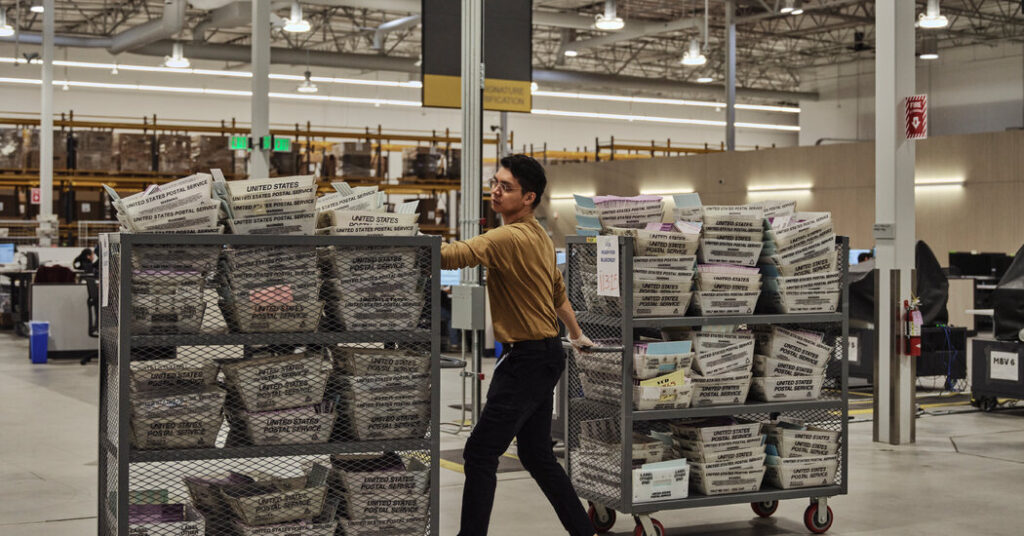
Typically, more than 80 percent of ballots in California are cast by mail. Ballots that had been returned well ahead of Election Day were processed as they were received, and counties posted those votes shortly after polls closed on Tuesday night. But ballots received close to or on Election Day — as well as those postmarked by Election Day and received within seven days — can take up to 30 days to be counted.
Those later ballots, referred to as the “late mail” vote, often determine the outcome of races. And this year’s primaries are further complicated by a marked climb in the share of ballots returned by registered Democrats in the lead-up to Election Day.
Four weeks ago, about 40 percent of the ballots cast by mail came from registered Democrats. In the week leading up to Election Day, the Democratic share of returned ballots was over 50 percent, meaning that the mail ballots counted in the days and weeks after Election Day could be significantly more Democratic than those reported so far.
In the 2022 primaries, by contrast, the partisan makeup of mail ballots remained relatively stable throughout the early voting period, at about 53 percent Democratic. Even then, the ballots that were counted after Election Day shook up candidate standings in some races.
In the 2022 Los Angeles mayoral primary, Karen Bass had received about 37 percent of the reported vote by the end of election night, compared with the more conservative Rick Caruso’s 42 percent. By the time all the ballots had been counted, Ms. Bass had risen into first place with 43 percent of the vote, and Mr. Caruso had fallen to 36 percent.
And even without a shift in partisanship over time, the counting can still take a while: In the 2022 and 2024 primaries, more than a quarter of the House races remained uncalled by the Monday after Election Day.
Hard figures on the number of ballots that remain to be counted won’t be available until later in the week, but in past California elections as much as 50 percent of the vote has remained to be counted after Election Day.
Alex Lemonides contributed reporting.
Luke Vrotsos is an elections analyst at The New York Times who covers American elections and public opinion using a range of data sources.
The post Many Ballots Remain Uncounted in California. They Are Likely to Lean Democratic. appeared first on New York Times.