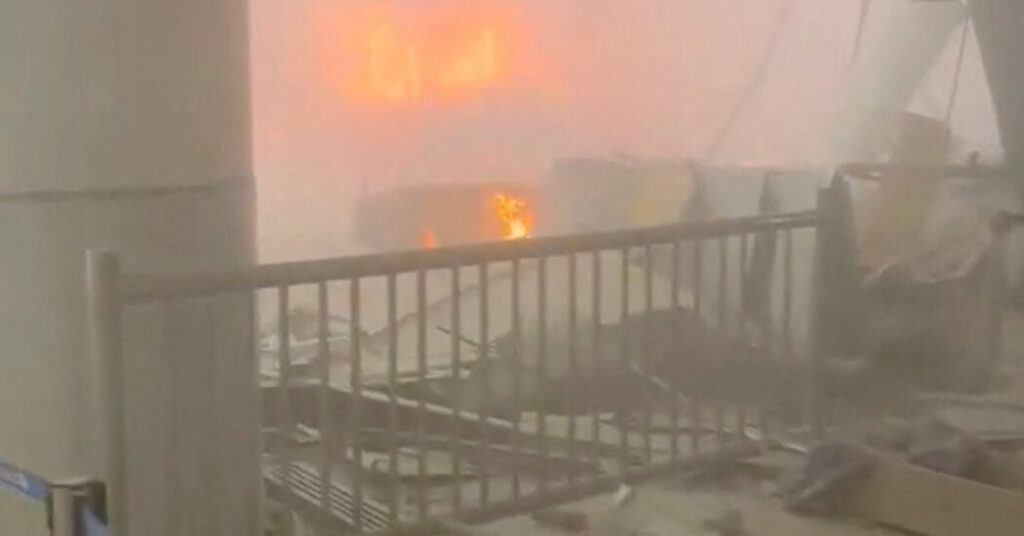
Iranian attacks targeted Kuwait and Bahrain on Wednesday, the U.S. military and local authorities said, killing at least one person, injuring more than 60 and disrupting aviation during a busy holiday season across the region.
The death is the first reported fatality in a Gulf state since the United States and Iran agreed a cease-fire in April, and as the countries continue to exchange strikes despite a truce that was meant to allow them to negotiate an end to the war.
U.S. Central Command, which oversees military operations in the region, said that a wave of Iranian drones had “failed to hit intended targets.” It added in a separate statement that no American personnel were harmed in an attempted attack on U.S. forces in Kuwait.
Hours later, Kuwait’s foreign ministry announced that an Iranian ballistic missile and drone attack had seriously damaged the country’s international airport, killing one person. The country’s health ministry said in a separate statement that 63 people were injured in the attack.
Bahrain’s military said on Wednesday that it had intercepted three Iranian missiles and several drones targeting civilian sites. Overnight, Iran’s Islamic Revolutionary Guard Corps said it had targeted an American naval base in Bahrain.
The Iranian foreign ministry said that Iran had a right to target the origin of U.S. attacks on facilities on Qeshm Island, according to Iranian state media. U.S. Central Command said it had conducted “self-defense strikes” on Qeshm Island in response to attempted Iranian attacks across the region.
The attacks came during a busy travel season at the tail end of the Islamic holiday of Eid Al Adha.
The strikes on Kuwait injured both travelers and airport workers, Abdullah al-Rajhi, a spokesman for the country’s civil aviation authority, told a local television channel. It also damaged “diplomatic missions,” the foreign ministry said, without elaborating.
In recent years, U.S. forces have operated out of a site within that airport complex. It was unclear if they are currently doing so.
The attacks highlighted the dilemma that Gulf Arab governments are confronting as the U.S.-Israeli war against Iran drags on. They have been dragged into a conflict with a neighboring country that they had hoped to avoid through diplomacy.
Since the war began, the Gulf countries have been targeted in thousands of Iranian missile and drone strikes that have killed civilians and damaged critical infrastructure, including ports and energy facilities, as well as hotels. Although the frequency of the attacks has decreased significantly since the cease-fire was announced, periodic strikes have persisted.
This week, Kuwait reported Iranian attacks and the United Arab Emirates said it had been targeted by multiple Iranian strikes.
The Gulf Arab countries have traditionally relied on the U.S. military to protect them and deter attacks from Iran. Yet the presence of U.S. bases and American troops on their land — along with secret direct attacks that some of the Gulf states have launched against Iran — have made them prime targets.
Iran has also found an effective way to increase economic pressure on President Trump by attacking the Gulf countries, which are major energy exporters and important hubs for global trade. Oil prices rose on Wednesday and are up more than 30 percent since the start of the war, as the latest attacks raised new doubts about diplomatic efforts to end the war.
Vivian Nereim is the lead reporter for The Times covering the countries of the Arabian Peninsula. She is based in Riyadh, Saudi Arabia.
The post Attacks on Kuwait and Bahrain Add Further Strain to Cease-Fire appeared first on New York Times.