President Donald Trump has spent much of his second term putting his personal stamp — and in many cases his image — on American institutions. Now his eponymous impulses have expanded to the celebration of America’s 250th anniversary.
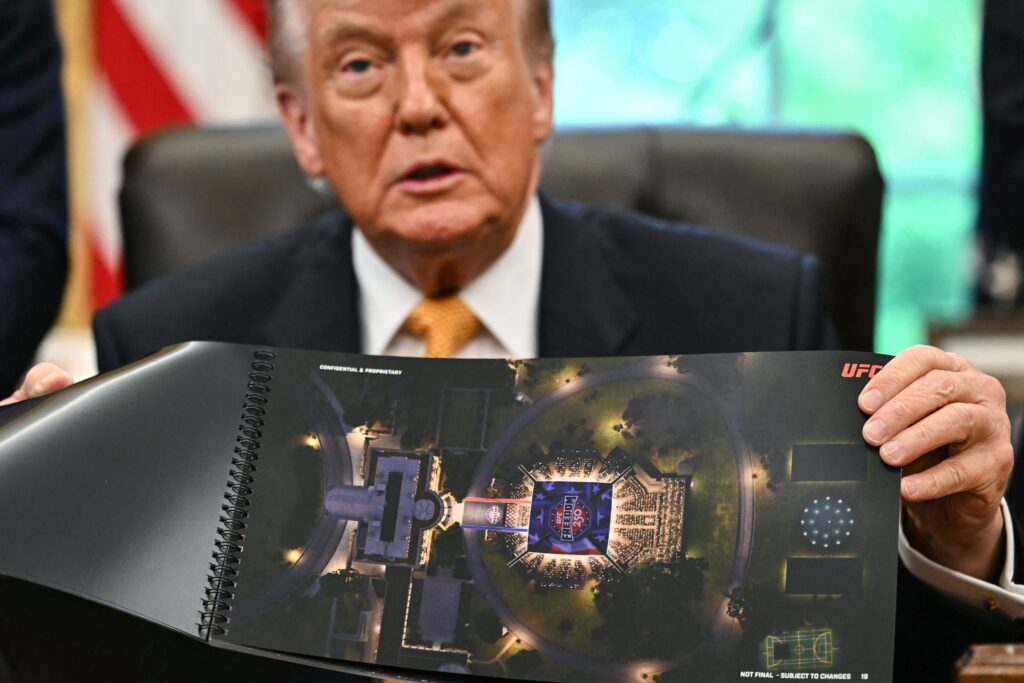
Trump’s face will be stamped on a celebratory gold coin marking the semiquincentennial. His stern visage will peer from commemorative passports. Administration officials are pushing for a $250 bill featuring the president’s portrait. On Trump’s 80th birthday, June 14, the White House lawn will transform into a ring for a “Freedom 250” UFC fight.
“I think it’s going to be the biggest event we’ve ever had at the White House,” Trump said recently.
The pattern has culminated with many performers withdrawing from the Great American State Fair, one of the anniversary’s marquee events, after saying they did not realize how closely it was associated with Trump. The president responded by announcing he will headline the event himself, since he is “the Number One Attraction anywhere in the World, the man who gets much larger audiences than Elvis in his prime, and he does so without a guitar.”
Historians, political leaders and others worry that America’s 250th birthday, which might have been an opportunity to pull a divided country together, is becoming so much about Trump that it will instead be just one more polarizing event on the national landscape.
“This is a celebration of the Declaration of Independence, and it’s not about any president — not Donald Trump, not his predecessors,” said John Pitney, a former national GOP official who now teaches political science at Claremont McKenna College in California. “And to the extent that we focus on Trump, we’re drawing the focus away from the Declaration. That’s problematic.”
The most visible elements of the national celebration are taking shape not in classrooms, fairgrounds or parade routes, but in a slate of events driven by the White House and centered on Trump. Through a presidential task force he created by executive order, naming himself as chairman, he has advanced initiatives that aim to define how the milestone is seen and experienced.
The events represent only a slice of the broader semiquincentennial effort, much of which is being organized by nonpartisan and state-level groups focused on education, local history and civic engagement. But the White House-backed programming is larger, more centralized and explicitly branded, positioning the president and his agenda — as well as his view of history — at the center of the most widely broadcast moments.
During a January congressional hearing on the commemoration, Rep. Jared Huffman (D-California) accused Trump of trying to “hijack the country’s 250th anniversary … and rewrite history.”
The nation’s landmark anniversaries are rare moments of collective self-reflection. As the country approaches its 250th birthday, the tension between a nation telling its own story and a president shaping that story from the White House may help determine how the semiquincentennial is remembered — particularly as some of its most visible and ambitious events are closely associated with Trump himself.
The White House and other defenders of the president’s efforts note that a vast array of organizations are marking the 250th in varied, even outsize, ways — including sports leagues such as the NCAA and the NFL. The UFC fight is being funded by private donors, not taxpayers, they add, and the president has helped to raise funds for many of the events, including more historically focused ones.
“President Trump is ensuring that America gets the spectacular birthday it deserves,” said White House spokesman Davis Ingle. “The celebration of America’s 250th anniversary is going to display great patriotism in our Nation’s Capital and throughout the country, and the President is proud to participate in our historic semiquincentennial celebration. Only people who suffer from a severe case of Trump Derangement Syndrome would find a problem with that.”
One person familiar with the president’s thinking said Trump initially felt the events memorializing America’s founding were not grand enough and, shortly after taking office, sought to bolster the spectacle. The person brushed off critics of the nature of Trump’s involvement, saying it was inconceivable that any president from either party would not play a key role.
“Does the president preside over the nation’s 250th year? Yes, but that’s because he won the election,” said the person, speaking on the condition of anonymity to speak frankly about tensions among organizers. “But we have major events in the nation’s capital. We have programming that brings our nation together. … The country gets to determine how it gets to celebrate.”
A spokesperson for Freedom 250, the organization established by Trump to coordinate the festivities, said the scope of the celebration was broader and more inclusive than the events that have received the most attention.
“We have engaged a wide range of national and civic organizations, businesses, and worked with all 50 governors, federal agencies, the White House and the president as the nation’s elected chief executive to deliver events that inspire pride and shared purpose,” spokesperson Rachel Reisner said in a statement to The Washington Post.
The initiative has deployed a fleet of six traveling “Freedom Trucks” — mobile museums designed to bring exhibits on the American Revolution and the founding era to communities around the country — and has partnered with institutions such as the National Archives on exhibitions featuring the Declaration of Independence and other founding documents.
The details of the semiquincentennial are particularly salient amid the debates over history that have dominated Trump’s second term as president, and his appointees have sought to revise the telling of American history.
The administration pushed to remove a Philadelphia-area plaque about nine people enslaved by George Washington, for example. Officials have launched broader efforts against diversity education and ethnic studies in American classrooms. Trump officials have sought to remove a mention of his own impeachment from a museum exhibit.
“There’s two teams — there’s team patriot and team context,” said Tevi Troy, a presidential historian who served as a top official in the George W. Bush White House, describing the current divisions over American history.
“One wants to say, ‘Well, let’s look at the context and who was left out — what were some of the flaws in American history?’ And there’s another one that says, ‘Let’s talk about how great America is,’” Troy said. “Trump is in that latter camp, and he’s going to make the presidency and the celebration consistent with that.”
Trump faced similar criticism for his handling of the 250th anniversary of the U.S. Army’s founding last year, which fell on his birthday. A massive military parade featured tanks and thousands of soldiers but also sparked nationwide protests from those who felt the president was celebrating himself, not the Army.
And Trump’s critics have long said he is overly eager to stamp his personal brand on institutions that belong to all Americans, from the John F. Kennedy Center for the Performing Arts to the U.S. Institute of Peace. (A judge recently ordered Trump’s name removed from the Kennedy Center.)
Trump is not the first president who has attempted to align a national commemoration with his political agenda. As he sought reelection in 1972, President Richard M. Nixon renamed his election campaign “The road to 1976” and was accused of trying to “steal” the bicentennial celebration.
That stoked protests of Nixon’s efforts, including one demonstration where he was burned in effigy. Nixon resigned in August 1974, a year and a half into his second term and well before the bicentennial celebrations.
M.J. Rymsza-Pawlowska, a historian at American University who has written about the bicentennial, said it is hardly surprising that a president would seek to harness the 250th for his own purposes.
National commemorations are “always a really good time for federal government to manufacture consent,” Rymsza-Pawlowska said. “It always behooves whoever is in power to align themselves with the history and promise of this country’s founding. It’s not surprising that Trump is doing this. If Nixon thought he could put his face on U.S. passports, he would have.”
Troy, the presidential historian, said the president does not have the power to actually make people watch the festivities. Just because Trump-centered events will dominate the 250th commemoration does not mean that people will opt to consume them all, he noted, especially in this era of fragmented attention.
“If something was on network TV in 1976, it was the biggest thing — maybe the only thing — going,” Troy said. “Now it’s much harder to capture national attention about one thing. The people who are going to tune into the Trump UFC fight are going to be the people who care most about Trump and UFC fights. But a lot of other people are going to be tuned to something else.”
The post America’s 250th birthday celebration increasingly centers on Trump appeared first on Washington Post.