
After Abigail Spanberger’s landslide election win in Virginia last November, she’d hoped to govern as she’d campaigned — rising above the partisan fray and focused on affordability.
It hasn’t worked out that way.
Key takeaways
- Abigail Spanberger won Virginia’s governorship in a landslide, but the right turned on her quickly due to redistricting, and now the left is turning on her too.
- The left is disappointed because Spanberger vetoed bills on several top progressive priorities — like collective bargaining and marijuana — and has been sensitive toward business’s concerns on topics like data centers.
- Spanberger had practical and political concerns with these bills. But her experience shows how other Democrats will struggle to please a base demanding bold action.
She alienated the right early on by joining the national battle over gerrymandering that Republicans kicked off (after initially saying she wouldn’t), endorsing a map that would favor Democrats in 10 of Virginia’s 11 US House districts. It passed as a ballot measure, but was tossed out by the state’s highest court.
Additionally, when some enthusiastic Democrats in the legislature proposed a litany of new taxes and fees, Fox News rounded them up and the story caused a sensation as Republicans accused her of abandoning her focus on costs — even though Spanberger hadn’t endorsed any of those ideas.
So lately, the governor has tried to reestablish her moderate credentials — by saying no to Democrats in the legislature, with her veto.
In recent weeks, Spanberger vetoed major bills on retail marijuana sales, collective bargaining for state and local government workers, class action lawsuits, prescription drug prices, gambling, criminal justice reform, and more.
For that, she’s been met with fury from the left — denounced as a sellout betraying progressive causes. And with further battles over the state’s budget ahead, her relationships with key figures in the legislature have gotten worse.
To her critics, Spanberger is squandering what could be a short-lived opportunity for much-needed major change. To her defenders, she’s trying to make center-left governance actually work — preventing progressives from going too far in ways that would lead to poor governance and voter backlash in a state that is not quite solidly blue.
It’s a preview of challenges other states might face next year if a blue wave creates more new Democratic trifectas — and at the national level in 2029 if Democrats take the White House and Congress.
While Spanberger faces some Virginia-specific hurdles, her broader dilemma is a familiar one. Is it possible to play procedural hardball without angering the middle? When the base wants to pass the whole progressive agenda all at once, when should a governor or president push back? And if you’re already taking on fire from the right, can you afford to have the left mad at you too?
The governor’s dilemma
The early controversies and criticism from the right took a toll on Spanberger’s approval rating.
At the heart of it was the redistricting referendum, which required her to commit to what was by definition a partisan crusade — its only purpose was to hand Democrats seats, to make up for Republican redistricting gains elsewhere.
Though she had won election by a 15-point margin, by early April, Spanberger’s approval rating was down to 47 percent — and her disapproval was 46 percent. Her honeymoon had ended.
That was about the time she had to decide what to do with the 1,156 bills the legislature had sent her by the close of its session. During that session, Spanberger was “little seen or heard,” Virginia Mercury columnist Bob Lewis wrote.
This wasn’t entirely surprising: The legislature was used to taking the lead. In Virginia, governors are prohibited from running for reelection, making them instant lame ducks. “The joke in the legislature is, you don’t like the governor, just wait a couple minutes,” Richard Meagher, a political scientist at Randolph-Macon College, told me.
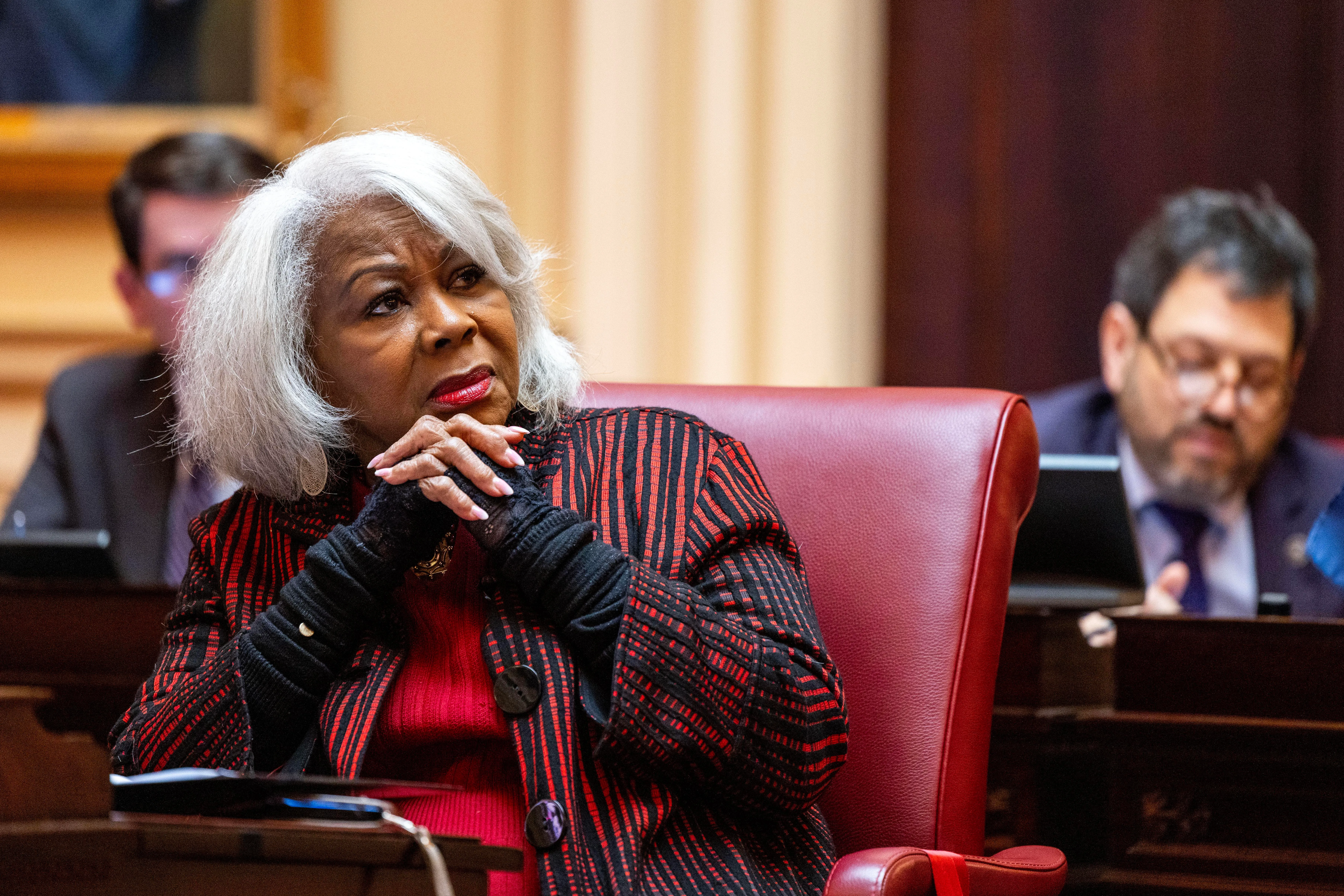
Powerful figures like L. Louise Lucas, the state senate president pro tempore and finance committee chair, call the shots. The 82-year old Lucas has served in the legislature for more than three decades; she’s recently gained national attention for her partisan combativeness and spicy social media presence. (When Sens. Mark Warner and Tim Kaine raised concerns about her redistricting plans, she said their complaints were “coming from a cuck chair in the corner”).
After four years under Republican Gov. Glenn Youngkin, Democrats had a long list of things they wanted to do with their newfound control of state government — an agenda that amounted to bold progressive change, as well as the procedural hardball of the redistricting effort (since blocked in court).
Spanberger signed the vast majority of the bills sent to her into law — including measures on the minimum wage, paid family and medical leave, gun control, and reproductive rights.
But on other key measures, she balked.
What the governor vetoed
There were some bills that Spanberger flatly vetoed — such as on gambling, criminal justice reform, and a new fee on mattress sales to fund mattress recycling.
On other bills, she took a different tack — initially proposing major amendments to what the legislature had passed, and only vetoing when the legislature rejected her suggestions. Here, she said, she remains committed to the goals of these proposals — but she simply believes the bills as written will work out poorly, and wants changes.
For Democrats’ long-awaited bill to legalize retail marijuana sales (recreational use was legalized in 2021), Spanberger wanted to add new tough penalties for public consumption and possession of large amounts. Her critics viewed this as a poison pill designed to kill the bill, since progressives in the legislature were ill-inclined toward making drug laws harsher.
For labor’s prized bill to let state and local government employees collectively bargain, Spanberger proposed delaying implementation for local government employees until 2030 — when, notably, she’d be out of office. (Some local governments had complained that, if the original bill passed, workers could negotiate higher compensation and squeeze their limited budgets.)
And for a bill creating a process to let people file class action lawsuits in Virginia (they’re one of just two states that has no formal procedure for that), Spanberger proposed limiting the bill to a few cities and Fairfax County, and giving judges a way to dismiss such lawsuits earlier.

There are a few common themes in her vetoes. She’s sensitive to perceptions that the Democratic Party is soft on crime or disorder — or that it’s too eager to impose new taxes.
Another concern is keeping businesses feeling good about the state. Virginia political analyst Bob Holsworth told me that the state’s politicians have long cared deeply about national ratings of their business climate, such as CNBC’s. Virginia often ranks No. 1 on such surveys (though they dropped to fourth last year).
To explain Spanberger’s veto of a prescription drug pricing board, for instance, Holsworth pointed toward recent investments by companies like AstraZeneca in bringing drug manufacturing facilities to Virginia.
Here too, there are echoes of Democratic tensions in other states: In New York City, Mayor Zohran Mamdani has found himself in a standoff with ultra-wealthy residents threatening to leave or abandon planned investments over his tax-the-rich proposals. In California, Democrats are divided over a proposed wealth tax that’s generating the same concerns and influencing the governor’s race. And more leaders could find themselves in similar positions as they try to manage their base’s populist backlash against the rich while trying to attract businesses and grow their tax base to accommodate new spending.
Data centers and bad blood
The business climate is a major factor in another huge fight currently splitting Spanberger from progressives — data centers.
Lucas, the senate finance committee chair, wants to eliminate tax incentives for data centers, and rely heavily on this for revenue in the state’s budget (which must be settled by June 30). But Spanberger argues that ending those tax breaks would effectively mean breaking a promise to businesses who chose to build in Virginia.
“Lucas came up with an issue that is really problematic for the Democrats, because on one hand you’re talking about a tax exemption that goes to the richest people in the world,” Holsworth said. “And then on the other hand, if the rug gets pulled out from under this exemption, Virginia’s rating among the best states for doing business in the country goes flying down.”

With data centers drawing populist opposition at the local, state, and federal level, and a broader AI backlash simmering in some corners of the left, other Democrats are likely to face these challenges as well. In April, Maine governor Janet Mills vetoed a proposed moratorium on data centers over concerns it would penalize a project that had already been planned.
As the battle over the budget stretches on, tensions between Spanberger and legislators have risen. Many of them view her as blindsiding them with her vetoes, and failing to engage in the process early enough.
Meanwhile, the relationship with Lucas keeps worsening. An interview this week in which Spanberger said the legislature might not respect her due to sexism didn’t go over well.
“You have gotta be kidding me!” Lucas posted on X Wednesday. “There is a record number of women in the GA and four of them are in leadership and a woman LG, yet you think this is all about you! Okay, you thought it to be a great idea but just remember, you started this mess!”
There’s bad blood behind the scenes too. In February, Spanberger’s chief of staff filed a defamation lawsuit against a longtime adviser to Lucas, claiming he was spreading scurrilous rumors about her.
But being at odds with Lucas could be risky. “Lucas has a little bit of the mob boss in her — which endears her to a lot of Democrats in the commonwealth,” said Meagher, the Randolph-Macon college political scientist. “Democratic voters, particularly when they look at the national leadership, are tired of tepid, moderate, mealy-mouthed leaders.”
Meanwhile, Lucas’s national profile could soon get bigger. Last month, the FBI searched her office and a marijuana dispensary she owns. Sources told the New York Times that the search stemmed from a corruption and bribery investigation opened during the Biden administration. Lucas has positioned herself as a victim of Trump’s retribution crusade, claiming, “I am not backing down.”
Other Democrats will face similar challenges
In theory, Spanberger is trying to appeal to her state’s median voter. But in between elections, the median voter is often disengaged and turned out. The loudest voices are partisans and ideologues; which leaves her with a right that’s already turned against her and a left that’s turning on her too.
And while some of Spanberger’s challenges are unique to her state, other incoming Democratic governors — or the next Democratic president — could soon find themselves in similar situations.
The party’s base and interest groups will demand a wish list of progressive agenda items they’ve long dreamed of passing, as well as hardball procedural moves to help counter perceived foul play on the right.
Picture a Democrat being sworn in as president with congressional majorities in 2029, and immediately being swamped with demands for filibuster abolition (which would uncork even more long-deferred legislative priorities) and court-packing. Meanwhile, activists are pushing for major new spending programs even as the deficit and national debt are worsening.
The executive will be the one tasked with weighing all the associated political and practical tradeoffs — and deciding when to say no. If Spanberger’s experience is any indication, there won’t be any easy answers waiting for them.
The post This Democratic governor won in a landslide — and is now at war with her own base appeared first on Vox.