CHICAGO —One end of the regulation-size basketball court that anchors the south tip of the Obama Presidential Center campus is emblazoned with the words “Yes We Can,” and at the other end, “Fired Up, Ready to Go.” The facility’s main tower, which houses a museum documenting the 44th president’s life and career, features a “Hope and Change Lobby,” and outside there is a playground (with a child-safe poured-in-place rubber surface), a women’s garden, barbecue grills, and a green roof with wheelchair-accessible raised beds for vegetables.
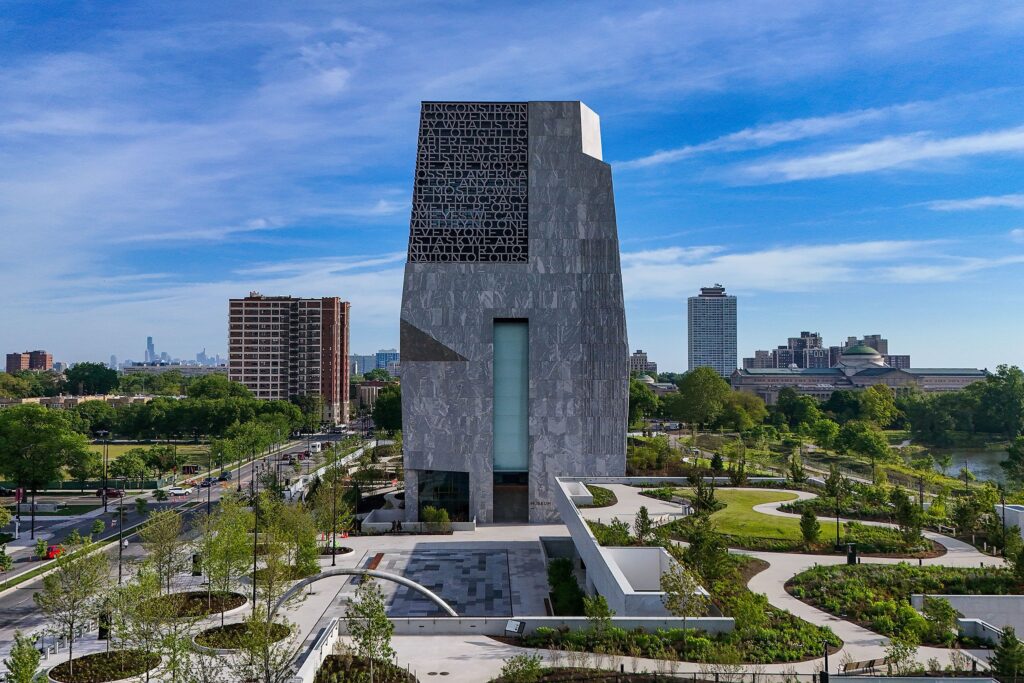
It would be easy to parody the Obama Foundation’s 19.3-acre complex, which opens June 19, and plenty of critics and politicians already have. The 225-foot tall stone-clad tower, designed by Tod Williams Billie Tsien Architects, has been dubbed the Obamalisk, and architecture traditionalists, who have thrown their lot in with President Donald Trump, have savaged the design as stark, brutalist and fortress-like. Trump weighed in recently with a childish meme on social media: A monumental trash can surrounded by an urban clutter of cars and telephone poles.
This all feels a bit like trying to brand your political opponent before they can make a good first impression. And the Obama center makes a good first impression despite all the negative chatter. Tod Williams Billie Tsien Architects knows how to create buildings that feel welcoming and open while also cool and contemplative, public space that pulls one out of the fray and into new forms of communion. Like their design for the Barnes Foundation in Philadelphia, the Obama center is both porous to its urban environment, but with a slightly cloistered sense of detachment once you are inside.
The Obamas chose a site in Chicago’s Jackson Park, near the University of Chicago, on land that was used in 1893 to host the World’s Columbian Exposition, a giant world’s fair that did not allow African Americans to mount exhibitions or celebrate their contribution to American life. A center honoring the nation’s first Black president will open close to where one of architectural marvels of the 19th century once stood, the expo’s “White City” of gleaming classical pavilions that celebrated America’s ambition to be a global power.
The campus is linear, following a strip of land bordered on one side by a man-made lagoon and on the other by a well-trafficked four-lane avenue. The decision to use public park land, designed by the revered landscape architects Frederick Law Olmsted and Calvert Vaux, was controversial. But much of the new structure is covered by a green roof and gardens, including the parking structure, which, after vigorous protest from locals, was moved underground. Obama center officials argue that by reclaiming a four-lane road that once cut along the eastern edge of the campus and topping the structure with gardens, they have actually added almost 4 acres of green space to the park.
On a sunny, warm day last week, it was clear that if the substantial rooftop gardens can be maintained, if the trees and grass planted there flourish, and if the center allows public access as it has promised, the loss of these acres of public park will be compensated for by several substantial urban amenities. Among them: A new branch of the Chicago Public Library, a basketball court, playgrounds, picnic sites and a large collection of public art.
The most controversial element of the design, the Obamalisk tower, makes a different impression when seen in photographs and encountered in person. Images circulating online do indeed suggest a rather dour, hermetic structure, over-scaled and oppressive. But the building is not out of scale to several nearby high-rise apartment buildings, and when seen up close, it is a trim and neatly detailed structure, wearing its façade of speckled gray New Hampshire granite rather like Obama wore a blue suit: It is tailored and businesslike, understated and a bit reticent.
The tower’s opacity is simply a case of form follows function. The building serves as a museum, and modern museum designers favor windowless spaces where light can be carefully controlled both to preserve fragile materials and to highlight the impact of video, film and backlit images. Visitors are rewarded with ample light in the atrium and in the eight-floor “Sky Room,” which is open to visitors regardless of whether they pay the $30 museum entrance fee. From the Sky Room, there are rewarding views of Chicago’s south side, Lake Michigan and the University of Chicago campus.
The exhibitions, designed by Ralph Applebaum Associates, begin with a basic civics lesson about democracy and the contradictions built into the American experiment. An original copy of the Declaration of Independence greets visitors in the first gallery, along with ample evidence of unequal treatment of African Americans, women and minorities. The display and tone take a generally progressive view of American political history, but they also acknowledge some of the administration’s failures, like the botched launch of the Obamacare website.
As visitors move from a general overview of American history to the particulars of the Obamas’ political trajectory, the display becomes more interesting, more personal and often quite moving. Visitors given advance access to the museum last week wept during a video about the tragically dissonant events of June 26, 2015, when the Supreme Court issued its Obergefell v. Hodges decision that legalized same-sex marriage on the same day that Obama famously sang “Amazing Grace” at the funeral of Clementa C. Pinckney, one of nine people murdered at Emanuel African Methodist Episcopal Church by a racist gunman named Dylann Roof.
Architect Billie Tsien said that the former president was intimately involved in the design and evolution of the building, including the museum tower, which grew more vertical, becoming a visual anchor as the architecture evolved. The challenge, programmatically, was to make a building that was grand enough to satisfy visitors who would expect some kind of monument honoring the nation’s first Black president, without becoming architectural hagiography or overbearing.
“It’s about him, but it’s not for him,” said Tsien.
Valerie Jarrett, the longtime Obama adviser who serves as CEO of the Obama Foundation, says the center will be “issue agnostic,” with a focus on convening and developing a new generation of leaders rather than specific engagement with politics or international issues.
“We are a 501(c)3, we are not a political organization, we have nothing to do with politics,” she said in an interview. “This is not a testament to the past, it is an active, living, engaged center that focuses on the future.”
She also explains the foundation’s decision to operate separately from the National Archives and Records Administration, as a fully private institution. The vast majority of presidential records are now digital, and those records and paper documents are administered by NARA. But unlike other presidential libraries that include NARA-operated research sites on their campuses, the Obama center is independent.
“We have all the advantages of having access to NARA, including to artifacts, without having to be at the whim of the federal government,” she said. Among other things, that means the foundation doesn’t have to close when the government shuts down.
But it also completes what some critics see as a disturbing evolution of presidential libraries from research institutions to fully curated museums in the business of legacy burnishing. There is also the deeply troubling fact that there are basically no meaningful restrictions on or transparency when it comes to contributions to presidential libraries. The Trump library is particularly worrying, given preliminary designs that suggest it will be a giant tower that may be fully monetized as a profit center to benefit the president and his family.
But, while the Obama center isn’t a presidential library in the old sense, it feels a lot like a modern public library, a building type that has evolved from palaces for reading into multipurpose community centers. It has a restaurant that will be open to the public, a recording studio, meeting rooms that can be reserved for community functions, and an auditorium that is scaled and designed to feel more like a church than a convention space for VIPs. When asked if there were any concerns about convening world leaders in the center’s forum building while kids were hanging out in the library or playing on the rooftop gardens, Emily Bittner, the foundation’s vice president for communications, said, “No, we welcome that tension.”
It would be unrealistic to expect that former presidents wouldn’t take an interest in crafting their post-presidential reputation, and perhaps ill-advised, too. Legacies can be undone if not defended and legacies are as much about the long-tail of ideas as they are about legislation. Stepping into the Obama center reminds one of a precious but endangered natural resource: all those feelings of empowerment and optimism that helped sweep the Obamas into power 17 years ago. It feels like a time warp to hear the old slogans, the Hope and Change stuff, and given how thoroughly cynicism has woven its way into public life, you may roll your eyes at the thought of reliving Obama years, even in museum form.
Since the Obamas took up residence in the White House, there has been a 45th, a 46th and a 47th president, enough time to begin seriously parsing a basic question about the 44th: Did Obama represent a new chapter in American politics or was his presidency the last gasp of a dying age?
Two design details seem to acknowledge the question. A sculpture by the beloved American artist Martin Puryear in front of the main forum building looks a bit like a small-scale version of Eero Saarinen’s Gateway Arch in St. Louis, but not quite symmetrical, with a slightly lopsided deviation from perfect symmetry. For foundation leaders, this represents Martin Luther King Jr.’s famous observation that the arc of the moral universe is long, but bends toward justice. Ask them what Obama thinks of our current moment, and they deflect quickly to the observation that the progress of democracy has always been two steps forward, one step back. And Obama, they say, isn’t coming out of retirement to save the day. That’s for a new generation of political leaders.
Another detail: The top of the museum tower is ornamented with concrete cast letters spelling out a passage taken from Obama’s “You are America” speech, given on the 50th anniversary of the Selma to Montgomery civil rights march. The words wrap around one corner of the building, which makes it impossible to read them as a coherent block of text.
“The issue of legibility isn’t so important,” said Tod Williams, standing in the Sky Room where the words are visible through a glass window. “We leave it for people to draw their own conclusions.”
So, is this rhetoric, or ornament? Did all those words almost two decades ago really matter, or was it all just a warm bath in oratorical good vibes? Something dark and catastrophic was brewing during the Obama years, and it seems in hindsight, that America was sleeping when it should have been on alert. Now, we wonder if the age of oratory and rhetoric is all in the past, if the presidency is just a game of Supermarket Sweep, with the winner grabbing as much loot as possible before the next administration comes to power. Was Obama the alpha or omega of American civic life?
He would probably say, neither. And he’d be right. Our cynicism is on us, and no one else. And so, the Obama center opens, sibylline and circumspect, open but reticent, a little buttoned down, full of potential yet rather vague about specifics. Regardless of your politics, you must at least credit the building with this: It wants to be a good neighbor and that is no mean thing to aspire to.
The post The Obama Center opens as a time warp to an old political order appeared first on Washington Post.