STOLEN REVOLUTION: Betrayal and Hope in Modern Iran, by Yeganeh Torbati and Bozorgmehr Sharafedin
Before the bombs began falling on Iran earlier this year, the war was sold by its advocates as a possible catalyst for regime change — a final blow against a government already weakened by years of economic crisis and political unrest. To many outside observers, the Islamic Republic appeared vulnerable to collapse. Yet the coordinated bombing campaign by the United States and Israel has only strengthened the most hard-line elements of the Iranian state.
Those of us who have spent years studying modern Iran understood that this was always the more likely outcome. Again and again, moments that seemed poised to break the system instead became the conditions through which it adapted and endured. It is a recurring pattern that the New York Times journalist Yeganeh Torbati and the veteran Iran correspondent Bozorgmehr Sharafedin trace in “Stolen Revolution,” their deeply reported and quietly devastating account of half a century of upheaval in the country. The result is one of the most perceptive books on modern Iran in years, capturing not only the machinery of repression but the fragile forms of hope that survive beneath it.
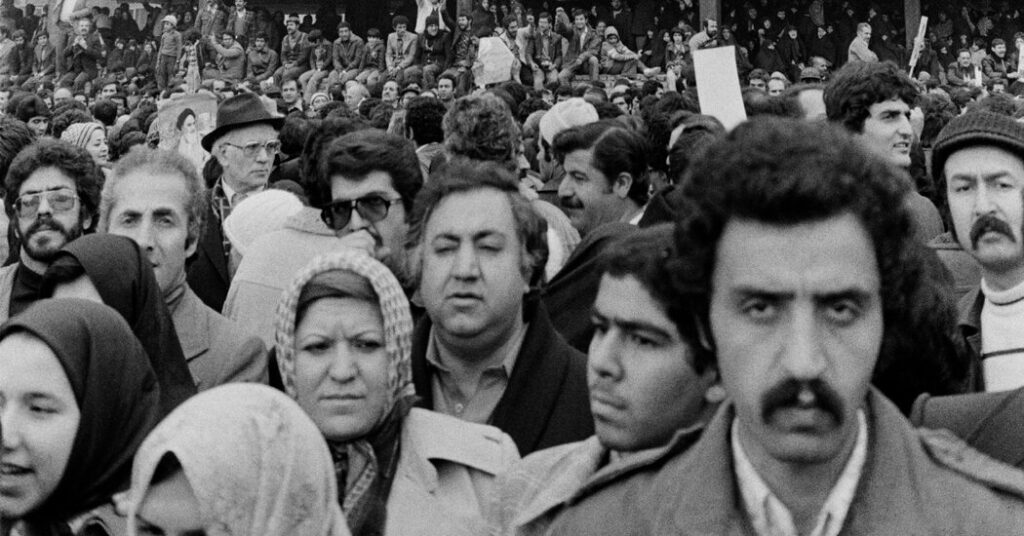
The revolution of 1979 that gave rise to today’s Islamic Republic, the authors argue, was the culmination of tensions that intensified in the wake of the C.I.A.-backed coup restoring the Shah to power after a brief exile in the 1950s. It was animated by competing promises of justice, freedom and moral order, as well as a fight against foreign domination that extended back to the Constitutional Revolution of the early 1900s. The coalition that finally toppled the Shah for good included clerics, leftists, students, nationalists and secular intellectuals, many united less by a shared idea of the future than by a shared rejection of the present.
As power narrowed into the hands of a clerical elite around Ayatollah Ruhollah Khomeini, what followed was not the triumph of one coherent ideology so much as the gradual exclusion of competing visions. The religious regime hunted, expelled and jailed its former allies. “A revolution that was launched with egalitarian ideals and immense hopes,” Torbati and Sharafedin write, “has resulted in a mafia state.”
The authors render the early years of the revolutionary movement through the life of one participant, the Islamic scholar Mehdi Karroubi. There are scenes of striking intimacy: the young Karroubi crossing secretly into Iraq to meet the exiled Khomeini in 1966, hiding in a palm grove near the border before finally reaching the religious leader’s modest home in Najaf and kissing his hands in tears. For decades, Karroubi helped distribute Khomeini’s speeches across Iran. Hounded and repeatedly arrested by the Shah’s secret police, he spent much of the ’60s and ’70s sleeping alongside dissident leftists and his fellow clerics on prison floors.
Karroubi’s trajectory from there illuminates the contradictions of the Islamic Republic. In the late ’70s and early ’80s, he helped construct institutions that would support Khomeini’s government. He defended the revolution even as it narrowed politically and morally, enforcing a conservative dress code and banning Western music.
But the regime eventually became something far harsher than Karroubi had imagined, resorting to mass execution and torture to assert control. The brutal Iran-Iraq War of the 1980s accelerated that transformation. Bolstered on both sides by U.S. arms, the eight-year conflict empowered the paramilitary force known as the Islamic Revolutionary Guard Corps and normalized a politics of sacrifice, surveillance and permanent emergency that reshaped public life.
By the ’00s, Karroubi was sitting in Parliament warning against the expanding power of the security state. When the Green Movement erupted in 2009 in response to the disputed re-election of the hard right populist president Mahmoud Ahmadinejad, he became one of the regime’s most outspoken internal critics.
If the first half of “Stolen Revolution” traces the consolidation of power, the second turns to the persistence of resistance. Here the book becomes especially alive in its portrait of younger Iranians who experienced the revolution not as a lived memory but as a political inheritance.
The authors detail the re-emergence of civil society at the turn of the 21st century, during the presidency of Mohammad Khatami. Newspapers flourished. Student youth groups and literary circles proliferated, creating spaces in which democratic practice became part of daily life rather than abstract political theory. “Democracy was the system by which they ran their organizations,” the authors write, “so it began to seem natural that a country should be run that way too.”
Soon modest cultural organization began to feel politically consequential. In one telling episode, the 17-year-old activist Hila Sedighi spends weeks planning a poetry night for an audience of 500 people, only to have it abruptly canceled by local authorities. Refusing to abandon the event, the teenager navigates layers of bureaucracy until a nervous cultural official quietly signs a letter of permission, warning her, “I’m lighting this fire both for you and for me.”
Torbati and Sharafedin also vividly evoke the mixture of exhilaration and improvisation that defined the Green Movement: campaign materials passed phone to phone by Bluetooth in subway stations, a human chain stretching for dozens of miles through Tehran, young organizers convinced that sheer turnout could overwhelm whatever fraud the state attempted.
Millions poured into the streets demanding greater accountability. Once again the language of rights and representation surged to the surface. And once again, the state endured — not because dissent disappeared, but because the institutions built to contain dissent proved stronger than the forces challenging them.
Torbati and Sharafedin are especially good at conjuring the fear and spontaneity that accompany the realization that private frustration has suddenly become collective action. To elucidate the Women, Life, Freedom movement that began in 2022, they describe the Kurdish Iranian activist Rozhin Yousefzadeh as she walks through streets of Tehran unveiled. She fully expects arrest at any moment, only to find strangers quietly emboldened by the sight of her.
If the book has a weakness, it lies in its title. “Stolen Revolution” implies a cleaner break than the evidence supports. What Torbati and Sharafedin actually demonstrate is that the Islamic Republic emerged organically from the contradictions within the revolution itself. The system did not simply betray its ideals of popular rule and relief from oppression; it translated these ideals into institutions in service of a government that tragically refused to sustain them, opening tiny cracks for reform to break in.
At times, too, the narrative leans toward inevitability, as though the movement from hope to repression were somehow preordained. But the book itself repeatedly reveals moments when events might have unfolded differently or when public pressure forced lasting concessions, however small. In late 2022, security forces eventually seized Yousefzadeh for walking the streets without a head scarf and dragged her toward a police van. But she was not alone in her defiance, and within a few months, in many neighborhoods across the country, large groups of women went unveiled for the first time in decades.
What Torbati and Sharafedin ultimately show is a society that was slowly but meaningfully changing from within — through women’s resistance, civil society organizing and generational shifts in public life — before the recent attacks by the United States and Israel strengthened the forces most determined to suppress that change.
Read in the midst of the war, the book’s title takes on a double meaning. In a country forged through struggle against foreign influence, pressure from outside does not loosen the system. With Khamenei and much of his cohort dead, the Revolutionary Guard have emerged more entrenched than ever. Civil society faces renewed suspicion and the already fragile space for reform — in poetry nights and street protests — has narrowed once more under the cloud of national security.
And yet “Stolen Revolution” ultimately resists despair. What persists across its generations of activists and dissidents is not merely memory but political capacity: the ability to gather, to organize, to imagine otherwise. The revolution, in that sense, never fully ends. Like the forces it opposes, it recedes, hardens and returns.
STOLEN REVOLUTION: Betrayal and Hope in Modern Iran | By Yeganeh Torbati and Bozorgmehr Sharafedin | Doubleday | 484 pp. | $35
The post The Many Revolutions That Almost Freed Iran appeared first on New York Times.