At a United Nations emergency Security Council meeting on Monday, diplomats were nearly unanimous — with the exception of the United States — in calling for Israel to withdraw its forces from southern Lebanon and refrain from threatened escalatory attacks on the country.
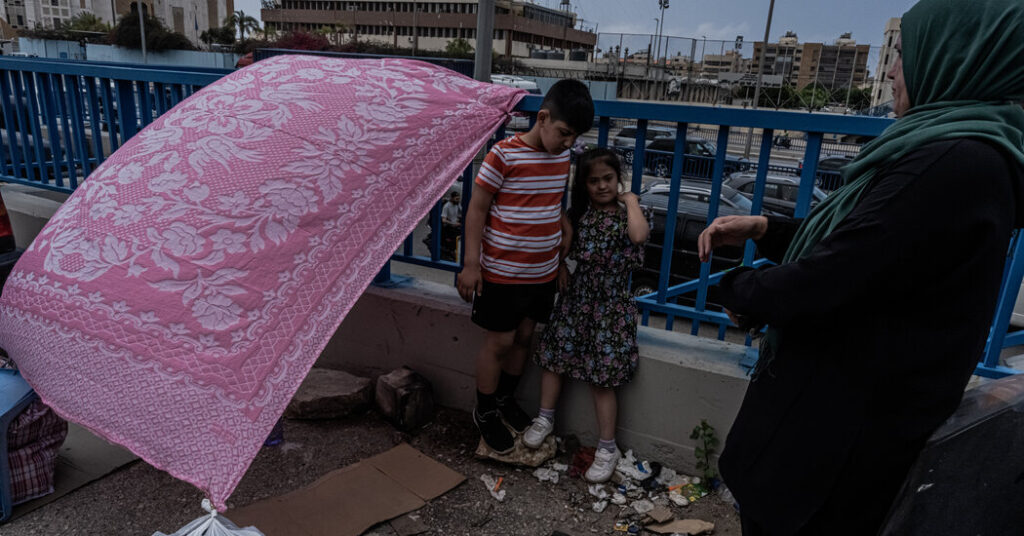
The meeting, requested by France, took place on a day of turmoil in Lebanon, with tens of thousands of people fleeing their homes, shelters overfilling and a sense of panic because Israel had threatened to imminently attack the southern suburbs of Beirut, Lebanon’s capital. A day earlier, Israel had moved deeper into Lebanon’s southern territory, inciting alarm and fear of an expanding military occupation.
The tensions culminated with President Trump intervening and saying he had gotten Israel to back off from striking Lebanon and Hezbollah, a Lebanese militant and political group, not to attack Israel.
Hezbollah attacked Israel in early March in defense of Iran not long after the war started. Israel has been attacking Lebanon in an effort to destroy Hezbollah. The Lebanese government has been engaging in direct negotiations with Israel to end hostilities but it has no power over Hezbollah.
The fate of a peace deal between Iran and the United States was also at stake, as Iran signaled that it would suspend negotiations if Israel carried through with attacks Beirut.
On Sunday, Israel’s forces moved deeper into southern Lebanon, capturing Beaufort, a Crusader castle that served as the Israeli Army’s headquarters during the long occupation of Lebanon from 1982 to 2000. Flying the Jewish state’s blue-and-white flag on the castle incited fury in Lebanon and beyond.
“Israel’s presence north of the Blue Line is a clear violation of Lebanon’s sovereignty and territorial integrity,” said Martha Ama Akyaa Pobee, a senior U.N. official addressing the Council, referring to the demarcation line dividing Israel from Lebanon and the Golan Heights. “These hostilities are reverberating across the region.”
Iran has said that among its conditions for a peace agreement with the United States is an end to hostilities on all fronts, including Lebanon. Iran’s Armed Forces issued an evacuation warning for northern Israel, saying residents should leave if Israel attacked Beirut.
At the Council meeting, some of the sharpest criticism of Israel’s actions came from France, Britain, Russia and China, all permanent members of the Council. The United States, which started the Iran war with Israel in February and is the fifth permanent member of the Council, focused its comments on blaming Iran and Hezbollah.
France’s ambassador to the U.N., Jérôme Bonnafont, told the Council that Israel was committing “a major strategic mistake” in Lebanon, and while it had a right to defend itself against Hezbollah attacks, “nothing can justify the continuation and scale of its military operations in Lebanon.”
Britain’s deputy ambassador, James Kariuki, condemned Israel’s actions. “This reckless and disproportionate escalation of Israeli military action exacerbates an already devastating environment for Lebanese civilians and places the government of Lebanon under further strain,” Mr. Kariuki said.
Israel’s ambassador, Danny Danon, said Israel did not want escalation and it did not seek Lebanese territory. He said that “the problem is Hezbollah” and its decision to fire on Israel in early March in defense of Iran. Mr. Danon said Hezbollah’s attacks on communities in northern Israel had intensified in recent weeks and that its attacks reached further into Israel’s territory this past weekend.
Diplomats representing other countries at the Council — Bahrain, the Democratic Republic of Congo, Pakistan, Denmark, Liberia and Colombia, which holds the rotating presidency in June — called for immediate de-escalation by Israel and expressed concern that more airstrikes, displacement of civilians and destruction would undermine any chances of a lasting peace.
Lebanon’s ambassador, Ahmad Arafa, asked the Council to condemn Israel’s actions with a united voice and criticized the Council for failing to stop repeated aggressions against his country, allowing impunity for Israel that has “emboldened the perpetrator to commit the very same crimes time and time again.”
Farnaz Fassihi is the United Nations bureau chief for The Times, leading coverage of the organization. She also covers Iran and has written about conflict in the Middle East for 15 years.
The post Security Council Members Call for Israel to Withdraw From Southern Lebanon appeared first on New York Times.