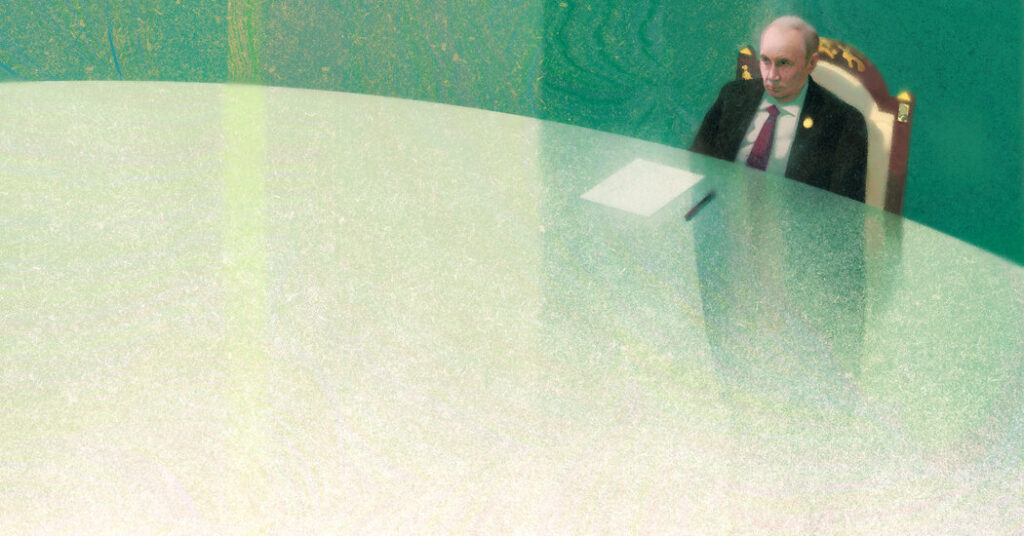
“No Exit,” Jean-Paul Sartre’s one-act existential play on the hell of non-endings, was first performed in Paris in May 1944. World War II was about to enter its fifth year. In the play, three people, recently deceased and apparently locked in a drawing room of hell, face the bad choices of their lives, from which, in death, there is no escape.
If the Russian authorities would allow Sartre’s play to be put on in Moscow in 2026, one wonders what President Vladimir Putin and ordinary Russians, more than four years into Mr. Putin’s “special military operation” in Ukraine, would make of it.
Since the full invasion of Ukraine in 2022, Putinism — the hyperpersonalist system of rule that Mr. Putin has imposed on Russia for around a quarter century — has arrived at what might seem an eerie equilibrium, but on a closer reading is a trap for all involved. Mr. Putin has subordinated his state and his society to a war that is slowly sapping Russia’s strength, depleting the nation’s wealth and consuming the lives of its young people.
On the surface, calm prevails. Mr. Putin has found a way to fund his expensive war, staving off economic collapse and continuing to generate considerable numbers of military recruits, mostly through large cash bonuses. Russia, far from being isolated, interacts diplomatically and commercially with much of the world. Despite some recent signs of domestic discontent — as ordinary citizens have increasingly found themselves poorer, less insulated from the war and increasingly blocked on the internet — Mr. Putin can be confident that he remains in complete control.
But perpetuating a war is not the same as winning one. As his army ekes out gains on the front line, Mr. Putin has few escalatory tools left to change the dynamic. Involuntary mobilization would give Russia an advantage, but it would be acutely unpopular among Russians. Nuclear weapons, of any kind, would be a terrible option. Employing them would not guarantee victory, and would risk provoking a harsh military response from the United States and Europe or a rupture in Russia’s relationship with China, its most important ally.
Nor can Mr. Putin simply withdraw from Ukraine. Were Russia to accept a settlement along the current line of contact, Mr. Putin would have little to show for his efforts other than a narrow strip of territory in southern Ukraine. Apart from the injury to his vanity, as a consummate political survivor he understands that if he were to present such a small prize to Russians who have lost family members, it would be an admission of the war’s fundamental senselessness. The poor quality of his strategic thinking and his hubris could then become a pressing political factor within Russia.
Mr. Putin has maneuvered himself into a trap. But, beyond himself, he has burdened the whole project of Putinism, should it outlast his tenure, with some version of this war in perpetuity. Any future leader in Mr. Putin’s mold would not be able to watch passively as a heavily armed and battle-hardened Ukraine integrates into Western security structures and a militarizing Europe.
If Mr. Putin does not have a way out of his war, ordinary Russians do not yet have a way out of Putinism. The recent public dissent in Russia has been misinterpreted. The discontent is absolutely real, but its essence is a frustration with the fact that Putinism, despite its failures, seems interminable.
Today, the president faces no antiwar movement and no opposition party. He can repress Russian citizens at will. Even to go about their daily business is to enable and at times to administer the system that prosecutes the war and fosters repression. Most Russians work for the state in one way or another — the private sector being subordinate to the government — and yet have no say in how the state is run.
Finding a collective exit from this system is psychologically and politically impossible for the time being. There are no individuals or institutions that can unseat the president; there is no visible path toward terminating his rule or replacing it with something better. In these circumstances, we might see flickers of verbal opposition — like in response to the throttling of the internet — but with nowhere to go, they are easily extinguished.
Theorists of 18th- and 19th-century revolutions emphasized the importance of rising expectations as a catalyst. When people sense that a better future is possible, they act to expedite the process — as in the Eastern European revolutions of 1989, which followed Gorbachev’s promises of glasnost and perestroika.
Mr. Putin has been assiduous about ensuring Russians’ low expectations. The promise of a modern Russia, prosperous and open to the world, has faded into complacency and numb acceptance of dictatorship and forever wars. This uncomfortable equilibrium cannot last forever. The early promise of Mr. Putin and Putinism, after what he saw as the catastrophe of the collapse of the Soviet Union, was a comfortable predictability and an improved standard of living, efficient governance, if not freedom as such. But Russia’s president, who has become a superlative authoritarian over time, has shown himself to be a mediocre head of state, a poor caretaker of the Russian economy and the agent of a regional disorder that is boomeranging back into Russia. With each Ukrainian strike on Russian territory, the war is eroding the well-being of Russian citizens.
The path to competent Russian leadership now appears to require an unraveling of Putinism, and the less legitimate and effective the current system becomes, the fiercer the post-Putin battle for position will be. When it comes, his exit could well shatter the stability he sought to impose when he became Russia’s president more than 20 years ago.
Michael Kimmage is the director of the Kennan Institute and the author, most recently, of “Collisions: The Origins of the War in Ukraine and the New Global Instability.”
The Times is committed to publishing a diversity of letters to the editor. We’d like to hear what you think about this or any of our articles. Here are some tips. And here’s our email: [email protected].
Follow the New York Times Opinion section on Facebook, Instagram, TikTok, Bluesky, WhatsApp and Threads.
The post Putin Has No Good Way Out appeared first on New York Times.