Before her film “Traces of Home” played to a sold-out crowd at Hollywood’s TCL Chinese Theatre as part of the Los Angeles Latino International Film Festival, director Colette Ghunim led the audience in a therapeutic breathing exercise.
Given the content of her movie, the 34-year-old filmmaker — who is working on getting a certificate in somatic coaching — feels it’s necessary to be in a clear mental space before watching it.
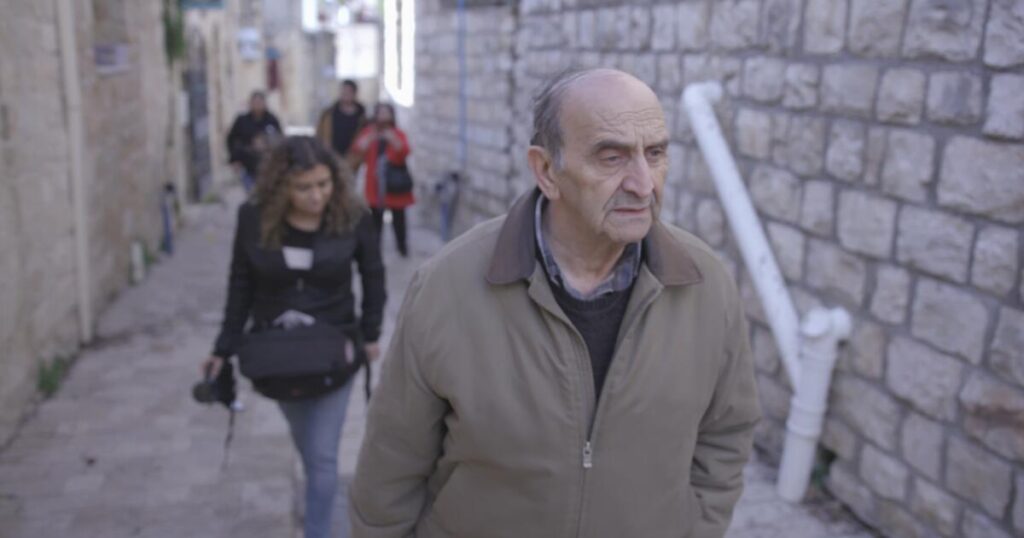
“Traces of Home” follows Ghunim as she travels with her family to her father’s homeland of Palestine and mother’s native Mexico for the first time since both parents were forcibly displaced decades ago. Her father’s family was forced to leave the Palestinian city of Safed in 1948 during the Nakba, in which 750,000 Palestinians were expelled from their homes to make way for the establishment of the burgeoning state of Israel. Her mother’s family left Mexico to flee from the abusive nature of her maternal grandfather.
Beyond investigating the political and personal experiences that shaped her parents, Ghunim turns inward to examine how those events informed the strained relationships she has with them. She especially dives into the frayed connection she shares with her mother. In one scene, she even confronts her mom about where the levels of resentment in their relationship stem from.
The movie’s political timeliness and emotional vulnerability are what led Mexican actor and outspoken advocate for Palestinian rights Melissa Barrera to sign on as an executive producer for the project.
“It feels so close to my heart, not only because of my love for Palestine, but because I’m Mexican, and because this is the story about a Mexican Palestinian American family,” Barrera told The Times.
“There’s something about the lens through which the story is told about an immigrant family, about the trauma that gets passed on through generations because of forced immigration — something that we’re seeing so much of right now. People don’t really think about the trauma that refugees carry and pass on to their children and grandchildren.”
Barrera noted that while she came on as an EP late into the process, she felt it was necessary to attach her name to it so that the film’s status could be elevated.
“My role is to get as many eyes on it as possible and if my name helps to get it anywhere, I gladly will share it with the people that I think need to see it,” Barrera said.
And she successfully elevated its status.
Thanks in part to Barrera’s connection to the project, “Traces of Home” was one of only a few screenings at LALIFF that was fully sold out.
The 35-year-old “In the Heights” star also talked about how fearless Ghunim is as filmmaker due to her ability to have such vulnerable conversations about personal trauma on film.
“She’s had a difficult relationship with her mother her whole life, she wants to heal that,” Barrera said. “She knows that even though it’s going to be uncomfortable, she has to have these conversations and do it on camera and expose her herself in her most vulnerable state for the good of, not only her family, but every other family that is going to be watching and think, ‘I can also have that conversation with my mom or with my dad or with my brother or sister.’ It was super-selfless what she did and beautiful and very inspiring.”
“Traces of Home” is the type of project that Barrera hopes to create space for within Hollywood as she embarks on creating her own production company.
“We want to make all kinds of content and want to have art house movies that are deep and talking about important issues that maybe other studios wouldn’t dare to touch,” Barrera said. “I want to work with good people. I think that there’s a lot of issues in the industry, where a lot of not so nice people keep getting work, and there’s no filters, and I think that’s why the industry then can become toxic. I just think that we need a cleanse.”
Following her film’s premiere at LALIFF, Ghunim spoke with The Times about the personal nature of the project and the emotional reception it received at the festival.
This interview has been edited for length and clarity.
How did you decide that you wanted to put your family’s story out there?
I started filming in 2017, so it’s been a nine-year journey. In the beginning, my real impetus was more in the political space — talking about the family separations at the border and the refugee ban in the Arab world. It just felt so imperative to share my own parents’ stories of forced migrations from Mexico and Palestine. That was the first piece around social justice, showing who immigrants and refugees really are.
Then while I went into production, a lot of mentors of mine said, “Colette, you need to dig deeper. What is your motivation? There has to be a deeper layer to this to make it a solid film.” I was like, “What deeper layer?” Then they suggested, “Maybe you need to start going to therapy.” That was when I first started going to racial identity therapy because I was feeling this disconnect to home, to heritage. I thought about how that affected me. That’s where I started to learn about intergenerational trauma and realized that the relationship with my mom just kept coming up over and over again. It was the controlling-ness, the strictness and not understanding why she was the way she was, until I realized this is trauma. So that’s when the film started to shift into unpacking this relationship with my mom and the trauma space, but also still not knowing what the end of the film was going to be. We went to Mexico and Palestine — and it was an amazing experience — yet it became something so much, so much bigger by the end of it.
A lot has happened in both Palestine and Mexico that has changed how the world views them. Both populations have been very politicized, especially in the U.S. How did you navigate that evolving identity, and how did the events of the world shift how the movie played out?
We were in the edit room in 2023 when the Gaza genocide began, and it was truly so hard, because working on a film about this level of trauma and the origin story of the Nakba, of how it even came to be at this level of apartheid and ethnic cleansing — that was the impetus. We had a lot of conversations with people that were like, “Are you gonna try to add in present-day events? Are you gonna try to shift the story in some way?” We thought about it, but it didn’t feel like something to actually include in the film, because it would lose its localized approach. This is a personal story, not a news piece that we see already so much. In previous versions we had Trump in it, we had things from the news and it just made it feel like we’re just trying to put in news that we didn’t actually need. People already know about it and what people actually need is to know is who Palestinians really are.
It just became much more important to get the story out there [due to the realities of the world] and it was interesting because there is a scene with my dad watching the news — he watches the news all the time — and in 2021 there was another round of extreme violence in Palestine and so the news was going on while he was listening to it and I filmed that. We didn’t put a time on it, but it could have been now, it could have been a year ago, it didn’t matter that it was in 2021.
So ultimately, we decided to just keep the movie as it was. It just became more imperative to get the film out as soon as possible once everything broke out.
I noticed that a lot of people came up to you after the film’s LALIFF screening and were sharing that they felt very seen by the movie. What has that been like to see people react so strongly to it?
What a gift to be able to have it be received so fully by others that are seeing their own reflection of their inner struggles with their family and within themselves. As BIPOC people getting a space to actually feel seen for what we’ve gone through is really amazing, especially as a child of immigrants and refugees. It can be like, “Why are we complaining?” We’ve got everything. We were so privileged. Our parents did so much to bring us here and yet there’s still these blocks that are in front of us from the previous generations that a lot of people didn’t even realize.
It was amazing to hear afterwards from people who came to the screening that had never even heard of intergenerational trauma. They told me, “This is making me realize so much about my own parents and making me want to talk to my own family about our issues.” That is the first step to healing everything, really — it’s a slow process, but it’s one that’s really needed. So, I’m just so grateful.
After this experience of making the film, do you feel more Palestinian? Do you feel more Mexican?
Totally, yes, I think it’s such a loss for so many of us who have never been back to our parents’ homelands. That level of disconnect is it’s called ambiguous grief and the ambiguous loss that we don’t even know what we’re missing until we go there. Being able to actually go to Palestine and to go to Mexico and feel the land and feel the people there, that it was like, “Oh my gosh, no wonder I don’t feel like I fit in the U.S.” [Society] tries to construct us into this bubble of something that is not our nature and so going back to my own roots, I feel like my ancestors at my back now in a way that I’ve never felt them before. Learning the languages was also essential for that reclaiming of heritage too. Knowing our roots is so important.
Can you talk about what it has meant to get Melissa Barrera and John Leguizamo as executive producers? How did it come to be they got attached to the project?
It’s been amazing to see how this team has grown to become the best team I could have never imagined. A producer that I had in Chicago was working on a film about John Leguizamo, so he’s been close friends with John for a long time. He was the one who made the connect to bring John in. When we got to our rough cut we showed it to Al Jazeera journalist Dena Takruri, she loved it and came on board. She was friends with Melissa and she was like, “Melissa, you need to see this, I think you would love it as a Latina, and having that Mexican connection.” Melissa watched it and then was in as well.
I am amazed by Melissa; she is the real deal. Her level of courage to just say,”What is happening in Palestine is absolutely terrible and I’m supporting to end the occupation” is unbelievable. She sticks to her principles and her values in a way that is so rare in this industry. It makes sense that she is able to tap into soul of what the film is about because that’s what her nature is too. Having that kind of person that’s so authentically herself attached to the film is such an honor.
There is this moment in the film where your family is on a bus in Palestine and your local guide is talking about a fence that is separating Palestinians and Israelis and he notes that the company who built it also put in a bid to create the wall at the Mexico-U.S. border. When you heard that convergence of the reality of shared struggle within your identities, how did you take that moment in?
I was surprised but not surprised at the same time to hear that. The level of interconnected-ness of it just came full force at me. It’s literally the exact same evil corporate entities that are doing the thing to create this level of settler colonialism and displacement across borders everywhere. That’s why it felt so essential to put that in the film. We may think as Latinos that Palestine is so far away, we’re going through the same thing that they’re going through again and again across the world.
The post Palestinian Mexican doc ‘Traces of Home’ was so moving Melissa Barrera had to get involved appeared first on Los Angeles Times.