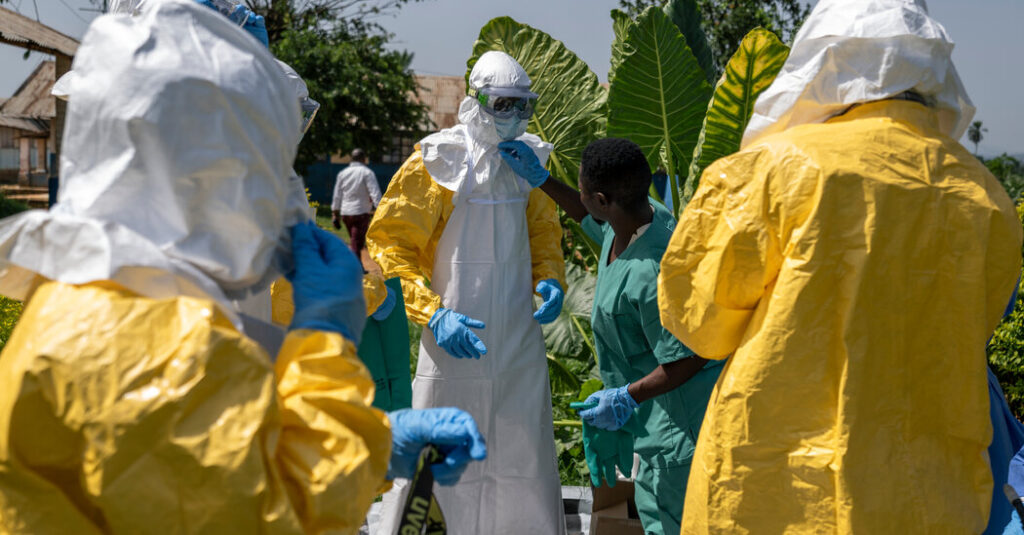
Months ago, doctors in Ituri Province in northeastern Democratic Republic of Congo started seeing patients with the vomiting, diarrhea and bleeding that are the hallmarks of Ebola. The tests kept coming back negative.
It was weeks before samples from sick people — many of whom had already died — made it to the National Institute of Biomedical Research in the capital, Kinshasa. There, researchers used a different test that screened for more species of Ebola and related viruses.
They finally identified the culprit: a species of Ebola significantly different from the one the original test could detect. But by then, the outbreak had seeded across the border into Uganda and become a full-blown public health emergency.
As health workers battle a devastating virus that has killed at least 49 people and infected 452 more so far, they have been hampered by a chronic lack of investment in high-quality tests for clinicians facing pathogens that surface in the most marginalized places.
“We were looking for the Zaire strain while it was the Bundibugyo species that was wreaking havoc,” said Dr. Mamadou Kaba Barry, the head of mission in Congo for the aid organization Alliance for International Medical Action. Like many physicians in the region, he has responded to multiple Ebola outbreaks. The doctors who saw the first cases feared what they were seeing, but the negative tests confounded them.
“There were alerts,” he said. “Yes, we took samples; yes, we did the test, but we did the test on the Zaire strain.”
Because there is no vaccine to protect against this species of Ebola virus and no proven treatment, only public health measures like contact tracing can bring the outbreak under control. Rapid and accurate diagnostics are essential: Health workers need to know who has the virus so they can isolate infected people away from uninfected ones and trace contacts.
People who come to a health center with symptoms that could be Ebola will be isolated together — even though some may have typhoid or malaria, which can present with similar symptoms — and end up infected with Ebola at the place they came for care. That fear, in turn, discourages people who fall ill from seeking out care and increases the chances they will infect others in their communities.
“There is no way to work on this disease without having diagnostics that are promptly accessible, and we do not have rapid tests,” said Carmen Pérez Casas, the head of pandemic preparedness at Unitaid, a global health agency that funds accelerated access to diagnostics. Confronting Ebola without a way to test, she said, “is terrifying.”
Now, health workers, research labs and test developers are racing to meet the need, with some small improvement. Dr. Samuel-Roger Kamba, Congo’s health minister, told journalists in Bunia, the Ituri capital, on Saturday that testing is no longer delayed. “We have everything we need to cover current testing needs,” he said. “Today, all the samples that arrived — and we had about 71 yesterday — have all already been examined.”
In Bunia, the lab is now testing 150 samples per day, on four machines that screen for the genes of the virus, with no backlog.
But most of the samples come from sick people already in clinics, and there is still little contact tracing in the community, the World Health Organization says. Many hundreds of samples would need to be collected and tested within hours to bring the outbreak under control.
In May, the researchers at the national laboratory in Kinshasa who first identified Bundibugyo as the source of the outbreak used a genetic testing technology called RADI-One, which can screen for all four Ebola species that affect humans as well as Marburg virus, another hemorrhagic fever that has caused outbreaks in the region.
The W.H.O. is working with the manufacturer of RADI-One, a small South Korean firm called KH Medical, to install about a dozen more machines in the region, said Dr. Nicksy Gumede-Moeletsi, a medical virologist with the organization.
Expanded access to this testing will address only part of the problem in Congo because it relies on taking samples to a central lab — a slow and often fraught process in Ituri, where the road network is limited and violence persists.
There is no rapid test for Ebola like the home tests that became popular during the coronavirus pandemic — kits that would allow health workers in Ituri to quickly separate potential Ebola patients from uninfected people in clinics, and simplify contact tracing. While rapid tests for the virus do exist, they were designed for the Zaire species — and in any case, because of the way Ebola viruses behave in the body, a rapid test cannot accurately identify sick people until their viral load is extremely high. Such a test could, however, be used to confirm Ebola in people who have already died.
But while the need for better tests has been clear for years, there has been little investment to develop them because there is no high-income market, said Sonjelle Shilton, who works on access to diagnostics for the aid group Doctors Without Borders.
“That message was there: We need pan-species Ebola tests — because they faced these same problems in the last Bundibugyo outbreak,” Ms. Shilton said. But the private sector sees little incentive to invest in research and development for a diagnostic tool that will be used almost exclusively in the world’s poorest places, the same reason there are no vaccines or treatments to deploy against Bundibugyo, she said.
Until this outbreak, the RADI-One technology was not nearly as widely installed in Congo as the world’s most-used molecular diagnostic, GeneXpert.
The tests that originally came up negative for Ebola in the current outbreak were GeneXpert, which is made by the California-based company Cepheid. International funding helped install that technology in laboratories for testing during the coronavirus pandemic, and for H.I.V. and tuberculosis programs.
However the GeneXpert test that Congolese labs are equipped for detects only the Zaire species of the Ebola virus, which has caused the largest outbreaks in the past.
Cepheid does have a test to detect Bundibugyo as well as other Ebola species. The U.S. Food and Drug Administration has approved it for use by the U.S. Defense Department.
Dr. Connie Savor, the chief medical officer for Cepheid, said the company was committed to producing an initial run of 5,000 tests to respond to this outbreak. But the test will have to be approved by regulators in Congo and recommended by the W.H.O. before it can be deployed. The slow-moving bureaucracy of these institutions has delayed response in other outbreaks, including Congo’s continuing mpox epidemic.
“It comes down to, how quickly we can deploy across the different rules and different partners and the requirements of the countries: It could be a matter of weeks or months,” Dr. Savor said.
She said it would be “premature” to discuss the price Cepheid would charge for these tests.
Adam Hong, the chief executive of KH Medical, the company that makes the RADI-One tests, said the company was increasing its manufacturing capacity and expanding support activities in Congo and Uganda to respond to the Bundibugyo outbreak.
While there is limited commercial market for these diagnostics, his company is committed to developing tests for pathogens that mostly affect people in the poorest places, Mr. Hong said. “We believe that strengthening access to diagnostics for emerging and neglected infectious diseases is an essential component of global health security,” he said.
Declan Walsh contributed reporting from Bunia, Democratic Republic of Congo.
Stephanie Nolen is a global health reporter for The Times.
The post Only the Right Tests Can Stop This Ebola Outbreak. Congo Has Hardly Any. appeared first on New York Times.