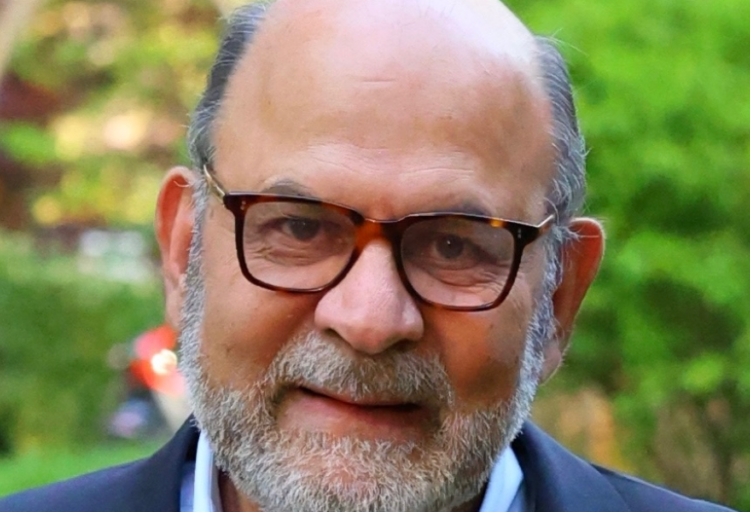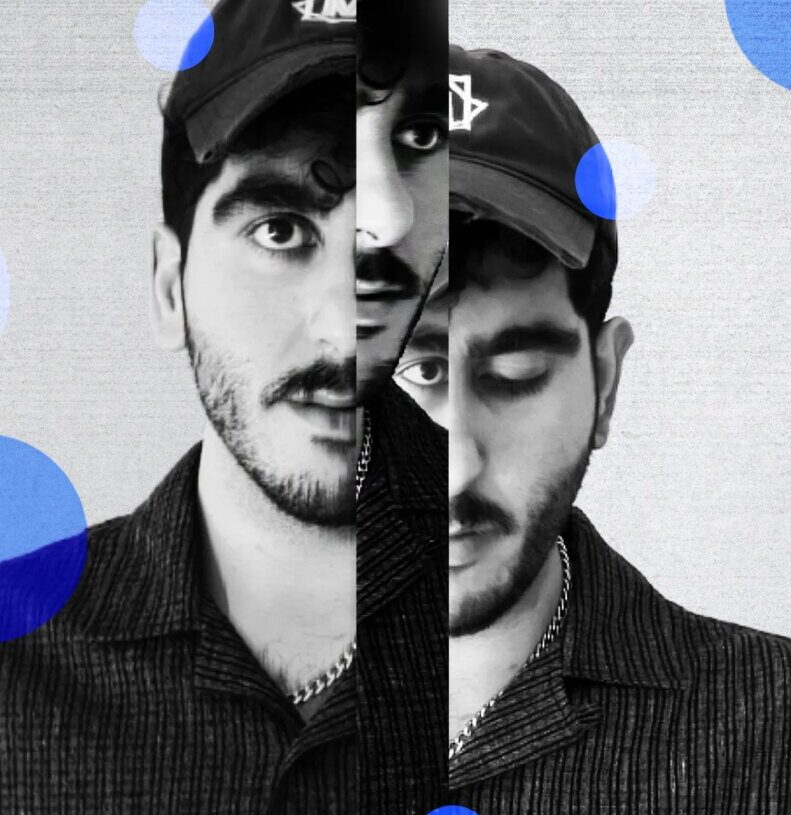
At 1 am during Ramadan, Palestinian journalist Ameer Al-Khatahtbeh sits shoulder to shoulder in a packed Yemeni coffee shop in New York, the kind of place that comes alive after evening prayer. Everyone is loud, heavily caffeinated, and happy to be out. His phone buzzes. Breaking news: Israel strikes Tehran.
He looks up at his friends, then builds a post and hits Publish. “Did you just post?” they ask. He makes his apologies and goes home to watch the news.
This is more or less how Al-Khatahtbeh, 27, has spent the last seven years. He runs @Muslim, with more than 12 million followers across platforms—6.7 million on Instagram alone. He has interviewed Zohran Mamdani, Riz Ahmed, Mo Amer, and Motaz Azaiza.
The success of @Muslim goes back to Donald Trump’s first term as president. Then a student at Rutgers University and planning a career in entertainment journalism, Al-Khatahtbeh witnessed the effects of Trump’s Muslim ban through his Yemeni and Iranian roommates.
When he wrote about how the ban was impacting students on campus, he couldn’t find the right outlet to reach and warn other Muslims that their universities might not be able to protect them. That’s when he decided to create a space for Muslim media.
That comes with 13 hours of screen time. He says he finds it embarrassing, but the admission is tinged with pride. “I have to stay in the know. I’m getting the news the same way as everybody else.”
But everybody else isn’t the de facto editor in chief of Muslim media.
This interview has been edited for length and clarity.
CARLA SERTIN: At what point did you realize this could be something a lot bigger?
AMEER AL-KHATAHTBEH: When I first launched @Muslim, February 15, 2019, I was already working in social media. I saw every single transitional moment of social media. I was just chronically online.
It occurred to me: What if I were to cover news the same way I’m making a post for Vice News, that style, but the story is Muslim-centered? When I started creating news in this way, Muslim news, it immediately took off. I think it was the first time that the Muslim community was seeing this style and way of news being delivered to them.
I make sure it’s digestible—so a fifth grader can read it, but also someone who’s a boomer. I make sure it’s shareable. I think by having this formula for every single post, it took off really fast. I launched it junior year of college, and by the time I was a senior, we had already amassed 50,000 followers.
When I was a senior, we went into Covid. It was the first lockdown Ramadan, lockdown Eid. Everybody was just on social media during that time. I really took advantage of that moment. We can’t go through our mosques. We can’t go out and celebrate Ramadan or Eid, so I have to make sure I am building this platform and publishing, publishing, publishing, to make sure that we still have this form of celebration or worship during the month of Ramadan.
That was when @Muslim really blew up. When I graduated in 2020, @Muslim had amassed 250,000 followers. I was like, OK, there’s something bigger here, and I’m going to keep doing this.
Is there a balance between appealing to younger generations and representing being Muslim?
It was a lot of trial and error, to be honest with you.
We were doing a lot of fun content. We were doing Muslim memes, and then also having conversations about the latest news. It was a mix of all this stuff—whatever was trending on Muslim Twitter or TikTok, we were on top of it. It was a very refreshing, Gen Z–centered look at topics we cared about. We did a whole conversation about how Billie Eilish said in an interview that she wears her clothes modestly and she’s being celebrated, but then when a Muslim woman wears a hijab, she’s considered oppressed. We would do these really sharp conversations. And then it pivoted.
It was really light-hearted and fresh, and then what I realized is—as I amassed more and more followers, because having a community at 250,000 followers that represented Muslims, and then having 14 million across all our platforms now—it’s international. It’s not niche any more. It’s global. It’s like stripping away a lot of the things we were having conversations about.
For instance, I can’t post TikToks with music any more. Back then we would use trending sounds, we would use music, and all of that. Because there are a lot of communities that feel some type of way about music on TikTok, and it became this huge wave. Gen Z was like, “We’re boycotting music on TikTok, because we’re going to be more Muslim.” It’s like always having to navigate what the community online wants.
I’ll never forget—we had done a partnership with [the Youtube channel] Cut. They have video series like Truth or Drink and Lineup and stuff like that. We did a collaboration where we did Muslims Play Truth or Drink, but instead of alcohol, it’s hot sauce.
October 7 happens, and our collaboration was going live with them, like Muslim Couples Play Truth or Drink. I said to the producers, “Guys, I’m so sorry. I cannot be promoting this right now because we are really locked in on covering Palestine.” It was inappropriate. I told them, “Don’t worry. We’ll push it out and promote it later on.”
And the next day happened. And the next day. I was like, OK, there’s actually no day where this is appropriate to be publishing, or going back to our old content, because this is the news we need to be covering every single day. There are updates every single day, and we’re up against traditional media that aren’t giving it coverage.
From October 7 till now, we started at 2 million followers and now we’re almost at 7 million on Instagram—more than doubled. It’s this pressure of having to make sure we’re on top of coverage of Palestine, on top of coverage of Sudan and Lebanon and Syria, because our audience has built this trust with us. We’re posting things that mainstream media aren’t publishing.
I’m navigating that balance of: I have this new audience of millions of new followers that weren’t familiar with us before October 7, and then I have my audience from before October 7 who knows what @Muslim is and the community that we are.
It sounds like a larger consideration, because Muslims are from everywhere, different cultures, different backgrounds—what they’re interested in may be different.
Every time I make a post, I’m like, can every Muslim understand this? Does this post resonate with them, whatever background they’re from? I segmented my audience into three different categories, and that’s how I move whenever I create content, whenever I publish. This was an unlock I had in the last year of understanding my community, because it grew really fast, and now I’m serving so many different people.
The three categories I broke down: I am serving traditional Muslims—the ones who practice every single day, five daily prayers, the ones for whom being Muslim is their core identity. Then I’m also serving cultural Muslims—the ones who identify as being Muslim but aren’t necessarily practicing, but still have an attachment to the faith, and they see @Muslim as a way to remain connected in some way. The third one is non-Muslims, because we cultivated a huge audience of people who follow us because we’re publishing news that they’re not seeing on their feeds, and they depend on us to make sure they’re getting their information correctly when it comes to stories that affect our communities. We’re kind of seen as like the Muslim best friend. That’s how I view our platform.
The pressure is real—I’m the one publishing all of the posts you see on the Instagram page. I’m the one publishing all of the tweets. I’m the one publishing all of the threads. Thankfully, I have Tuba—for the last three, four years, she’s been publishing on our TikTok, because that would have driven me mad as well.
How big is the team behind @Muslim?
It’s me and Tuba. I have someone helping me with digital strategy, and the rest of the people are contractors—they’re not part of a full-time team, per se. How @Muslim works is more so: Anytime I need something, or any time we’re creating something cool, we just have this huge Rolodex of friends or people in our network that we tap into and contract. It’s very scrappy.
From the outside, people think that @Muslim is totally funded, that we have a whole entire team and office, a full staff. No. It’s me building this small group of people that really passionately care about serving the Muslim community. Every time you see a post on @Muslim, on @MuslimNews, on @Ummah, every time you see a post on Twitter or Threads, it’s me publishing it. I’m the one creating it. I’m the one curating the news and curating what to publish at all times. And with that comes 13 hours of screen time.
I was really embarrassed because I connected with my friend Riyaad Minty, who created AJ+. He took me out to lunch and asked, “Hey, Ameer—I’m just curious, what’s your screen time?” Then he pulls out his and says, “Mine is like four and a half hours.”
I checked mine, and I was like, there’s no way it’s over 13 hours. It’s been over a month—the average is 13 hours of screen time a day. More than half of my day on my phone. The core reason is that I have to stay in the know. I’m getting the news the same way as everybody else. So if there’s a breaking news story happening to the Muslim community—if something’s happening in Lebanon, happening in Sudan—I’m receiving that same information as you.
That sounds like a lot of pressure.
@Muslim is in this unique position, because we are the largest Muslim publication and online space for Muslims online. We have eyes all over us, and people are intimidated and they don’t like posts we’re making if it doesn’t align with their agenda. It’s this constant pressure of: What if one day I get deplatformed?
I kind of have a safety net, because we’ve built such an established audience (one of a kind) that, God forbid anything happens to us, outlets would cover our story, just as they covered stories about us in the past, like when [Meta] banned us in India. Taylor Lorenz covered it, newswires published it—the first time an account had been banned in a region. That’s 330 million Muslims who cannot see my content. Our account is also restricted in Canada. So we’re restricted in India and Canada, and it’s this pressure of: They can’t fully deplatform us, I hope—but they’re finding different angles to censor us.
When I spoke to executives at Meta to try to resolve the India restriction, they said, “Someone placed a legal order to restrict your account in India.” I said, “OK—who is it, and why? Because I have not made a single post about India.” They said, “It’s confidential. We cannot share the legal order with you.” I’m the victim of a legal order placed against me that restricts my access to my community, and I can’t even see it. Who do I communicate with? How do I resolve this? I’m American—I have no legal jurisdiction in India.
[Ameer pulls up the email communications] Here it is: “Your content is restricted within India because Facebook has been notified by the authorities under an emergency order pursuant to Section 69A of the Information Technology Act 2000.” But then it’s like—can I see the legal order? Can I resolve it? Why did they place it? I never made a post about India. I get so many DMs and messages from Indian followers saying, “We can’t see your content.” I just don’t know how to respond. I’m trying.
[Editor’s note: In an emailed statement to WIRED Middle East, Meta shared a link to its policies around government-issued requests to restrict content and accounts, but did not comment on @muslim being banned in India. Its policy states that it reviews takedown requests, and if they are found to be valid according to local law, content may be restricted in that country. Its policy also notes that, in certain cases, it may be under a legal obligation to maintain confidentiality of the body that issued the takedown request.]
It impacted us significantly—India was one of our largest audiences. After the ban in May 2025, for the first time we plateaued and started declining. I was at 6.7 million followers for months, whereas every single month before that it’d be 6.8, 6.9, 7 million. I’d probably be at 7.5 million by now if it weren’t for this restriction. Indian followers are unfollowing while we’re still gaining elsewhere, so it’s neutralizing our growth.
I say this because it’s a dangerous precedent. What’s stopping any other country or nation from reaching out to Meta and saying, “I don’t like this outlet, and I don’t want it seen in my country?” And Meta has this system of abiding by whatever legal order they’re given.
OK—so then how do I appeal it? How do I go through a legal process? For Canada, at least there was an appeal process. For India, there’s nothing. No appeal, no justice, no clarity. I’m still trying to find a resolution.
I just want to put it out there because this is something that really matters to me. People might not care that a Muslim Instagram page is banned in India. But we’re doing a real service for our community, and this is genuinely harming us—and harming 330 million Muslims who can’t access news and information like everybody else.
This story was originally published by WIRED Middle East.
The post Meet the Accidental Editor in Chief of Muslim Media appeared first on Wired.