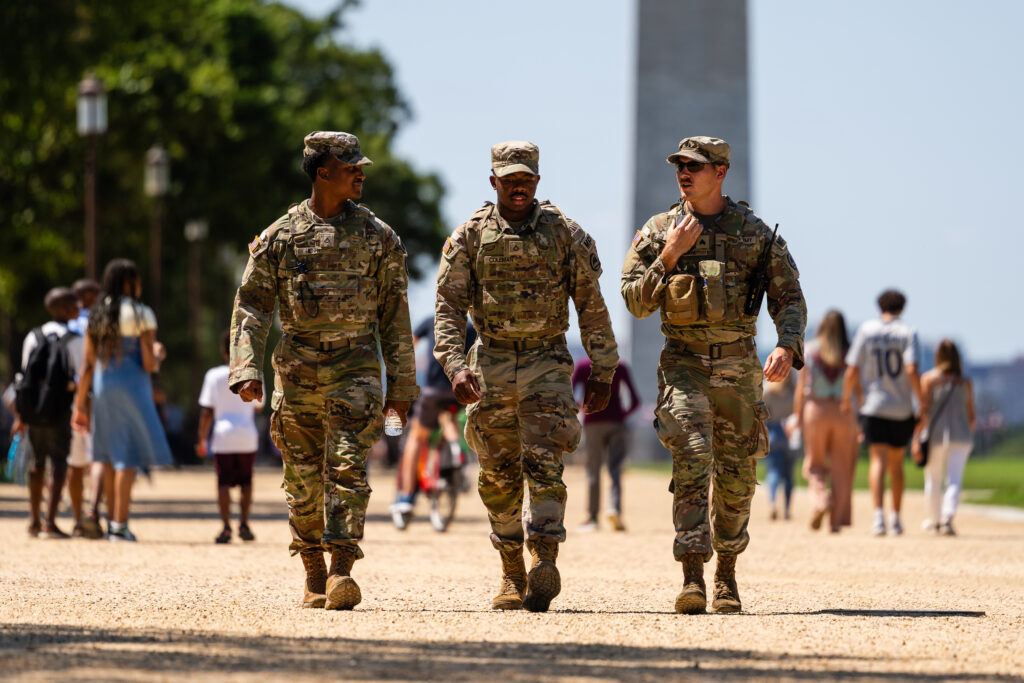
President Donald Trump has often claimed credit for D.C.’s recent drop in crime, going so far as to say that his surge of National Guard troops to the nation’s capital was able to “solve the problem.” Many Democratic politicians see nothing but a waste of resources that accomplished nothing.
A recent analysis by the Niskanen Center shows that Trump and his critics both exaggerate their cases, and D.C.’s experience has important lessons to offer other cities.
The report found that while the sudden increase in uniformed individuals on D.C. streets last summer had no detectable impact on violence, it reduced by 24 percent opportunistic crimes such as theft and vehicle break-ins. More important than the deployment, however, have been proactive enforcement strategies by D.C. police to prevent serious crimes.
Some may resist the finding that the National Guard deployment was effective in reducing crime. Crime was already dropping in D.C. before troops arrived, and they were largely limited to areas saturated with tourists, not neighborhoods with the highest crime rates.
But the numbers are clear: Property crimes clearly plunged in the weeks following the deployment, much faster than they were falling beforehand. The report also found that gunshot detections fell considerably after the National Guard arrived, as did 911 calls.
This isn’t to say that the deployment, which cost $185 million last year alone, was an efficient use of tax dollars. The report estimates that the average daily cost of a Guard member in D.C. was $607, compared with $384 for a D.C. police officer.
But the natural experiment does support the well-established maxim that greater visibility of law enforcement officers prevents crime. That’s a repudiation of the movement to shift resources from cops toward social services.
The report also challenges the notion that increasing the head count of officers should be the top priority. More important is how they are deployed. The size of D.C.’s police force, around 3,144 officers, has fallen to a 50-year low. Yet crimes have fallen despite that trend.
The researchers believe that this was largely due to the Metropolitan Police Department’s efforts to use its increasingly limited resources strategically. It dramatically ramped up enforcement of drug and traffic crimes and went after people who violated the conditions of pretrial release or parole. The goal was to stop more serious crimes before they happened.
D.C.’s success is critical because while recruiting more police officers will be essential in the coming years, cities will continue to struggle filling their ranks given the nationwide shortage of police. Flooding streets with armed patrols, as Trump has done, simply may not be sustainable or attainable, even if it is effective. Investing in evidence-based strategic enforcement will be crucial.
The post Lessons from Trump’s National Guard experiment appeared first on Washington Post.