WHAT CAME WEST, by Josh Weil
Before the American researcher Leo Kanner published his landmark paper on autism in 1943, gathering disparate behaviors and affects beneath a clinical umbrella, the condition was poorly understood, linked to schizophrenia and treated with crude, if not barbaric, measures. Wind the clock back further, to a century before Kanner, and treatments were downright medieval: bloodletting, ducking, the rack.
Josh Weil explores this history and other travesties in his gripping, adventurous novel “What Came West.” The book evokes the horrors of rapacious American expansion by following a neurodivergent trapper, Silas Hall, whose trek from his boyhood home near Pittsburgh to California’s high Sierra leads him, Odysseus-like, to the son he abandoned years earlier.
While literary westerns are full of clichéd outsiders, I don’t believe I’ve met this particular lone wolf before, shut off but startlingly vibrant in his mind. Weil, the author of three previous books, alternates between a lengthy letter Silas scribbles to his son, Elisha, a teenager still in Pennsylvania, and a gory reckoning (narrated in the third person) among peaks and gorges during the autumn of 1849. Lured by gleams in mountain creeks, white settlers are pouring into the West and stirring Silas’s Native neighbors, the Nisenan, to action.
Born at the dawn of the 19th century, Silas can’t control impulses such as hand flapping. He scraps with classmates, frustrates his siblings and tests the patience of his devoted parents. His father, a rural veterinarian, is wise to the ways of biology, and suspects that Silas’s triggers are related not to cognition but to another underlying issue. He rejects quack remedies. “He simply observed me,” Silas notes, “the same sharp eye and alert senses that had brought him renown as an animal doctor.”
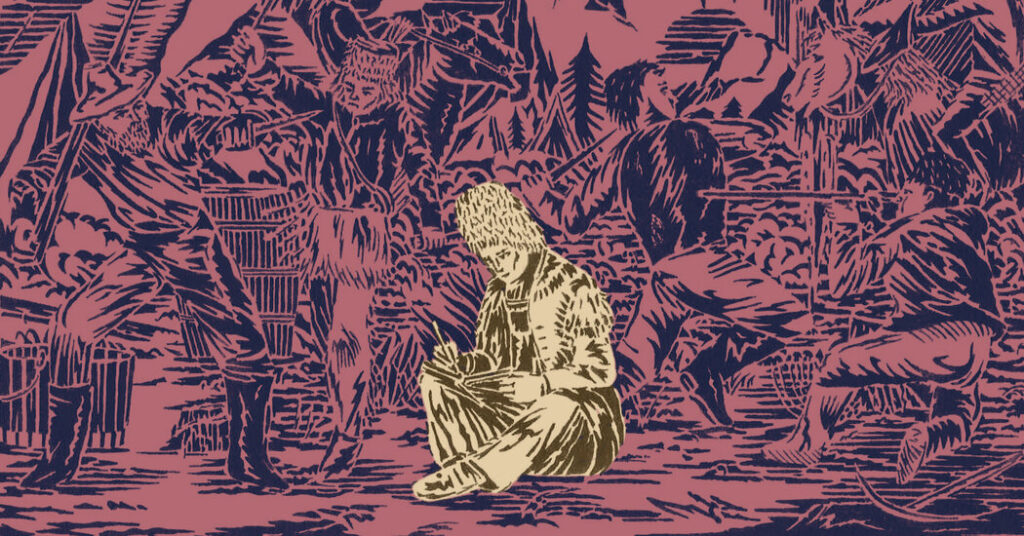
His father’s decency buffers the youth as he grows older and more isolated. Silas expresses himself through pencil and chalk, a means of regulating behavior. His sketches attract the attention of Delia, a mute servant; they conceive a child and relocate to Pittsburgh, where he finds work as an illustrator. (Weil scatters his own drawings like birdseed across his text, lending it a deft immediacy.)
Silas grasps that something is wrong deep inside. “If I could have hunted without killing, I would have,” he tells us. “Not just to spare the creature’s life, but because of what the taking of it did to me. The hammer, the powder, the strike, the spark, my skin: a rush I recognized, too near what would come over me when I was pushed too far.” Fearing that he might hurt his own family, he lights out for parts unknown.
He moves west on a current of good will, buoyed by genial Mormons, Shawnees in a wickiup, a camp of escaped slaves, bands of ruffians — a pluralism thriving on the frontier. He can’t resist the urge to chronicle his self-imposed exile to Elisha in ravishing set pieces: a teaching sojourn in an asylum, torment at the hands of a sadistic French trapper, torture in Native captivity, bonds with other tribes.
Weil conjures the famous Green River Rendezvous in boisterous prose:
Pack trains stretching half a mile … the whole range emptying out into a valley already loud with calls of traders hawking powder, lead, razors, buckles, haggling over the price of beaver … liquored whoops ringing out at a first swig, or sight of someone unglimpsed since the last rendezvous, or simply from relief at having made it to another. All those humans talking in all that mash of English and French and Spanish and Arapahoe, Blackfoot, Coeur d’Alene, Pawnee.
Like all of us, he’s thunderstruck by the continent’s grandeur; after a flurry of violence he seeks peace, claiming the Sierra Nevada as “my mountains.” He builds a cabin in a canyon, a sanctuary surrounded by willows and woodpeckers, until forty-niners destroy his delicate equilibrium.
Whose destinies manifest here? Weil suggests that the peoples of America melded (or failed to meld) within a cauldron of suffering, their collective history a saga of bondage and dispossession. That saga includes ecological ruin, such as the hunting of billions of passenger pigeons to extinction in just five decades, the disappearance of bison from ranges and valleys, the clogging of rivers by prospectors panning for gold. Yet sparks of kinship also shape Silas’s tale; he relies on the kindness of strangers and the counsel of his friend, the savvy chief No Rope.
Black hats and white hats, a vigilante hiding out in Native territory: This is well-trodden literary terrain, distinct as hoof prints in a corral. There are ample shootouts and knife fights, a surreal violence akin to graphic scenes in novels by Robert Coover, Larry McMurtry and Cormac McCarthy. “What Came West” piles on period details: pistols and muskets, saddle packs and mink pelts, male and female mules known as “johns” and “mollys.”
Although Weil strays from his through-line and into verbal thickets, his knotty language reveals an earthy, off-kilter quality in Silas, a truth told slant. Weil uses internal rhymes and a profusion of participles; fragments float across his pages like flotsam. “If I had more time I wld start over. This letter. Wld simply say that I am sorry. Am sorry son,” Silas writes to Elisha. “Wld pick up my pen once more. Redip the nib. And in the days or hrs or however long I might have left wld try again.” There are a few odd anachronisms — Silas’s father uses the word “OK” before it was coined — but they don’t hinder the flow.
Weil’s divided narrative reflects a divided self, a country divided on the cusp of a cataclysmic civil war, inflamed by slavery and conquest of Indigenous lands. In our 250th anniversary year he steers clear of grandiose pronouncements, allowing Silas’s singular imagination to carry the larger epic. Weil homes in on a parent’s love and desire for a better future: “Elisha, do you ever still feel me waiting? Outside your door? My ear to the wood, listening?” In that moment of waiting — a pause, a catch of breath — lingers the fate of a nation cobbled together by wonder and woe.
WHAT CAME WEST | By Josh Weil | Doubleday | 496 pp. | $32
The post Go West, Young Neurodivergent Man appeared first on New York Times.