
A hoax costs taxpayers hundreds of millions of dollars and incites arson attacks against dozens of churches.
This time, however, it’s not the latest headline out of Minnesota — look a little further north.
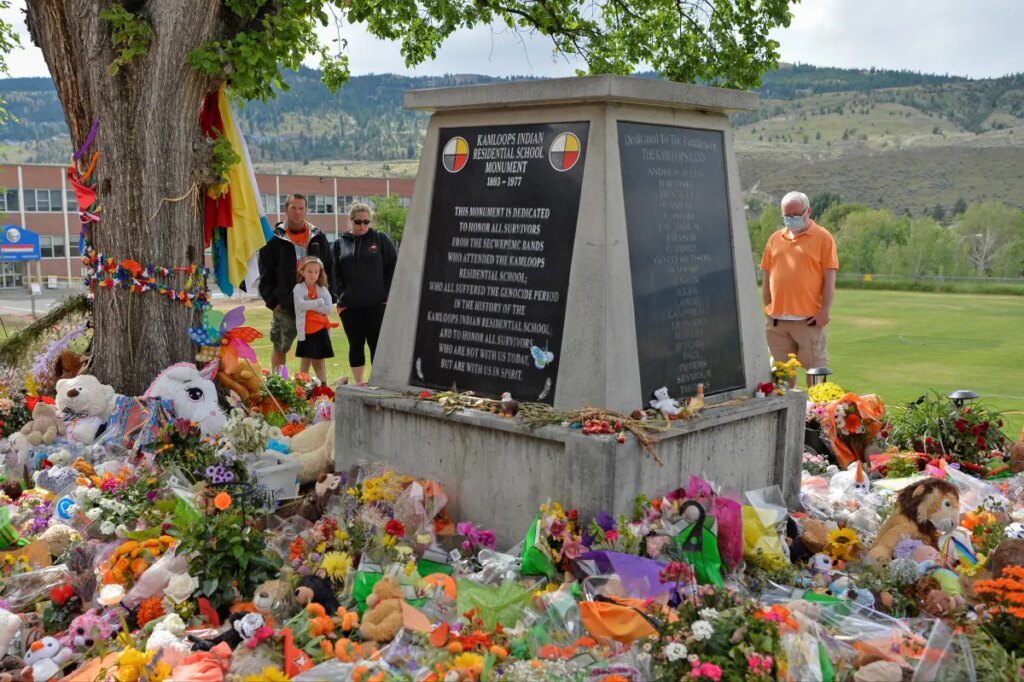
In 2021, at a time when media throughout the western world were still in a state of high agitation after the killing of George Floyd, Canadian outlets picked up on a story too sensational not to be true:
Hundreds of indigenous First Nations children had been buried in unmarked graves at residential schools run by the Catholic Church in British Columbia.
The Kamloops Indian Band sent around a press release that “confirmed” it.
The statement claimed the remains of 215 children had been found with the help of an expert using ground-penetrating radar.
“We had a knowing in our community that we were able to verify,” said the band’s chief, Rosanne Casimir.
“Some were as young as three years old,” she continued, asserting that “the final resting place of these children” was in the Kamloops Indian Residential School.
Only it wasn’t — no human remains have been found at Kamloops.
And the media that fanned the flames of the story is finally admitting it.
Even now Canada’s biggest daily paper, The Globe and Mail, phrases its retraction in cagey terms.
“There has been no public confirmation of the discovery of any human remains,” the paper conceded on Saturday.
Yet that funny phrasing leaves one wondering, is there private confirmation of human remains — another “knowing,” perhaps?
The Globe and Mail editorial, titled “There is no reconciliation without truth,” is a masterpiece of embarrassed equivocation, lamenting conditions at Canada’s residential schools of First Nations children and even insisting that the absence of bodies “does not mean children did not die there” before finally, eight paragraphs into the story, taking a smidgen of responsibility.
“The media, including the The Globe and Mail, did not initially scrutinize, much less challenge” the story.
“The initial headlines and stories in the media simply stated as fact that the remains of 215 children had been found. Many of those early stories, including in this newspaper, made references to ‘mass graves’,” a phrase that went beyond even Chief Casimir’s claims.
Yet right after the admission of its failures, the paper’s editorialists wistfully speculate, “Perhaps it will be proven, some day, that there are hundreds of unmarked graves at Kamloops” — as if the error here was just in being a little too hasty to declare what will sooner or later turn out to be true.
After all, that truth is what would fit the narrative The Globe and Mail laid out in the first seven paragraphs of its story, a tale of wicked residential schools and countless First Nations children doomed to a miserable death.
The narrative comes first; the facts must follow.
This time they didn’t, but next time . . .
The narrative isn’t going away just because its showcase story has been debunked.
The consequences of the media hype aren’t going away, either:
Canadian taxpayers footed the bill to the tune of hundreds of millions of dollars — real money in US dollars, too — for First Nations groups to investigate “soil anomalies.”
The government simply doesn’t know where that money went.
As enormous as the fraud here appears to be, however, worse is the destruction unleashed by arsonists and vandals against Catholic churches in the wake of the story.
Canada’s state broadcaster, the CBC, cataloged 33 churches “burned to the ground” between 2021 and 2024, with 24 of those incidents “confirmed arsons.”
“A researcher and some community leaders suggest Canada’s colonial history and recent discoveries of potential burial sites at former residential schools may have lit the fuse” for the incendiary attacks, the CBC reported.
Yet it was the media that lit the fuse, not only by hyping an outrageous story that was never backed up by evidence but also by laying down a grand narrative that served to inflame anger at churches — and in typical fashion, although the residential schools were Catholic-run, other churches also suffered from indiscriminate attacks.
We see this kind of thing all too often in America, too.
Unlike the unmarked graves at Kamloops, George Floyd’s death was a reality.
But the grand narrative spun by the media for years leading up to the riots perpetrated in Floyd’s memory was every bit as irresponsible as the narrative that made the Kamloops hoax believable.
Black Americans were not being casually killed by white police officers, and high-profile cases like Floyd’s almost always involved individuals who were violently resisting arrest.
American media outlets, like Canada’s, have let progressive politics shape the stories they tell — and how they tell stories.
And that often leads to violence.
The Globe and Mail has a long way to go before it makes amends, and the same can be said about all too many of America’s largest papers, too.
Daniel McCarthy is the editor of Modern Age: A Conservative Review.
The post Canada’s mass-graves scam reveals the high price of media bias appeared first on New York Post.