Contrary to wisdom influencers might peddle online, developing a unique sense of style, one that reflects the wearer’s inner world, is hard work.
No one understood this better than Diane Keaton, the actress who died in October at 79. Keaton would often blend traditional men’s wear suiting, ties and bowler hats with patterns and silhouettes more associated with femininity, such as polka dots and billowy skirts. She bucked industry norms, famously accepting an Oscar for her role as the title character in “Annie Hall” while wearing a linen jacket, a scarf draped over a crisp, white shirt, two full linen skirts and high heels paired with socks.
“I look back on ‘Annie Hall’ and can’t talk about that movie without talking about the fashion,” Keaton wrote in her 2024 coffee table book “Diane Keaton: Fashion First.” “It was everything to me. I loved being able to dress like myself.”
Not all of these ensembles were widely celebrated, of course — a good number became fodder for worst-dressed lists.
Keaton cultivated her style in the hours she spent finding gems in second hand stores, collecting and making art inspired by the world around her and tearing through books on architecture and photography, she wrote in “Fashion First.”
This June, the British auction house Bonhams and the Fine Art Group, an art advisory organization, will hold four sales in New York and Los Angeles, with some also available online. The sales will feature Keaton’s personal effects, including her designer and vintage clothing; her art collection, including works she made; furniture and decor from her Sullivan Canyon home in the Santa Monica mountains; and mementos like the original untitled script for “Annie Hall.” The collection spans 50 years of Keaton’s life.
“Diane was always drawn to design and to fashion but only through the lens of her unique perspective, her innate sense of unmistakeable taste,” Dorrie Hall, Keaton’s sister, wrote in the introduction of the auction catalog.
“During visits to my home, she might gently suggest a shift — a chair repositioned or a painting rehung. These gestures were never impositions, but thoughtful offerings, grounded in a refined understanding of space and style. Inevitably, the result was transformative,” she added.
With hundreds of items to choose from, members of the Styles team were asked: Which pieces of Keaton’s personal ephemera would they select if money were no object?
Designs From the American West
Andy Warhol always advised buying in multiples. One object is a souvenir. Five objects are an idea. Ten are the beginnings of a collection. Thus, my imaginary auction money is on these three Navajo pictorial weavings of Shiprock in New Mexico.
Each is relatively compact. All were clearly made for the tourist trade. Keaton’s adventuresome acquisitions for her houses consistently leaned on both the mythology and the design vernacular of the American West. From her earliest forays into collecting, her tastes were uncommonly assured. She had both a good eye and the smarts to spot undervalued stuff. Thus, auction estimates on the weavings are — as always at celebrity auctions — deceivingly modest. So, yes, I would like to believe in the opportunity to score one of these beauties or, better yet, all at prices estimated as low as $600 each. This won’t happen. Still, there is no harm in leaving a bid.
Keeping Time and ‘Annie Hall’
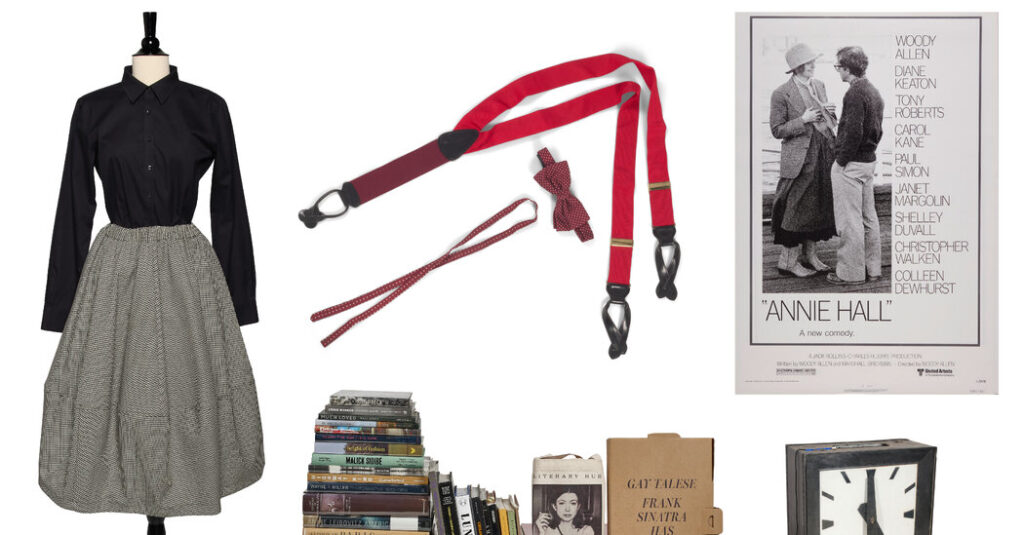
These images pay tribute to several key aspects of Keaton’s life and interests. She loved photography. She loved design, and these pictures have a stark architectural quality. But beyond these characteristics, they were taken by Jack Rollins, who was Woody Allen’s manager for a time and then was listed as a producer for many of his movies, including “Annie Hall.”
I have been trying to wear a watch every day to help reduce my phone dependency. Often, I grab my phone to see what time it is and then get pulled into the abyss. At home on the weekends, it can be easy to forget to put on a watch. But I would not forget to look at this beautiful clock if it were somewhere in my living room. I could glance at it when company was over and say, “Wow! I had no idea how late it is!” thus nudging everyone toward departure without rudely and conspicuously looking at my wrist.
Because no matter what, “Annie Hall” is still one of the best romantic comedies of all time.
Chic Ensembles and a Bright Travel Bag
Sartorially speaking, Keaton will be remembered for her affection for men’s suits and statement hats. But this unusual coat, with its bulky pockets and wraparound collar strap, suggests that her stylistic subversiveness wasn’t so tidily summed up.
Kudos to whichever Bonhams stylist assembled this ensemble: You’ve got my number. The combination of a simple black button-up from Brooks Brothers, the first name in American traditionalism, with a billowy skirt from the renegades at Comme des Garçons is my idea of chic urban dressing.
There’s something aspirational about a nice travel bag. It suggests a faith that the future holds trips exciting enough to warrant the stylistic flex: in this case, a citrus orchard’s worth of tangerine. The fact that this particular bag is from Barneys — another much-missed New York City institution — is just icing on the pebbled leather.
Three scraps of eccentricity from the quirkmeister in chief? Irresistible. Bonhams showed some restraint by not throwing a bowler hat into this lot, which might have been overkill.
I displayed a Turner print in my home for years before realizing that the washy, atmospheric seascape was actually a gruesome whaling scene, so I’ll allow that my walls may be better primed than most for a distressing scene of animal imperilment. But this photo of a Smithsonian Institution diorama featuring buffaloes tumbling off a cliff to their deaths, taken by David Wojnarowicz in 1989, is a poignant response to the cascading deaths from the AIDS crisis. Wojnarowicz’s friend and mentor Peter Hujar had died two years before, leaving him his darkroom.
Well-Worn Books and Mementos
This old metal sign used to sit in the office of Keaton’s Sullivan Canyon home, and to me it projects early Hollywood vibes and old celebrity glamour. It feels like the kind of cinemaland artifact that might get me closer to the ghosts of Billy Wilder and Alfred Hitchcock.
I’m not a big cook, but owning these battered and worn cutting boards, with the knowledge that Keaton herself probably once furiously chopped tomatoes and sliced steak on them, might just give me the push I’d need to become one.
There’s something deeply American, frontier-esque and wacky about this slab of a wheeled metal table. It looks like it’s out of a Tex Avery cartoon. And I want it.
There’s something magical about being young and entering a photo booth — you step inside for an insignificant minute, yet the strip will forever capture the way you were at the time. At some point in the 1970s, Keaton stepped into a booth for this photo, smiling and making faces while she was in there, and that’s a wonderful thing.
Keaton was a big collector of art and photography books, and there are some lovely selections in this heap — a copy of “American Music” by Annie Leibovitz and “Eyelids of Morning” featuring photography by Peter Beard.
Guy Trebay, Ginia Bellafante, Louis Lucero II and Alex Vadukul contributed reporting.
Yola Mzizi is a reporter for The Times covering fashion and style.
The post At Diane Keaton’s Estate Auction, Colorful Trims, ‘Annie Hall’ and More appeared first on New York Times.