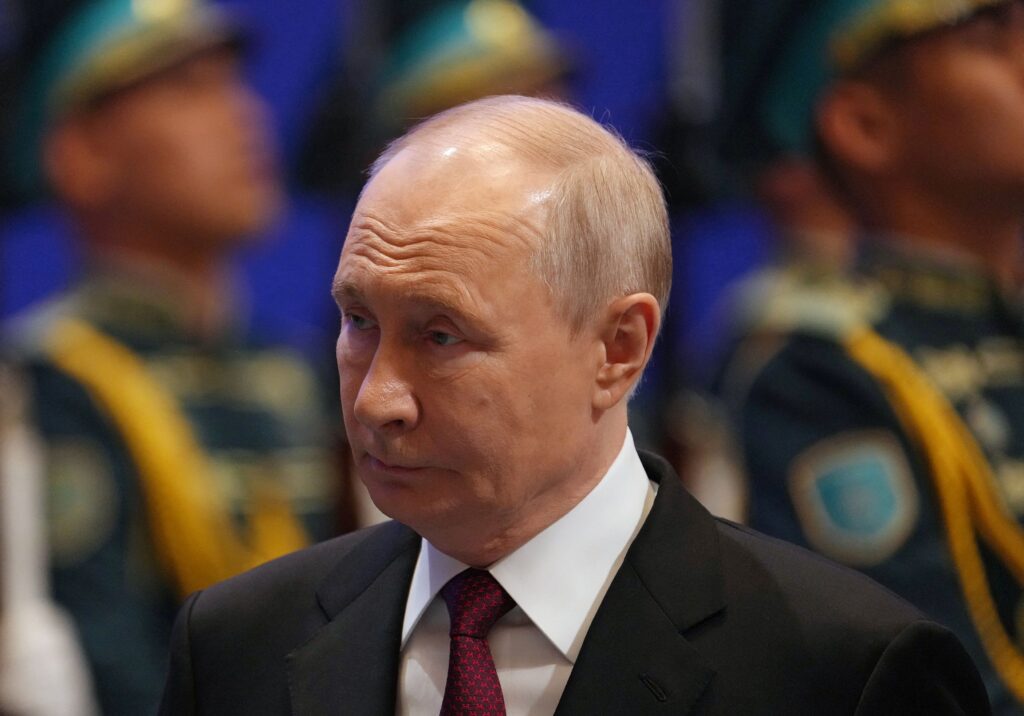
Pressure is mounting on Russian President Vladimir Putin over how to end his war in Ukraine as Moscow’s battlefield offensive stalls, financial resources dwindle and more frequent Ukrainian drone strikes inside Russia exacerbate growing public dissatisfaction, Russian and European officials and analysts said.
Russian officials have issued increasingly shrill threats to intensify the bombing of Kyiv, warning Western officials to leave the Ukrainian capital. Overnight Tuesday, Russia fired yet another fierce barrage of ballistic missiles and drones at the city, killing at least four and injuring dozens as several residential buildings were hit. Russia also bombed the city of Dnipro, in central Ukraine, killing at least nine there.
On Friday, former Russian president Dmitry Medvedev, now the deputy head of its security council, dismissed European anger over a Russian drone that crashed into an apartment in Romania, a NATO member, calling the incident “only the first warning sign.”
“Citizens of E.U. countries, you should realize your authorities have unilaterally entered into a war with Russia,” Medvedev posted on X. “So be vigilant and don’t be surprised by anything. The peaceful sleep is over.”
European officials, speaking on the condition of anonymity to discuss sensitive security matters, said the escalating aggression was a result of increasing difficulties that Russia is facing militarily and economically, and could signal a bid to force a revival of stalled peace talks in pursuit of a deal on Moscow’s terms.
A recent analysis published in one of Russia’s top foreign policy journals, Russia in Global Affairs, stated that Putin’s war goals were now unachievable, and the report appeared to be a further sign of growing dissent at the top of Russia’s political establishment.
The analysis by Vasily Kashin, a respected Russian academic, argued that ongoing Western assistance for Kyiv means it is now impossible for Russia to outspend Ukraine on military equipment and technology, while Ukraine’s mobilization efforts are proving a sufficient counterweight to Russia’s more limited conscription system.
“The war is going on between comparably equal opponents. Historically such wars have only extremely rarely led to the total destruction of one of the sides,” Kashin wrote. “Liquidating the anti-Russian regime,” he wrote, is “principally unattainable without a total military occupation of the entire country over a long period. For Russia, this is technically impossible.”
Several senior European officials have raised concerns that Russia could try to expand its war against Ukraine into Europe — comments that Putin on Friday dismissed as “crude, brazen lies.”
In a speech last week, the head of Britain’s electronic surveillance agency, GCHQ, said Moscow’s progress on the battlefield was “going backward” while warning of Russian efforts to intensify its hybrid warfare against Britain and other European countries.
In official comments, Russian officials have tied their harsher rhetoric about targeting Kyiv to a Ukrainian airstrike that hit a student dormitory in Starobilsk, in the Russian-occupied region of Luhansk, in eastern Ukraine, killing 21 people.
But Russian and European officials and analysts said the Kremlin was scrambling for ways to reclaim the initiative as it confronts a summer fighting season that could be more difficult than expected.
Ukrainian midrange drone strikes are causing severe disruption to logistical networks and supply routes along the key land corridor connecting Russia across occupied southern Ukraine to Crimea, which Russia invaded and annexed in 2014 in violation of international law.
Fuel is now being rationed in Crimea as a result, said Sergei Markov, a pro-Kremlin analyst, and over the weekend there were reports of widespread gasoline shortages.
Russia has fired waves of ballistic missiles, cruise missiles and drones at Ukraine in recent weeks, including what many Ukrainians said was one of the worst strikes on Kyiv since the start of Russia’s full-scale invasion in February 2022.
“Clearly the announced strikes and the recent actions of Russia in relation to Kyiv are a reaction not just to the recent strike of Ukraine on the college in Luhansk but also a reaction to the expanding geography of Ukrainian drones and missiles,” as well as the slowed military offensive, said a Russian academic close to senior Russian diplomats, who spoke on the condition of anonymity to discuss sensitive matters.
Putin appears to still think that Russian forces can seize the remaining territory in the Donetsk region in eastern Ukraine “within several months,” the academic said, and on this basis restart talks to end the conflict. But the academic said: “We don’t see this. May is coming to an end and it’s clear that if additional efforts are not made then we can only speak of stagnation.”
Tatiana Stanovaya, a senior fellow at the Carnegie Russia Eurasia Foundation, said events seem to be turning against Russia.
“Russia’s military advantage is beginning to dissipate and Ukraine is expanding the geography of strikes and their intensity, while the U.S. has taken a pause in the negotiations,” Stanovaya said. “All of this creates the feeling that things are not moving in the direction Putin wants.”
She added: “To a great degree, escalation is the only way to respond to a situation which you can’t control.”
Jonatan Vseviov, secretary general of Estonia’s Foreign Ministry, warned in a post on X that the Kremlin was trying to escalate tensions with NATO “in a last attempt to lure the West into a negotiation trap, fracture support for Ukraine, and divert us from our course.”
On Friday, Putin repeated an assertion first made earlier this monththat Russia’s battlefield momentum meant the conflict in Ukraine was “nearing its conclusion.” But he has provided no evidence of that.
Russian analysts and one of the European officials said Moscow could be using the threat of escalation to try to coax the United States into resuming peace talks, in which the Kremlin is counting on the Trump administration to pressure Ukrainian President Volodymyr Zelensky into withdrawing forces from the heavily fortified Donetsk region.
“But this isn’t going to happen,” Stanovaya said. “I can’t imagine it will.”
Capturing Donetsk has emerged as Putin’s top military goal, and his main condition for ending the war after his wider effort to occupy Kyiv and topple Zelensky’s government failed.
But Russian analysts and European officials say agreeing to a Ukrainian withdrawal from Donetsk would simply allow Putin to rearm and later attempt to take more territory.
Putin also claimed to have annexed four Ukrainian regions — Luhansk, Donetsk, Zaporizhzhiya and Kherson — but his forces still do not fully control them.
Russia’s economy is under increasing strain despite surging oil prices resulting from the U.S. war against Iran and closure of the Strait of Hormuz, a key channel for global energy supplies.
Increased spending on the Russian military combined with plummeting revenue from the civilian sector as the economy contracts amid punishing sanctions and high interest rates mean Russia will continue to rack up a considerable budget deficit, according to Janis Kluge, an economist with the German Institute for International and Security Affairs.
“Regional budgets are where the pressure is at the moment,” Kluge said.
Russian Finance Minister Anton Siluanov told the Kommersant newspaper last week that the government was preparing to make severe budget cuts everywhere apart from defense and social spending after doubling the deficit in the first quarter of this year compared with the previous one.
“Our reserves are not endless,” Siluanov said.
Even normally pliant Russian members of parliament are finding it difficult to hold their tongues.
Valery Gartung, a member of parliament with the pro-Kremlin party A Just Russia, swore during a speech in parliament last week when describing the country’s growing budget hole of 11 trillion rubles (about $150 billion).
“What are we going to do about this? Print money? Is it going to be as it was in 1992 when every week prices grew 30 percent?” Gartung asked, referring to the hyperinflation that ravaged Russians’ savings in the early 1990s.
As Russian casualties mount, reaching tens of thousands killed and wounded every month, Russia is finding it increasingly difficult to replenish its troops.
Drone-controlled “kill zones” on the front line mean “soldiers can’t crawl out,” said Mikhail Khodorkovsky, at one time Russia’s richest man who is now a leading opposition figure living in London. “Before, almost half of the casualties returned to the front line. Now they can’t do this.”
Some European officials have suggested that at current rates of attrition, Russia could be forced to launch an unpopular mobilization following parliamentary elections in September.
But others said the Kremlin more likely would be forced to pause its military campaign given its reluctance to embark on such a political risky move. A wide-scale conscription in autumn 2022 led to protests and tens of thousands of men fleeing the country.
“The reason why they haven’t done it will continue to be the reason they don’t do it,” one of the European officials said. “Russia might want to pause instead because it’s not sustainable for them.”
Western officials, long pessimistic about Ukraine’s chances, see the tide turning against Putin — at least for now.
“There is an outcome where Russia just runs out of puff,” said Sir Alex Younger, the former head of Britain’s Secret Intelligence Service, “where it doesn’t get pushed out of Ukraine but where the activities of the Russian army become strategically irrelevant.”
Natalia Abbakumova, in Riga, Latvia, and Serhii Korolchuk in Kyiv contributed to this report.
The post As Russia fails to achieve war aims in Ukraine, Putin needs a way out appeared first on Washington Post.