President Trump made plain what he wanted when he gathered conservative Latin American leaders in Florida this March. Promising that, together, they would “eradicate the criminal cartels plaguing our region,” Mr. Trump told the leaders he just needed one thing.
“We need your help,” he said. “You have to — just tell us where they are.”
Mr. Trump may now gain an ally in a country experts say is the most important to that mission outside Mexico: Colombia.
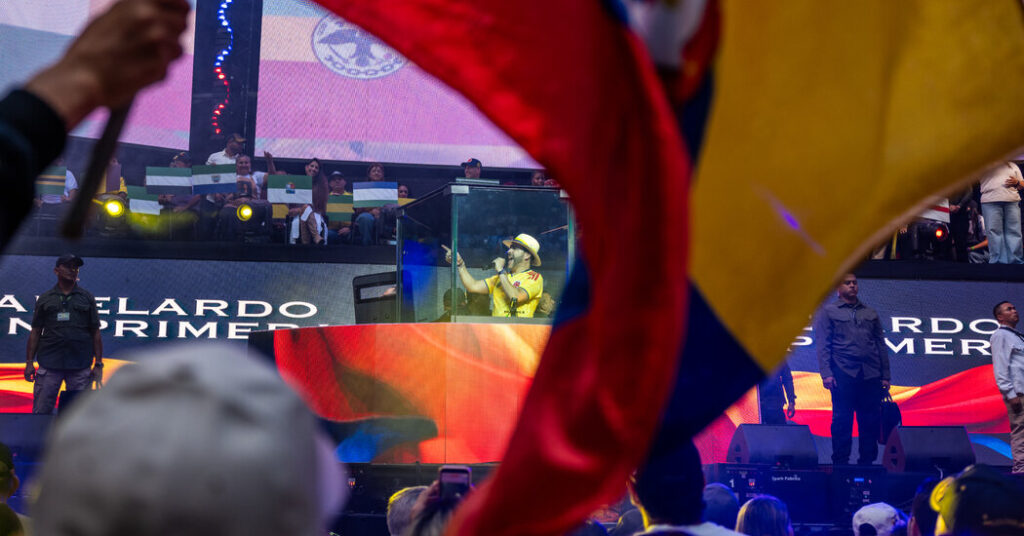
Abelardo De La Espriella, a criminal defense lawyer with no political experience who calls himself “The Tiger,” surged ahead of his conservative rival in Colombia’s presidential election on Sunday, to advance to a runoff.
He will face off on June 21 with a left-wing senator from President Gustavo Petro’s party. Along with building 10 mega-prisons, Mr. De La Espriella has promised he will crush his country’s armed trafficking groups.
“We are going to confront, defeat and punish the enemies of Colombia who want to destroy our homeland,” Mr. De La Espriella said in a speech in Barranquilla following the results.
His leftist opponent, Iván Cepeda, a longtime human rights defender, in contrast, has cautioned against excessive military force and has been vocal about what he calls “the failure of the war on drugs,” which he said has done little to slow the global trade.
If Mr. De La Espriella wins, it would be a trophy for Mr. Trump in the region, said Gimena Sánchez, the Andes director at the Washington office on Latin America, calling Colombia, “the number one ally for the U.S.”
Colombia is the world’s biggest cocaine producer and home to several major trafficking groups that the Trump administration has designated terrorist organizations.
As armed groups battle for control of cocaine routes and illegal gold mines, they have also spilled across Colombia’s borders into Venezuela, Ecuador and Brazil, key transit countries for cocaine.
Mr. De La Espriella centered his campaign on a promise to take drastic measures against the groups, as well as to crack down on urban crime, in what experts say amounts to a blend of Mr. Trump and President Nayib Bukele of El Salvador.
He has proposed constructing 10 privately-run mega-prisons “in the middle of nowhere,” and floated the idea of enacting “temporary” legislation to give his government far-reaching powers to lock up more criminals — drawing comparisons to the state of emergency El Salvador and Ecuador have used to deploy the military against gang members.
Mr. De La Espriella has vowed to bomb “narco-terrorist camps” on Day 1, and pledged to reclaim government control in conflict zones within 90 days.
He has also promised to go after coca production, calling cocaine “the source of all violence,” and has said he will eradicate 800,000 acres of coca plantations — an area about the size of Rhode Island — by restarting aerial fumigation, a technique that was banned after it was linked to health risks. (He has said he will use a safer chemical.)
Colombia has historically been one of America’s closest allies in Latin America. While collaboration has continued, experts say Mr. Petro, Colombia’s first left-wing leader, strained that relationship, denouncing Mr. Trump’s strikes on boats off South America’s coast that he claims are carrying drugs, as “murder.”
“The United States did not make it very private that they want a new president in Colombia that follows what the United States wants in the region,’’ Ms. Sánchez said, describing the Trump administration’s priority as securing new partners in a regionwide “narco-security cooperation effort.”
Through a newly-formed military coalition to eradicate cartels, the United States is seeking to persuade allies in Latin America to allow joint U.S. military strikes against criminal groups inside their territories, The New York Times has reported.
Mr. De La Espriella has suggested that while he would stop short of allowing U.S. military operations on Colombian soil — a red line for many governments in the region — he would enlist Colombia in the alliance, which includes nearly 20 Latin American countries.
Mr. De La Espriella’s rise represents a shift in the region from traditional conservative politicians toward MAGA-aligned figures, who promote militarizing law enforcement to address voters’ concerns about crime, said Vanda Felbab-Brown, a senior fellow at the Brookings Institution in Washington.
In Colombia’s runoff, voters will be asked, “Do they want to go essentially full throttle MAGA? And full-throttle Bukele?’’ Ms. Felbab-Brown said.
“De la Espriella,” she added, “is far right of right-wing.”
His strict security proposals worry some analysts, who say similar policies in El Salvador and Ecuador have resulted in human rights abuses.
Mr. De La Espriella has also taken an anti-migrant stance, promising to deport migrants who commit crimes in a country now home to as many as three million Venezuelans. He has also embraced conservative social positions that resonate with many voters in Colombia, a majority-Catholic country, including opposing abortion and the right of gay couples to adopt children.
He has pitched himself as pro-business and small-government, promising — like President Javier Milei of Argentina — to slash government spending, cut regulations, eliminate “useless” government agencies and root out corruption.
Mr. De La Espriella’s rival, Mr. Cepeda, represents a sharply different path on security.
Mr. Cepeda, who is best known for his work advocating for victims of Colombia’s long-running armed conflict, has said he will protect Colombians from violence. But he closed his campaign saying he would seek to pursue peace and reconciliation and stop the “violent cycle” that for decades has seen Colombian security forces attack armed groups, with mass casualties on both sides.
He has not said he will shelve Mr. Petro’s broadly criticized peace plan, “Paz Total” — or Total Peace — maintaining that negotiated settlements with armed actors are the only way to prevent more bloodshed.
His own security plan, he has said, will involve greater investment in conflict zones, supporting small farmers, creating jobs and assisting schools in preventing child recruitment.
In pushing back against the United States, Mr. Cepeda is taking a step away from Mr. Petro.
Mr. Petro often sparred with Mr. Trump, but he ultimately reassured the U.S. leader that his government was pursuing a full-out military assault on armed groups. At a White House meeting earlier this year, he conveyed that working with Colombia was Mr. Trump’s best bet for achieving his anti-narcotics aims in the region.
Mr. De La Espriella has leaned into a hard-liner’s image, giving speeches with his fist in the air. But he has rejected ideological labels, saying that his campaign was not “extreme right” but one of “extreme coherence.”
“I’m not defending ideologies, I’m defending foundational values and principles,” he said in recent interview with a Colombian influencer, citing family, liberty and security as the pillars of his campaign.
Mr. Cepeda, for his part, has sought to cast doubt on Mr. De La Espriella’s law-and-order message.
Invoking Mr. De La Espriella’s career as a criminal defense lawyer who frequently represented clients involved in controversies related to corruption and drugs, Mr. Cepeda called him a “swindler of swindlers,” who represents a “narco-trafficking, mafia-backed, plutocratic and corrupt past.”
Mr. De La Espriella has brushed aside scrutiny of his past, repeatedly saying that he has never been charged with a crime, and citing his legal career as proof of his commitment to the rule of law.
Some Colombians said they were concerned by his messaging. Juli Salamanca, the director of a trans health group in Bogotá, said she was supporting Mr. Cepeda for fear that Mr. De La Espriella might erode civil liberties and endanger hard-won rights.
“He represents all the hatreds of society,” she said.
Other voters disagreed. William Bohorquez, who attended a campaign event for Mr. De La Espriella in Barranquilla on Sunday night, said his candidate would steer Colombia back on course after years of “rudderless” leadership under Mr. Petro, especially in its relationship with the United States.
“Donald Trump sees that there is no interest from the current government in putting an end to drug trafficking or criminals,” Mr. Bohorquez said.
He added, “So, we want Abelardo to take an iron fist against crime and against the armed groups.”
Genevieve Glatsky contributed reporting from Bogotá.
Annie Correal is a Latin America correspondent for The Times.
The post Trump Stands to Gain an Important Ally in Colombia’s Upcoming Election appeared first on New York Times.