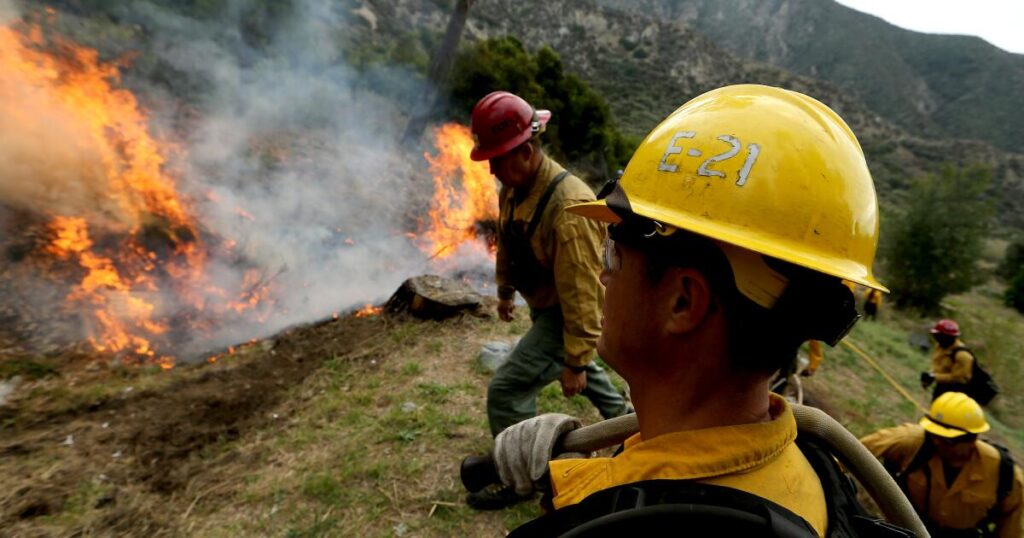
While most folks think that the U.S. Department of Agriculture focuses on farm policy, the largest agency within USDA is the Forest Service — famous for Smokey Bear and quietly doing significant work on many fronts.
As secretaries of Agriculture during the Clinton and Bush administrations, we spent years getting to know what this agency does: not only timber management but also stewardship of the 193-million-acre National Forest System across virtually every state and oversight of two-thirds of federal firefighting resources.
But now, the Trump administration has taken significant steps to dramatically change the agency, following an executive order last summer to consolidate the firefighting work of USDA and Interior. In January, the Interior secretary created the U.S. Wildland Fire Service, which brings together that department’s firefighting functions — but which does not yet incorporate the Forest Service.
While some changes to the service appear warranted and well-intentioned, others have been criticized as seemingly intended to dismantle this storied institution.
Most recently, the administration proposed to move Forest Service headquarters from Washington to Salt Lake City and consolidate its critical research functions into a handful of places, while closing 57 key research and other offices across the country. When the first Trump administration moved the Bureau of Land Management headquarters to Colorado, most of the agency’s leaders resigned rather than relocating, and their institutional knowledge and wisdom were lost. Other agencies have suffered similar fates when relocated. The work of the Forest Service is too important to be sacrificed cavalierly.
The agency is already reeling, having lost at least 6,000 employees through Department of Government Efficiency dismissals and other reductions.
In what could be the most significant change of all, the administration now proposes to transfer the Forest Service’s fire program to the Department of Interior. For more than a century under USDA, this program has managed forests through research-based techniques such as prescribed and controlled burning and maintenance of forest waste, aiming to prevent destructive fires.
With all of this change, we’re left with a pile of unanswered questions — the sort that the Trump administration should explain to Congress and the public.
What will this mean for firefighting? For relations with private landowners and Native nations? For the economies of the rural communities where most national forests are located?
Will these changes ultimately lead to selling off vast swaths of public land to private developers? That is a misguided notion that was once unthinkable but has unfortunately gained some traction in Congress.
How many employees will leave and what will be the effect on employee morale? How will the Forest Service be effectively managed with headquarters in Utah and operations in Washington, and how will the “streamlined” organization affect other operations of USDA and other land management agencies?
Will hiking, fishing and other recreation on public lands be affected by any loss of personnel?
These are only a few of the many questions that need to be answered if we are to maintain effective management and stewardship of some of our greatest national treasures.
During our tenures leading USDA, we both worked to streamline various programs and to right-size the workforce. Reorganizations of government agencies can reinvigorate calcified bureaucracies, and we strongly support pursuing thoughtful and well-reasoned opportunities to save taxpayer dollars.
However, when leaders undertake significant changes, they need to be driven by data, based on compelling evidence and carefully reviewed facts — not based on ideology or simply meant to “shake things up.”
So, if the federal government is going to move the Forest Service, reorganize its parts and further downsize this agency, every American should demand that key questions be answered first. Members of Congress should lead the charge through effective and bipartisan oversight.
There may be good reasons to make changes to the 120-year-old agency that President Teddy Roosevelt, our great conservationist president, wisely moved to USDA at the beginning of the last century. But so far, the administration has not effectively outlined those reasons for the public, and it has not asked for their input or feedback in any substantial way. Nor has Congress been meaningfully involved, an absolute and vital requirement for a change of this scale. The administration has not made the case or provided data to justify such an upheaval.
As we approach the 250th anniversary of our country this summer, millions of Americans will be traveling to enjoy our great natural resources, including our national forests. They will be enjoying a legacy articulated by Daniel Webster, memorialized on the wall behind the speaker’s chair in the House of Representatives: “Let us develop the resources of our land, call forth its powers, build up its institutions, promote its great interests and see whether we also in our day and our generation may not perform something worthy to be remembered.”
Protecting and sustaining the continued wise stewardship of America’s forests and forestry institutions is something worthy to be remembered.
Smokey Bear would demand no less.
Dan Glickman and Ann Veneman are former secretaries of Agriculture, serving under Presidents Clinton and George W. Bush, respectively.
The post The Forest Service is too important to be a political pawn appeared first on Los Angeles Times.