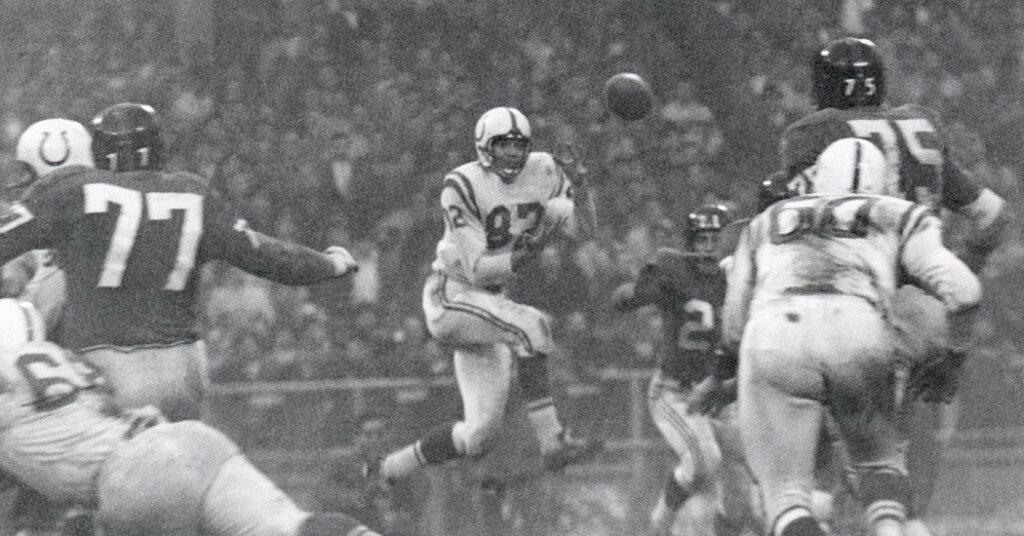
Raymond Berry, the nonpareil wide receiver for the Baltimore Colts whose sticky fingers and crisp pass patterns made him a favorite target of Johnny Unitas and the leading pass catcher in pro football history at the time of his retirement, died on May 25 in Murfreesboro, Tenn. He was 93.
His death was announced by the Pro Football Hall of Fame, into which he was inducted in 1973.
Berry was an unlikely star. He didn’t distinguish himself as a receiver in college. A string bean at 6 foot 2 and well under 200 pounds, he was neither physically imposing nor lightning fast. But he marshaled a relentless work ethic and a perfectionist’s discipline in polishing the precise footwork, deceptive swivels and knife-edge cuts that allowed him to carve out holes in a defense.
His eyesight was poor, and the pinkie on his left hand was bent askew, a result of myriad dislocations. But he was a shrewd analyst of his craft: He reportedly delineated 88 ways of evading a defender to catch a pass.
Berry was a strong leaper capable of contortions in midair, and even with just nine good digits he had flypaper hands — he squeezed Silly Putty to strengthen them — and rarely dropped a pass he should have caught or fumbled once he caught it.
For four seasons, 1957-60, he was arguably the best receiver in the game, leading the National Football League three times in receptions, three times in receiving yardage, twice in receiving touchdowns and twice in receiving yards per game. In a 13-year career, 1955-67 — spent entirely with the Colts — he played in six Pro Bowls and caught 631 regular season passes for 9,275 yards, on both counts more than anyone who came before him.
“Raymond had none of the characteristics you normally attribute to a great pass receiver,” Weeb Ewbank, who coached Berry for eight seasons with the Colts, said at Berry’s induction into the Hall of Fame, in Canton, Ohio. He added, “However, Raymond’s pass patterns were so minutely perfected that he was almost unstoppable.”
Of course, Berry also had a not so secret weapon. Most of the passes he caught were thrown by Unitas, often judged the finest quarterback in history. So attuned to each other on the field that their connection seemed telepathic, the two played together for Berry’s entire career and led the Colts to two championships, in 1958 and 1959.
Unitas and Berry provided a template for the passer-receiver combinations that came to dominate professional offenses as passing superseded running in the modern game plan. One sign of how much football has changed on the field since Berry’s retirement is that he has slid to 83rd in career receptions and 68th in receiving yardage.
(A sign of how the game has changed off the field is that on a Sunday afternoon in November 1958, Berry played in a Colts loss to the Giants at Yankee Stadium, and that night, bespectacled and soft-spoken, he was able to sign in with his real name as the mystery guest on the television show “What’s My Line?”)
Berry, who scored 68 regular season touchdowns, was not simply a consistent receiver; he was also an athlete who rose to the occasion. In the 1958 championship game, a rematch with the Giants that has since been lionized (with considerable hyperbole) as “the greatest game ever played,” Berry caught 12 passes, a record for an N.F.L. championship game that stood until 2014.
The 1958 game is generally deemed responsible for establishing the widespread popularity of pro football; televised nationally, it was the first N.F.L. postseason contest to go into overtime. The Colts, behind by three with two minutes to play, moved nearly the length of the field for the tying field goal, from their own 14 to the Giants’ 13, a drive that included three consecutive completions from Unitas to Berry.
In the overtime period, Berry caught two more passes on the decisive drive as the Colts won, 23-17. The following year, Berry caught five passes as the Colts repeated as champs, beating the Giants again, 31-16.
Raymond Emmett Berry was born on Feb. 27, 1933, in Corpus Christi, Texas, and went to high school in Paris, Texas. Even though his father was the school’s football coach, Raymond wasn’t a starter on the team until his senior year.
He played junior college football for a year and then attended Southern Methodist University, where he caught just 33 passes in three seasons, barely drawing interest from the pros; he was the 232nd overall pick in the draft. His Hall of Fame biography reads, in part: “Why the Baltimore Colts selected him, even as a ‘future choice’ on the 20th round of the 1954 draft, is a mystery.”
Berry is survived by his wife of 65 years, Sally; three children; and nine grandchildren.
After his playing career, Berry served on the coaching staffs of several N.F.L. teams. For five and a half seasons he was the head coach of the New England Patriots, a team he led to the Super Bowl in January 1986 in his first full season with them; the Patriots lost to the Chicago Bears, 46-10.
In 1973, after Berry’s election to the Hall of Fame, the sportswriter William N. Wallace of The New York Times called him “an innovator who never came unprepared.”
“He had his wife, Sally, throw to him during the off-seasons, and the worse the passes the better he liked it,” Mr. Wallace wrote. “Among the pros, he invented the off-target drill, footballs thrown by anyone handy toward a net so that Berry would have to dive or leap to catch them. He invented runner goggles to wear against the sun in the Los Angeles Coliseum. He was the first receiver to use goal posts as screening devices against defensive backs. He always wore full equipment pads and helmet at every practice regardless of the heat, and he and Unitas worked many overtime hours, perfecting pass plays.”
The post Raymond Berry, Hall of Fame Receiver for Champion Colts, Dies at 93 appeared first on New York Times.