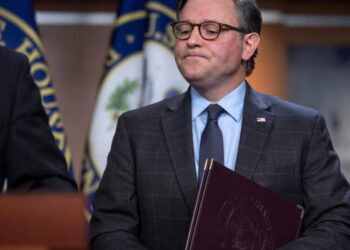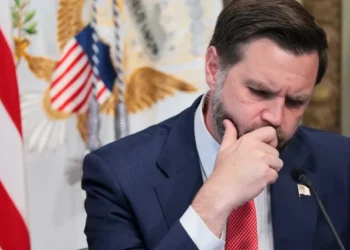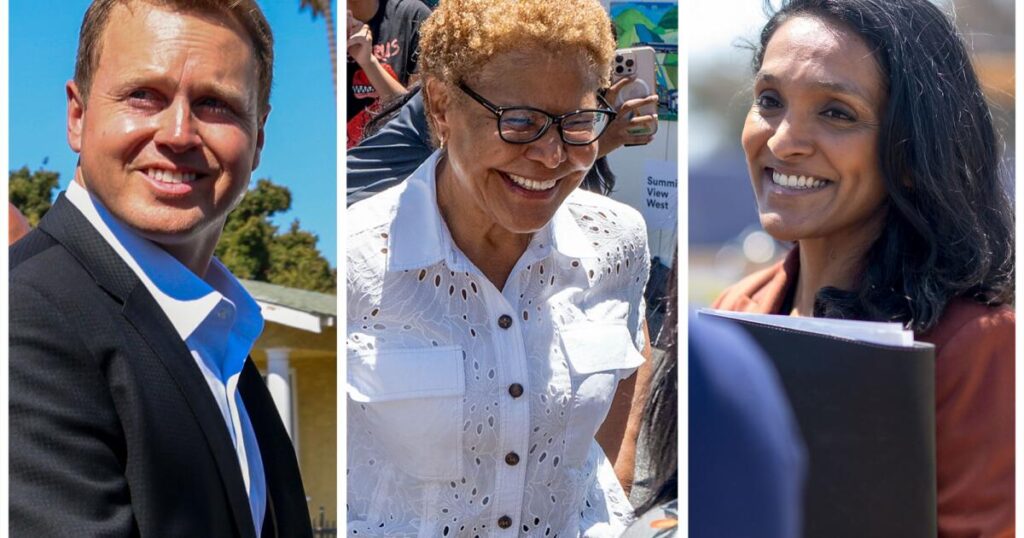
An embattled mayor. A brainy democratic socialist. A reality TV star who has been a staple on TMZ.
The top three candidates for Los Angeles mayor — incumbent Karen Bass, Councilmember Nithya Raman and Spencer Pratt of MTV’s “The Hills” — are fighting to secure an edge in Tuesday’s primary, capping one of the most unusual election seasons in city history.
L.A. voters have seen the arrival of AI campaign videos, an influx of dark money mailers and national media coverage from US Weekly, Vanity Fair and many other outlets, thanks in large part to Pratt.
Raman is neck and neck with Bass, with Pratt close on their heels, according to the most recent poll from the UC Berkeley Institute of Governmental Studies, which was co-sponsored by The Times.
“I definitely think anyone has a shot,” said Parke Skelton, a Democratic political strategist who worked for Bass’ first mayoral campaign. “There’s two chairs and three contestants, and the music will stop and one will be without a chair.”
If none of the candidates wins a majority in Tuesday’s primary, the top two vote-getters will face off in the Nov. 3 general election.
Such a close contest would have been unthinkable two years ago. In 2024, Bass was riding high in the polls and an array of politicians, including Raman, relied on her endorsement for their own campaigns.
But Bass’ approval ratings nosedived after the Palisades fire, which destroyed thousands of homes and left 12 people dead.
Angry residents of Pacific Palisades, including Pratt, who lost his home, railed at city leaders over an empty reservoir, poor deployment of Fire Department resources and the fact that it was caused by a week-old blaze that wasn’t fully extinguished. On the day the fire erupted, amid increasingly urgent forecasts of high wind warnings, the mayor was away on a diplomatic trip to Ghana.
Bass now finds herself battling for a second and final term, one that would cap a political career that has already taken her to Sacramento and Washington.
On the campaign trail, Bass has pointed to a 17.5% reduction in “street homelessness,” the number of people living outdoors or in their vehicles. She’s touted a drop in violent crime, including a homicide rate not seen since the mid-20th century. She’s talked up her push to convert darkened streetlights, many of them stripped of their copper wire, to solar power.
“We’ve laid a foundation,” she told The Times last week.
Raman, who endorsed Bass’ reelection bid only to launch a surprise campaign to unseat her, said the incumbent lacked urgency on an array of issues, including production of new apartments, fixing deteriorating streets and sidewalks, and halting the exodus of entertainment industry jobs.
Voters are “hungry for a different future for this city — one that is affordable, functional, creative, and safe,” Raman said in a statement.
When she launched her campaign, Raman positioned herself as an opponent of the status quo. But she was upstaged on that front by Pratt, who has portrayed both her and Bass as part of a failed City Hall establishment.
Pratt, a Republican, has been depicting the city as a hellhole filled with drug-addicted homeless “zombies.” He has talked about moving them to federal lands and vowed to ensure that police enforce all the city’s laws.
“The people I’m surging with are the people having to step over the naked drug addicts and step into human poop to get their $20 matcha,” he told Greg Gutfeld, host of late-night show “Gutfeld!” on Fox News, last week.
Pratt even received a shout-out from President Trump, who said he’d heard that Pratt is “a big MAGA person.”
The fight to become L.A. mayor is actually one of 10 contests raging at City Hall right now. City Atty. Hydee Feldstein Soto is facing her own tough reelection, with three candidates looking to make her a one-termer.
City Controller Kenneth Mejia has been facing an aggressive challenge from real estate executive Zach Sokoloff, whose campaign has gotten an enormous boost from his mother, Sheryl Sokoloff. By Friday, she had put $7.5 million of her own money into attack ads and other campaign efforts aimed at promoting her son.
There are also the seven competitive council races. Four of them have candidates backed by the Democratic Socialists of America, which is looking to push the city’s policies further left. The DSA’s L.A. chapter is also campaigning for Deputy Atty. Gen. Marissa Roy, who is looking to unseat Feldstein Soto.
The Central City Assn., relying heavily on funding from Airbnb, has been working against those efforts. The downtown business group is pushing for Deputy Dist. Atty. John McKinney, who is also looking to unseat Feldstein Soto. It’s also supporting several council candidates who are closer to the political center than their DSA rivals.
Some DSA council candidates have also faced attacks from Neighbors First, a so-called dark money 501(c)(4) nonprofit group because it’s not required to reveal the source of its funding.
In the mayor’s race, each of the top three candidates occupies a different spot on the political spectrum.
Bass is a lifelong Democrat who served in the state Legislature — including as Assembly speaker — and a dozen years in Congress. She has argued for humane treatment of L.A.’s homeless population and pushed for a ramp-up in hiring at the Los Angeles Police Department.
To her left is Raman, who had support from the DSA during her two winning council campaigns. She is also a YIMBY — part of the Yes in My Backyard movement — someone who wants to dramatically ramp up housing production, including in single-family neighborhoods.
Raman, whose husband, Vali Chandrasekaran, is a prominent Hollywood writer and producer, was heartily embraced by the left in her first council campaign but steadily moved toward the center on police hiring and other issues in recent years.
Pratt, who has appeared twice on Infowars’ “The Alex Jones Show,” has relied on a number of Republican political operatives to power his campaign. He has also picked up plaudits from GOP politicians and Trump-aligned media figures.
“There’s no real front-runner,” said Sara Sadhwani, a political science professor at Pomona College. “The margin of error is so tight that this race is completely up in the air.”
Trailing far behind are two other candidates — community organizer Rae Huang, a leftist who has criticized Raman as too moderate; and tech entrepreneur Adam Miller, a centrist Democrat who promised to bring his managerial skills to City Hall.
The campaign had been mostly sleepy until Pratt, who has his own extensive Hollywood ties, put in a solid debate performance on live television. Known for his bad-boy persona on reality television, he gave hope to Republicans and MAGA faithful who dream of an end to Democratic control of a deep blue West Coast city.
If Pratt makes the top two, he will still face a steep uphill climb. Fewer than 15% of voters are Republican, compared with 55% Democrats, according to party registration figures from April.
In head-to-head matchups with Bass and Raman, Pratt was down by double digits, according to the Berkeley-Times poll released last week.
Pratt has repeatedly pointed out that the mayoral election is nonpartisan. But that hasn’t stopped Raman from taking aim at his GOP connections, especially his appearances on Infowars and his remarks in 2009 about 9/11 being “an inside job.”
In one campaign video, Raman warned voters that Pratt would make the city “a lot more hateful and a lot more stupid.”
Pratt, appearing on CNN last week, said he is a “very different person” than the one he was nearly two decades ago. He also fiercely criticized Raman for opposing a law barring homeless encampments next to schools.
“This radical socialist is a serious threat to your kids,” Pratt posted on X.
In some ways, the mayor’s race resembles the 2005 municipal election, when then-Mayor James Hahn faced a quartet of challengers: then-Councilmembers Antonio Villaraigosa and Bernard C. Parks, a former police chief; former Democratic Assembly Speaker Bob Hertzberg and Democratic state Sen. Richard Alarcon.
Hahn was under fire from voters in South L.A., who criticized him for ousting Parks as police chief, and in the San Fernando Valley, where he had successfully defeated a secession movement. He made the top two but lost to Villaraigosa in the runoff, serving a single term.
Raphael Sonenshein, who runs the Haynes Foundation, which funds research on governance in Greater Los Angeles, said the contest bears some similarities to 1989, when incumbent Mayor Tom Bradley was running for a fifth and final term.
That year, Bradley faced a challenge from then-Councilmember Nate Holden, who blasted the incumbent over public safety and quality of life issues. Councilmember Zev Yaroslavsky considered a run against Bradley as well, but decided against it.
This time around, Sonenshein noted, political heavyweights such as real estate developer Rick Caruso and county Supervisor Lindsey Horvath eyed the contest only to stay out.
Still, Angelenos are far more dissatisfied with the direction of the city than they were in 1989, he said.
“It’s a harder road for incumbents,” he said. “It certainly wasn’t like that in L.A. decades ago.”
Times staff writer Sandra McDonald contributed to this report.
The post It’s a fight to the finish in L.A.’s wild mayoral primary appeared first on Los Angeles Times.