A divided federal appeals court on Monday blocked the Trump administration from removing more than two dozen transgender service members from the military while a lawsuit fighting their dismissal is decided.
The 2-to-1 ruling by the U.S. Court of Appeals for the District of Columbia Circuit is the latest legal salvo over a divisive policy that has forced out thousands of troops and left thousands of others in limbo for more than a year.
Monday’s ruling applies only to 28 plaintiffs, but those plaintiffs have asked the court to extend the protection to all transgender troops. A hearing is scheduled this month.
The lawsuit was filed last year by the transgender service members after the Trump administration banned them from serving. Monday’s ruling allows those who are now in uniform to continue serving while the case proceeds, though it allows the administration to bar transgender recruits.
It was unclear whether the government would appeal Monday’s decision. The Defense Department did not respond to requests for comment. In a similar case last year, the Supreme Court quickly overturned an appeals court decision allowing troops to remain in uniform.
In a written majority opinion for the three-judge panel, Judge Robert L. Wilkins, who was appointed by President Obama, wrote that the government had shown little evidence that transgender troops harm military operations, and that the Trump administration’s policy instead seemed to be “driven by the bare desire to harm a politically unpopular group.”
The decision was joined by Senior Judge Judith W. Rogers, who was appointed by President Clinton.
In a dissenting opinion, Judge Justin R. Walker, who was appointed by President Trump, said courts did not have the expertise or authority to make decisions about the military, adding, “The Constitution assigns that authority to Congress and the Commander in Chief.”
Days after taking office in 2025, President Trump signed an executive order saying that transgender troops had afflicted the military with “radical gender ideology,” and that the “adoption of a gender identity inconsistent with an individual’s sex conflicts with a soldier’s commitment to an honorable, truthful and disciplined lifestyle, even in one’s personal life.”
A short time later, Defense Secretary Pete Hegseth issued a policy that would force out all transgender troops.
About 4,200 openly transgender people were in the military last year, according to government court filings — about 0.1 percent of the armed forces. They worked as infantry platoon leaders, pilots, nuclear engineers, doctors, intelligence analysts, police and other key professionals.
In the past year, many have left voluntarily rather than face uncertainty — and possible harm by contesting the new policy. Hundreds of others have stayed, insisting that the military put them before retention boards, consisting of fellow service members, and force them out — a likely foregone conclusion given the president’s order.
Many of those members are still in uniform, unable to work, but still getting paid by the government.
One lawyer representing the troops challenging the ban, Shannon Minter, called the ruling a major victory.
“This will have an immediate positive impact on the lives of people who just want to serve their country, but have been through a long, dispiriting ordeal,” he said. “My clients feel vindicated that a court said what happened to them is wrong.”
Last year, after the Pentagon issued its policy to accomplish the president’s executive order, two groups of service members and potential recruits sued in separate cases, contending that the policy discriminated against them and violated their constitutional rights.
In both cases, federal judges quickly blocked the policy from taking effect while the cases were decided. In one case, filed by the lead plaintiff Emily Shilling, a decorated Navy aviator, a federal appeals court upheld the decision to block the policy, but the U.S. Supreme Court overturned the lower court in May, allowing the ban to take effect.
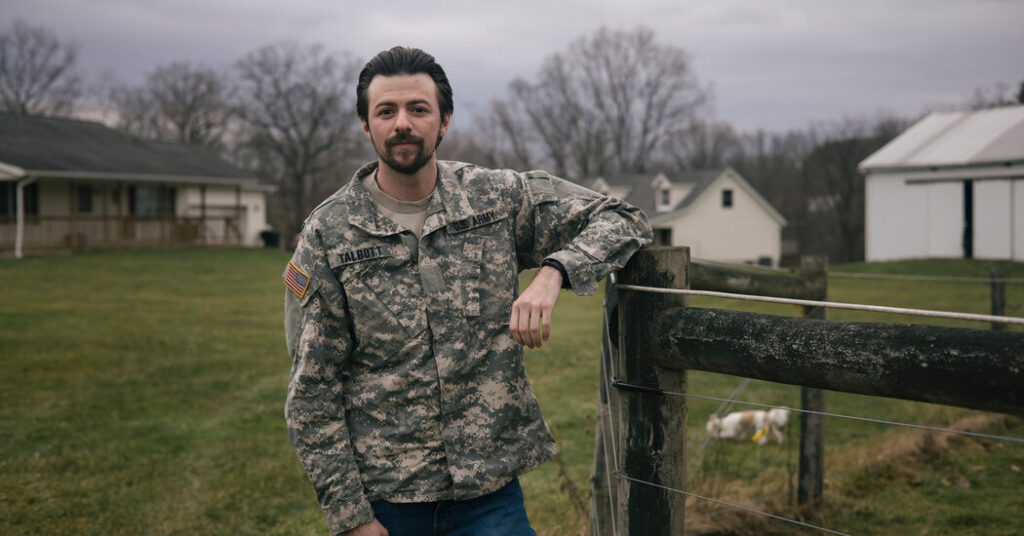
Monday’s ruling came in the case of the lead plaintiff Nicholas Talbott, a second lieutenant in the U.S. Army Reserve.
Mr. Minter said that while the groups of plaintiffs in both cases were similar, the legal arguments were different, and the Talbott case might have a better chance of surviving Supreme Court scrutiny.
The Shilling case, he said, focuses on whether discrimination against transgender people is sex discrimination. The Talbott case focuses on whether the Trump policy unfairly directs hostility and prejudice against a group of people.
Mr. Minter said the latter argument has simpler reasoning with a more established precedent. “You never know,” he added. “But it would actually be pretty extraordinary for the Supreme Court to intervene on this one.”
Dave Philipps writes about war, the military and veterans and covers The Pentagon for The Times.
The post Appeals Court Says 28 Transgender Troops Who Sued Can Remain in Military appeared first on New York Times.