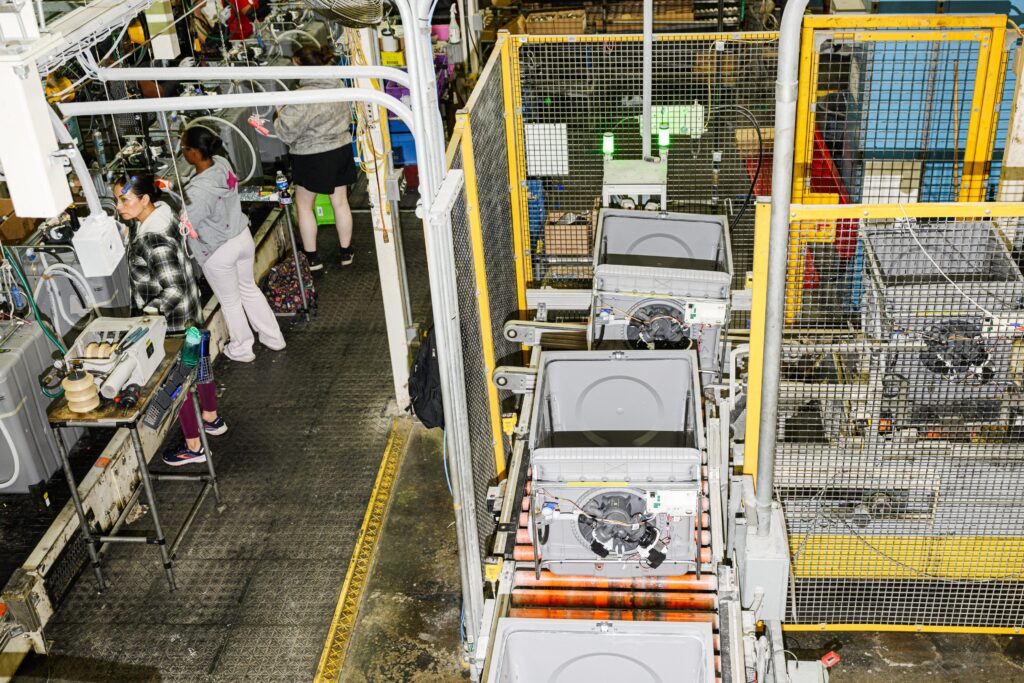
LOUISVILLE — For several decades, the sight of an empty factory in the American heartland usually meant one thing: More manufacturing jobs had decamped to a foreign locale.
But here at GE Appliances’ sprawling industrial headquarters, a vacant plant is a sign that jobs are coming home. This 1950s-era facility, one of five that turns out home appliances under familiar GE brands such as Hotpoint and Profile, is preparing to reclaim a manufacturing line that currently hums in China.
If all goes well, about 800 American workers will begin producing a combination clothes washer and dryer here next spring. The work, which also includes a line of front-load washers, will mark a milestone in GE Appliances’ $6.5 billion, 13-year bid to boost domestic manufacturing.
This reshoring success story has drawn plaudits from the White House, even though a Chinese corporation now owns GE Appliances and its American boss complains about President Donald Trump’s tariffs.
As the United States races to produce more of what it consumes, GE’s experience shows that bringing work home offers real advantages over ocean-spanning supply chains. But reviving domestic production means overcoming daunting obstacles, including relentless cost pressures, young Americans’ aversion to factory jobs and gaps in the nation’s industrial base.
“This should be a good proof case of, yeah, this can work. Is it easy? No. And do we have a lot of things working against us? Yeah,” said Kevin Nolan, GE Appliances’ chief executive.
What GE is trying has been a central Trump objective since he entered politics more than a decade ago, promising to quickly reverse a loss of manufacturing jobs that he attributed to faulty trade deals. Yet even as GE and other U.S. companies continue repatriating work that had migrated to low-wage venues, the labor market impact has been hard to discern.
U.S. factories employ 12.6 million workers today, virtually unchanged from April 2018, when Trump began imposing tariffs on China.
Once part of a business launched by famed inventor Thomas Edison, GE Appliances was sold to China’s Haier Group for $5.6 billion in 2016. The Chinese company, perhaps best known in the U.S. for its compact refrigerators, set out to revitalize a famous American brand by doubling down on local know-how.
GE’s reshoring initiative is a noteworthy break with its corporate lineage. When General Electric owned the business, then-CEO Jack Welch was an outspoken advocate of moving jobs to low-wage countries, once saying half-seriously that he wanted to put factories on barges that could sail wherever costs were lowest.
Haier, which has more than 60 factories outside China, has pushed into global markets to offset the impact of a property market collapse at home. In recent years, the company has shifted from a “China-centric” supply chain to a more decentralized approach, in part to get inside Trump’s tariff wall.
Delegating authority to Nolan is part of what Haier calls its “zero distance” strategy of making products where they will be sold. Nolan, a mechanical engineer who became CEO in 2017, is an evangelist for U.S. manufacturing. Early in his career, he fretted over lost national prowess as GE closed factories in Connecticut and North Carolina and moved work to low-wage nations. Later, working in China and South Korea, he learned that Asian manufacturing was a story of streamlined operations and skill, not just cheap labor.
Now that the conventional wisdom in Washington has shifted in favor of making more goods at home, GE is showing that domestic manufacturing delivers new products, tailored for Americans, faster, by having engineers working where their designs are produced, he said.
But he confronts a catch-22: To reduce his dependence on foreign suppliers, he needs first to import new factory equipment from foreign suppliers. The Trump administration is not making it any easier.
GE spends $4.6 billion per year with roughly 6,500 U.S. suppliers, up from 2,500 in 2019. But after decades of globalization, some key components — such as wiring harnesses — are no longer made in large volumes in the United States.
“The equipment I need to put in that factory, it’s not made in America. We’ve got drum lines coming from New Zealand. We need some stuff from China,” said Nolan. “But the equipment I’m bringing over, we’re paying tariffs on it that are insane.”
Suppliers will not invest in new U.S. capacity unless they are convinced that large customers like GE Appliances will buy from them over the long haul. And Nolan says tariffs are making that harder. He wants the government to permit tariff-free imports of equipment that is not available from a U.S. supplier.
The administration has made some factory construction more affordable. In April, the president cut tariffs to 15 percent from 25 percent on “certain metal-intensive industrial equipment and electrical grid equipment,” to support expansion of the industrial base.
But trade policy overall remains disconnected from the factory floor, Nolan said.
“We don’t have many leaders around here that have grown up in plants. So you’ve got people putting policies together that really aren’t talking to the people that are in there, that are fighting these struggles and know what the problems are,” he said.
Kush Desai, a White House spokesman, said the administration is promoting the return of manufacturing using “targeted tariff relief actions in addition to a broader pro-growth agenda of tax cuts, energy abundance, and deregulation.”
The emergence of a Chinese-owned company as an emblem of U.S. reshoring, however, has stirred unease among some White House allies. Nick Iacovella, executive vice president of the Coalition for a Prosperous America, which promotes domestic production, said the Chinese government could exploit GE’s Internet-connected appliances to access consumer data.
“They now own an asset in the United States that’s making appliances. Could they weaponize that company if they needed to? The answer is yes, absolutely,” he said.
Iacovella acknowledged there is no evidence that has happened, and Nolan dismissed the concerns as unfounded, saying no one in China could access GE’s systems.
“We operate under U.S. law, and protecting consumers’ data is nonnegotiable. We do not share consumer personal data with anyone in China, no one in China has access, and in the decade since the acquisition, no one from China has ever asked for that data,” Nolan said. “And if they ever did, I would not allow it.”
For GE, choosing whether to import a component or make it in the U.S. is a case-by-case decision. The key is reducing the amount of labor needed per unit to between one and three hours. At that level, savings from not having to ship products across the Pacific Ocean, coupled with this site’s inexpensive electricity and ample water, compensate for higher U.S. wages.
“Down under three hours, two hours, labor doesn’t matter anymore,” Nolan said.
Automation is ultimately what makes a larger U.S. manufacturing footprint possible. After one of GE’s water filter suppliers moved to Mexico, the company opted to make the products in house, using its most highly automated operation, with cameras, robotic arms, artificial intelligence and autonomous mobile robots.
Just seven workers are needed to monitor a line that produces nearly 10,000 filters every shift.
Introducing robotic production eliminated the need for three equipment operators. But rather than laying them off, GE reassigned them to work industrial presses that will be part of the reshored laundry unit, said Brian Schwarz, the plant manager.
“What we’re trying to do is not use automation to take away jobs but to use automation to create jobs,” he said.
Nolan has high hopes for job growth as a domestic factory “ecosystem” sprouts. But manufacturing jobs can be a tough sell to young workers dazzled by Silicon Valley. And the number of jobs associated with bringing work back from low-wage nations or expanding domestic manufacturing is likely to be limited, said Willy Shih, a supply chain expert at Harvard Business School.
Although factory wages in China have risen rapidly in recent years, Chinese workers make just one-fifth of their American counterparts’ pay, he said.
“There are still people moving production offshore because it’s cheaper,” Shih said.
GE Appliances has added around 4,000 U.S. jobs since 2016, but more than half of them came from organic growth in the business rather than reshoring, the company said.
Inside the plant that is being overhauled, blandly labeled “Building 2,” giant excavators are digging pits for 30-inch-thick concrete pads that will support the massive presses needed to pound coiled steel into shape.
The plant was constructed in 1951 to meet surging postwar demand for consumer goods. When GE decided to move the combo washer-dryer program back to the U.S., executives considered starting afresh. But everything that made this factory productive when it opened makes it attractive today, said Kelley Brooks, the 28-year GE veteran overseeing the modernization.
The building’s concrete floors are eight inches thick. Its towering columns stand 100 feet apart, making it roomier than modern warehouse-style facilities. Overhead supports easily bear the weight of several 40-ton cranes.
“I know it’s a cliché to say, but they just don’t build them like this anymore,” Brooks said.
Crews began emptying this Korean War-era facility late last year. So far, they have recycled 3.5 million pounds of scrap, roughly equivalent to 875 passenger cars, and hauled away enough dirt to fill at least 10 fully loaded Boeing 747 aircraft. The upgrade cost GE $490 million.
Many of the executives involved in today’s reshoring moved work offshore during globalization’s heyday. After years of pandemic, war and supply chain upset, they now demand bigger savings before choosing foreign suppliers.
“I think people have realized all the hidden costs associated with sourcing elsewhere,” said Bill Good, executive director of supply chain.
Roughly three-quarters of product cost stems from decisions made before production begins, which Good calls the “design shadow.”
Make something easier to produce, and the cost will shrink. Years ago, for example, the door for one of GE’s refrigerator models included dozens of parts that had to be installed manually. After investing several million dollars in new injection molding machines, GE now molds those doors in a single operation, driving costs down, said Tim Vibbert, who manages GE’s dishwasher production.
The former Apache attack helicopter pilot led an effort to ensure that most of his plant’s products could be produced on multiple assembly lines. That flexibility means fewer costly disruptions if one line is interrupted, he said.
Later this year, Vibbert expects to bring a dishwasher door, now being made in a low-wage country, back to this factory, where it will be produced on a highly automated line.
“It’s a supplier that makes it, and they make a great product,” Vibbert said. “But I can make it cheaper. And I can make it here.”
The post Why a Chinese-owned company is bringing factory jobs back to the U.S. appeared first on Washington Post.