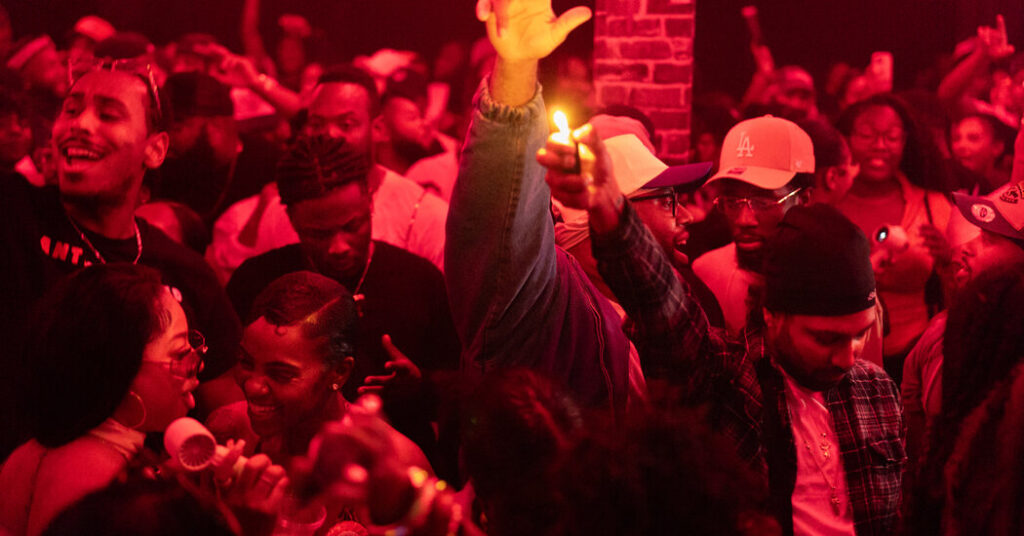
Even the aluminum vents in this Toronto basement were sweating, dripping condensation over the partygoers while they undulated to dance hall classics.
As if under a spell, the crowd obeyed the choreography called out by the D.J. — row the boat, step left and then right, show off your sneakers — as he spun “Clarks,” a 2010 party anthem extolling the British footwear brand that is popular in Jamaica.
But Converse, Vans and Nike Air Force 1s were the dominant shoe choice on this Saturday night in May, accessorized to match the Y2K-era aesthetic: sideways caps, basketball jerseys worn over white T-shirts, Baby Phat and Adidas tracksuits, visor sunglasses and splashes of denim, camo print, bubble gum pink and baby blue.
The dance floor, on the subterranean level of a nightclub, was a tableau of a forgotten Toronto party scene, one that had mostly faded by the late 2000s: the basement jam.
Now, driven by nostalgia for a simpler time unencumbered by nightclub politics like strict dress codes or the pressure to spend money on private booths and bottle service, some Toronto millennials have spurred a revival.
“The basement jam is a pure form of party,” said Tristan Dunn, 32, fresh off the dance floor in vintage denim overalls with one buckle undone. “There’s no booth. There’s no bottles. There’s no pretentiousness.”
The parties, also called “bashments,” became popular in the late 1960s as immigrants from the Caribbean hosted gatherings at home, especially in winter, when backyards were covered in snow. Invitations came strictly through word of mouth.
As the original generations aged out of hosting and night clubs provided an alternative setting, basement jams all but disappeared.
“The people who probably would have thrown basement jams, we still live with our parents,” said Ashley Henry, 30, who is of Jamaican heritage. “There is a real need that people in the diaspora and my community also have to go to these events. They just don’t exist,” she added.
Spotting an opportunity, Ms. Henry and two of her friends, Shaunalee Bennett and Ilya Mogg, founded an entertainment company called Uncle Delroy three years ago that puts on cultural events like dance hall karaoke and basement jams. It is a side hustle for the women, all of whom work full-time jobs, and events frequently sell out.
“We want everybody to feel like you’re at a family gathering,” said Ms. Henry, adding that the name “Uncle Delroy” was a nod to the stereotypical Jamaican uncle. “Many people think he’s a real person. We don’t correct them.”
Back in the day, basement jams were multigenerational and took place mostly in suburban homes, like the bungalow in east Toronto where Cheryl Thompson grew up.
“You wouldn’t have left us with Grandma, because she was at the party,” said Dr. Thompson, an associate professor at Toronto Metropolitan University who studies and teaches Black culture. The suburbs became a nightlife destination and a place to hear records, often stowed away in wooden crates shipped from Jamaica, that weren’t played on the radio. “The house ‘bashment’ was actually better than the club,” she said. “You would prefer to go there than to go downtown.”
That was also in large part because of racism in that time, Dr. Thompson said.
Today, Ms. Henry, an Uncle Delroy founder, says that Black patrons are sometimes treated differently when trying to enter venues in Toronto’s club district, particularly when it comes to dress code violations that seem arbitrary.
While the parties were once family affairs, the bash hosted by Uncle Delroy in the basement of a Toronto club in May was decidedly more provocative, a reflection of how hip-hop culture has evolved. The dancing was sinuous and athletic. Women bent at the hips and gyrated as if blending paint on a wall with their glutes, a move called a “bubble.” Some men danced happily behind, or “caught a bubble.”
“It’s one of the rare parties where everybody’s consistently dancing,” said Dana Cox, 37, who was taking a break to hydrate at the bar. “It feels very nostalgic.”
Steam from the heat of dancing bodies had fogged up the mirrored walls by 3 a.m. Partygoers banged on the vents, copying an old fad. Marijuana smoke wafted.
The soundtrack of the night was a love letter not just to dance hall throwbacks, but also to the city itself. The crowd broke out in song when Drake’s 2011 song “Trust Issues” came on. They swayed to the melodic steel drum of “Gwan Big Up Urself” by Roy Woods, a singer from the nearby city of Brampton, Ontario.
Basement jams also gave Toronto a spotlight on the world’s cultural stage, providing viral visuals in music videos like the one for the 2002 hit “Get Busy,” by Sean Paul.
Julien Christian Lutz, the music video’s Canadian director, who is better known as Director X, filmed it in Toronto’s suburbs, recreating the winter scene familiar to his upbringing in a West Indian household. Large parts focus on the dancers, whose style Mr. Lutz attributed to a blend of Afro-Caribbean and Canadian culture that was specific to Toronto.
“I found that there was a different flavor to the kids in the way they dance,” he said.
In the video, Mr. Paul hops out of a pickup in an oversize puffer jacket and enters a house. He greets the parents and steps into an unfinished basement where a party is in full roar.
“Canada played a huge part in my career,” Mr. Paul said in an interview, describing the many summers he had spent visiting his grandfather and extended family in east Toronto. In Jamaica, he was raised attending such family parties in the backyard, complete with a sound system and dance floor.
He deflects other people’s praise for expanding dance hall music’s reach, pointing instead to genre greats like the producer Steven Marsden, known as “Lenky,” who made the syncopated beat called “Diwali Riddim” pulsing beneath “Get Busy.”
The song boomed over the speakers early in the night at the Uncle Delroy basement jam, warming up the room as people trickled in. The bass line vibrated through the ground, as if sending a current across the dance floor.
Vjosa Isai is a reporter for The Times based in Toronto, where she covers news from across Canada.
The post Toronto’s Best Party Was Always Downstairs appeared first on New York Times.