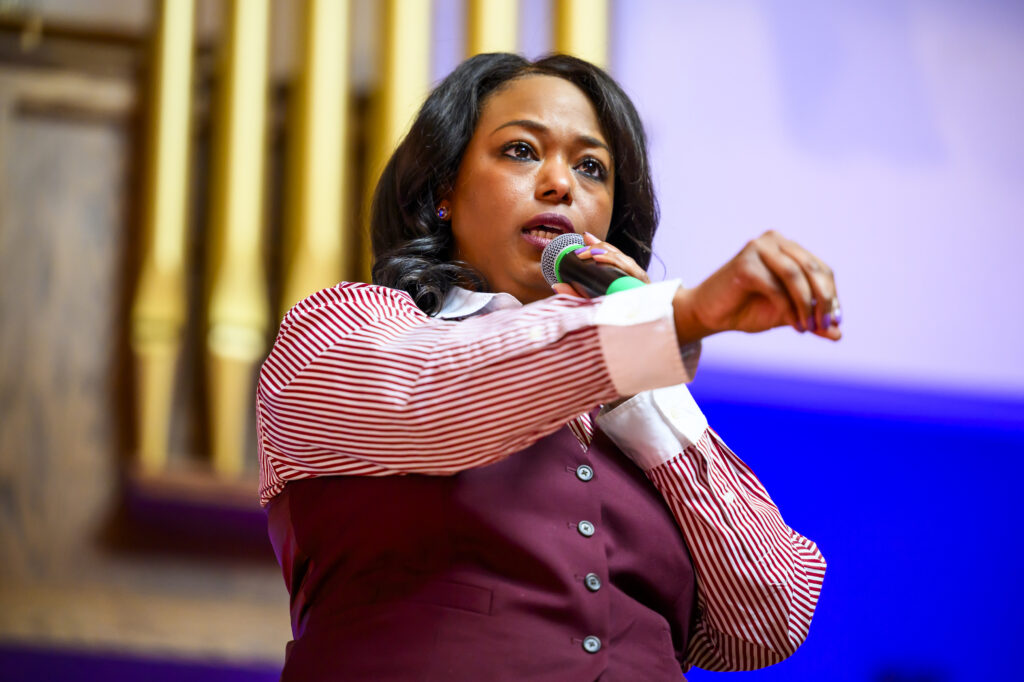
Janeese Lewis George stepped out of her campaign manager’s car next to the Walter E. Washington Convention Center and into a picket line against a food service giant.
She draped a sign over her neck — “Aramark Has No Union Contract” — and walked a couple dozen laps in a circle in the shadow of the giant inflatable union mascot Scabby the Rat.
“This moment is to let Aramark understand, if you’re going to do business in D.C., D.C. is a union town!” Lewis George, the Ward 4 D.C. Council member and a top mayoral candidate in June’s Democratic primary, bellowed from a bullhorn.
Here, Lewis George was in her element.
Running with an unwavering focus on workers’ and tenants’ rights, Lewis George, 38, has built a campaign fueled by rock-solid union support and progressive grassroots energy in a bid to become the first democratic socialist mayor in the nation’s capital. Her election would mark a drastic shift in the status quo during a high-stakes period in which the city’s economy is in distress, revenue is stagnant, and President Donald Trump is inserting himself in local affairs.
The prospect has excited disaffected liberals looking for a change agent after the 11-year tenure of the outgoing centrist mayor, Muriel E. Bowser (D), but it has unsettled some moderates and those in the business class fearing a radical shake-up, who see Lewis George as more lenient on public safety and open to new taxes compared with Bowser.
Her candidacy has evoked inevitable comparisons to the campaign last year of New York Mayor Zohran Mamdani, also a democratic socialist, by both fans and opponents. “This year is going to be D.C.’s turn,” the emcee said at a Democratic Socialists of America rally in March for Lewis George, who touted her promises of universal access to affordable child care and publicly owned social housing.
Her top opponent in the Democratic primary, fellow council member Kenyan R. McDuffie, widely seen as more moderate, has painted her ideas as unrealistic. “She wants to run D.C. using a New York City playbook,” he has said.
But for all the talk about New York, Lewis George, a third-generation Washingtonian, says it is her upbringing in Northwest Washington, in a family whose matriarch raised 13 children as a domestic worker, that is driving her run today.
“What happened there shaped my politics,” she said.
A ‘spirit of disruption’
It was around third grade when Lewis George realized she liked being onstage.
She remembers winning a science award presented by longtime Ward 4 council member Charlene Drew Jarvis for a project on the dangers of smoking. Lewis George told the audience how much she hated her mother’s habit. Mortified, her mother gave it up.
“I don’t know why I never feared judgment,” Lewis George said. “I would just get up there and be like, okay, take me as I am.”
Growing up on Kennedy Street, her childhood in the 1990s and early 2000s overlapped with one of D.C.’s most violent periods, exposing her to some of the city’s most damaging social ills. She visited incarcerated relatives. Lost neighbors to gun violence. Saw addiction afflict even those closest to her, including a favorite uncle she would later see on a street corner on the way to church.
But her mother, a union postal worker who took her to labor meetings, and paternal grandmother, a lunch lady at Alice Deal Middle School, instilled a commitment to education, Lewis George said.
Teachers pushed the extroverted teen toward student government as she got older, she said. She underwent a baptism by fire in city politics as a voting student representative on the D.C. school board, with contentious meetings running to 1 a.m. Her seatmate was Tommy Wells, who later served on the D.C. Council, then in Bowser’s cabinet — and now on Lewis George’s campaign. As a senior at School Without Walls, Lewis George was YMCA youth mayor, showing early signs of a kind of radical consistency in her political beliefs: In 2006, as the D.C. Council weighed publicly financing Nationals Park construction, she pushed legislation to prevent the displacement of longtime residents living around it.
“She always had a spirit of disruption, going against the grain, advocating for the least in community,” said Chioma Iwuoha, a committeewoman for the D.C. Democratic Party who has known Lewis George since she was 17.
Lewis George didn’t initially plan to pursue politics as a career. Seeing the impact of violence on her community as a child, she said, spurred her to pursue a law degree at Howard University. She got jobs waiting tables and clerking at Nordstrom Rack, and moved into her sister’s attic after a rent hike displaced her and her family from their Kennedy Street home — a story she tells often as one that shaped her positions on tenants’ rights.
At Howard, she gravitated toward studying the nation’s long history of mass incarceration of Black Americans and wrestled with what role she would play in that system as a Black lawyer. Her professors thought she would become a public defender. She surprised them when she decided to become a prosecutor, wanting to use the power as a force for good, she said.
“It was this theory that change has to happen from the inside out,” she said.
She put the theory to test working as a juvenile prosecutor under then-D.C. Attorney General Karl A. Racine. Her supervisor at the time, Elizabeth Wieser, said Lewis George was the kind of person who was “in early and there late” and who thought critically about how her decisions regarding punishment or second chances could affect victims, the accused and the broader community. She was open to emerging reforms, Weiser said, such as restorative justice and deferred-sentencing agreements, in which a young person’s case could be dismissed if strict requirements were met.
She began gravitating toward democratic socialism in 2016, inspired by Bernie Sanders’s presidential campaign and, later, Alexandria Ocasio-Cortez’s run for Congress. Seeing the movement as a fitting “merger” of her Democratic politics and a laser focus on workers’ rights, she went to her first Democratic Socialists of America meetup in D.C. in 2018.
She recalled a DSA member telling the crowd, “We’re not going to be able to win on the national level unless we start winning on a local level.”
D.C. as a ‘labor town’
Eight years later, in March, Lewis George stood on a makeshift stage in a D.C. Mexican restaurant before a roaring crowd of socialists.
“I’m a proud democratic socialist, proud of how far we have come,” she said.
She recounted to the crowd how she had gotten there, having stunned the city’s political establishment in 2020 when she upset Ward 4 council incumbent Brandon T. Todd, a close friend of the mayor.
She campaigned on protecting a tenants’ rights law that the council had rolled back, one she had used to purchase her first home in Manor Park; she and her husband, who are raising a baby son, recently purchased a $1.1 million home nearby.
And she lambasted Todd over a vote against the city’s universal paid family leave policy. For Lewis George, that was personal, too: Before she was a candidate, she went to the Wilson Building to advocate the leave policy after caring for her dying father.
Now in her second term, Lewis George has adopted a legislative style blending less flashy work — rigorous oversight of broken HVAC systems in schools as chair of the facilities committee, for example — with a more notorious reputation as one of the council’s most liberal members.
She has emerged as essentially the antithesis to Bowser, often disagreeing with the mayor on everything from rental housing policy to public safety, most recently firmly opposing an expanded youth curfew, a vote McDuffie is also hammering her on. Lewis George has pledged a more aggressive approach to Trump if elected, vowing to sever any coordination with federal immigration authorities. Her economic philosophy clashes with the mayor’s, too.
Bowser has prioritized major capital investments, such as in Capital One Arena, to revive the downtown economy, believing the growth in tax revenue could enhance spending to address needs in all eight wards. Lewis George rejects that as a “trickle-down” approach and says hers would be “bottom-up,” through direct investments in programs such as a universal child care subsidy that would attract working families to the city. To fund it, she has floated a business activity tax on companies whose owners live outside the city. Bowser, by contrast, has repeatedly warned against any new taxes.
“Some people are like, ‘Well, how are you gonna do it?’” Lewis George said of her child care plan, including funding boosted wages for educators. “It’s like the same way this mayor does it. She prioritized this city being a sports town. I’m gonna prioritize this city being a labor town.”
Her limited legislative record — Lewis George’s tenure on council is shorter than half of McDuffie’s — has been fodder for her opponent to pitch himself as more experienced. Lewis George bristles at the criticism, pointing to some of the bills she has passed that touch on everyday life, such as mitigating rodent-attracting litter and enhancing traffic safety infrastructure around schools.
Her marquee progressive ideas, such as bringing social housing to D.C., have not become a reality. Still, she has found success in championing or co-leading major amendments to legislation, such as an expanded labor agreement in the $3.7 billion Washington Commanders stadium deal that was heralded by unions, or taxing the rich to fund pay raises for child care workers.
It’s the times that Lewis George has separated herself from her colleagues, however, that have solidified her antiestablishment image — and ended up in attack ads.
Lewis George has often voted in the minority. At times, she has stood alone: Against lifting a pandemic-era eviction moratorium in cases in which the tenant posed a public safety threat, arguing others on the lease would be unfairly thrown out. Against an emergency public safety bill during a 2023 crime spike, opposing a temporary expansion of pretrial detention for those charged with violent offenses.
Council member Zachary Parker (D-Ward 5) said Lewis George called him about an hour before that vote as she was wrestling with her decision. She decided she could not move from her position, pointing to pretrial data to argue more detention would not prevent crime. “That’s an example where, whether or not you agree with her decision, I think it shows that she’s willing to stand up for what she believes in,” Parker said.
But where her allies see a principled leader unbowed by pressure, her critics see a left-wing insurgent out of sync with the city’s needs.
“She has proven herself to be an impediment and a barrier in every single way,” said Dean Hunter, CEO of the Small Multifamily Owners Association, who doubted Lewis George would hear out landlords about their economic stressors, such as unpaid rent.
As she has consistently backed tenants, many developers, housing providers and real estate agents, as well as the building trades association, have backed McDuffie — even as Lewis George has sought to make inroads with ideas such as a downtown development corporation and a pledge to build 72,000 new units of housing within five years.
Her broad opposition to increasing penalties and incarceration as a tactic to reduce crime — celebrated by advocates of criminal justice reform — has been villainized by critics, who have attacked Lewis George as too lenient while also resurfacing her 2020 campaign comments about defunding police.
Lewis George has walked back that rhetoric, in which she called for diverting police funding to violence intervention or other programs. Still, the DSA’s platform calls for substantially defunding police departments and ultimately abolishing them. Asked if she shares that vision, Lewis George said that she “does not always agree with what the DSA does” and argued that opponents’ “defund” attacks are “cheap shots.”
“I stood up in the moment, just like every generation before me has stood up, and made a loud, resounding call for investments in our community,” Lewis George said, adding that years of police brutality cases that did not result in justice informed her earlier calls. She says now that she would hire more police to alleviate overtime burdens straining the department.
Lewis George has managed to assuage at least some of her former skeptics. Yvette M. Alexander, a moderate Democratic former council member who represented Ward 7, said she initially shuddered at Lewis George’s affiliation with the socialist movement. But after hearing her out, Alexander became an early endorser, won over by a pro-worker platform she believes residents across the Anacostia River facing enduring challenges with housing or job instability have been crying out for.
“I like her fighting spirit. She’s not afraid to speak up,” Alexander said. “She’s not afraid to be in the minority.”
Council member Christina Henderson (I-At Large) said she admires what she called Lewis George’s “relentless pursuit,” often with a lawyerly flair, of pushing colleagues in liberal directions on her core issues, even as Henderson wasn’t sold on ideas such as social housing.
Still, she believed her friend would inevitably have to moderate her agenda if elected mayor, or have tough conversations with her supporters. They were often the same groups, Henderson said, lobbying her for millions of dollars in new spending, and at some point, “you’re going to have to tell somebody no.”
“I think her position as mayor will be very different,” Henderson said. “And I know it’s very uncomfortable for people to sort of trust in that because they haven’t seen it displayed on the council. But I just think the reality of anyone when they get to be the chief executive is that you’re not just governing for the groups that endorsed you. You have to govern for the whole city.”
Back at the picket, Lewis George wrapped up her speech, calling on the food services company to sign a contract with fair wages and benefits. “In this union town, we do right by our workers!” she said.
As Lewis George left, the crowd broke out in a chant of “Whose mayor? Our mayor!”
She hopped back into the car and headed toward city hall.
Her stalwart support for labor issues has translated into nearly two dozen union endorsements, an army of doorknockers, union members embedded in her staff and a union-funded political group dumping hundreds of thousands of dollars into attacks on McDuffie. (It’s also translated into a campaign finance complaint questioning whether those close connections amount to improper coordination, which her campaign denies.)
Riding toward the Wilson Building, Lewis George was aware of perceptions from skeptics that her fight for workers or tenants is dismissive of the needs of business owners — but said she would of course hear out their concerns if elected mayor.
“I’ve talked to business owners, and I’ve said, like, how could I help you, in addition to you helping your workers?” She recognizes, she said, that if she is going to build as much housing as she promises, she will need housing providers at the table, too.
But too often, she said, it is the concerns of people struggling to pay rent on low wages that are dismissed or unheard. That’s why she’s running, she said.
“The way they feel like I am dismissing the concerns of an owner, I want them to also meet the working people of the city where they are and understand where they are,” Lewis George said. “And I think people have to sit with the reality of struggle and stop dismissing it, in a very real way.”
Soon she pulled up at the curb of the Wilson Building and weighed scheduling options with her campaign staff. She could go to a meet-and-greet with a Democratic advocacy group, or a budget hearing, in which lawmakers were reviewing the mayor’s proposed cuts to universal paid family leave for D.C. workers — the policy that first galvanized her in local politics a decade ago.
It took her but a moment to choose.
The post The rise of Janeese Lewis George, who could be D.C.’s first democratic socialist mayor appeared first on Washington Post.