Even though the total area burned was relatively small, 2025 was the most economically damaging wildfire year on record, according to a new analysis published on Sunday.
The Los Angeles fires and a handful of severe blazes in other countries, including South Korea and Spain, drove up losses worldwide to at least $54 billion, the study estimates. It was the highest level of insured losses on record.
That figure does not include all indirect losses like missed work days, business closures and added pressure on health care systems. It is also a conservative estimate, because insurers do not typically share proprietary data and the damage can be difficult to assess in some countries.
When estimates of indirect losses are factored in, the fires that hit the Los Angeles area alone would add at least $100 billion to the total, according to the study.
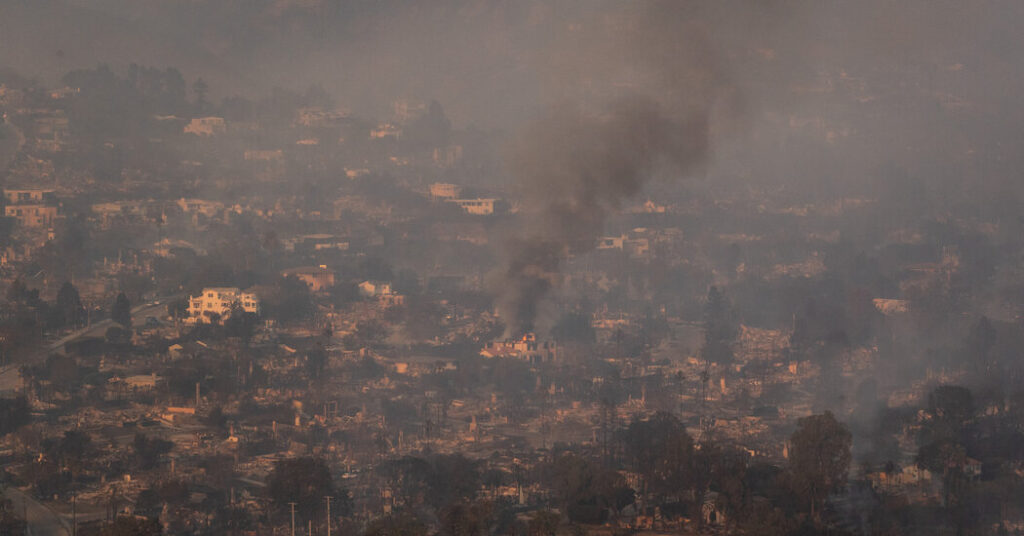
Those fires tore through at least 90 square miles early last year, killing at least 31 people and forcing more than 150,000 residents to evacuate their homes. Some experts estimate that hundreds more died from indirect causes such as smoke inhalation.
The researchers gathered data on wildfire area and damage from 2025 events in the EM-DAT database, which is the product of a global, communal research effort to track disasters and their costs to society and to the natural world. It is not a complete picture, but it provides researchers and policymakers with minimum estimates for damage from fires, floods and other disasters.
The fire damage set a record despite the fact that only about 1.3 million square miles were burned worldwide, the second-lowest area hit by wildfire since 2002.
“Not all fires are equal,” said Matthew Jones, a physical geographer at the University of East Anglia who led the study. He noted that small fires can have big effects on human health, the economy and the climate.
Severe, hard-to-control wildfires that hit populated areas drove last year’s losses.
The Los Angeles fires, which caused about $40 billion in insured losses and roughly $140 billion in total losses, were the costliest wildfires ever. Soon after, in March, high winds swept wildfire through about 400 square miles in South Korea, killing 32 people. It was the country’s deadliest wildfire to date.
In Europe, heat and drought led to fires across the Mediterranean area that killed 28 people and displaced more than 120,000, according to the new study. Analysts are still assessing the economic damage from them, but the European Union this year declared 2025 wildfire season the most destructive on record.
In 2025, for the third year in a row, Canada had extreme burning in its boreal forests. Those areas are not densely populated, but the forests help mitigate climate change by absorbing planet-warming carbon dioxide.
For Dr. Jones, the costs, economic and otherwise, of the 2025 fire year were unsurprising.
“It feels like this should be shocking, but the way things have trended, this is totally in line with recent fire activity,” he said. If anything, 2025 was emblematic of the new normal for fire, he said.
The area burned by fire has been shrinking in recent years, partly because of agricultural expansion into African savannas, which have historically been prone to fire.
Before about a decade ago, fire scientists and risk management experts were mostly worried about size, said Crystal Kolden, a wildfire scientist at the University of California Merced who contributed to the new study. Big fires posed the biggest risks. But that thinking has evolved.
“In the last decade, we’ve seen fire after fire, year after year, with these high-loss events,” Dr. Kolden said. As fires began hitting dense, urban areas with pricey structures, the economic damage spiked. “We get a high density of loss in a pretty small area,” she said.
Experts call such dense but damaging fires urban conflagrations: fires where tightly packed homes rather than vegetation provide fuel. They burn hot and fast. And they are difficult to fight.
The way academic researchers and insurance companies model and predict fires is changing in response to that. Now, experts track more factors than fire size. They track intensity, how blazes spread and the direct and indirect costs to society.
That information gives scientists, policymakers and insurers a more robust picture of fire risk and how it’s changing over time.
“It’s like tracking human health,” said Winslow Hansen, a forest ecologist at the Cary Institute of Ecosystem Studies who was not involved in the study. “We track a number of the body’s vital signs to see if things are deteriorating and to figure out how to mitigate that.”
The most important thing to take away from the report, experts said, is that relatively small but incredibly damaging fires are becoming more frequent.
“These fires, which weren’t at all gigantic, remind us that although area burned is the easiest fire-related variable to monitor, it is not necessarily the most important,” said Park Williams, a climate scientist at the University of California, Los Angeles who was not involved in the study. “Even small fires can have catastrophic consequences for society.”
The post 2025 Wildfires Were the Costliest Ever, Researchers Say appeared first on New York Times.