The Ebola outbreak spreading through the Democratic Republic of Congo could become the deadliest in history, aid groups have warned.
By late May, two weeks after the Congolese health ministry declared the outbreak, it was outpacing the international response. At its epicenter, though health workers and aid groups were racing to fight the virus, there was still very little infrastructure in place to slow its spread.
“I know the resources are often not enough,” Tedros Adhanom Ghebreyesus, the leader of the World Health Organization, wrote on social media on Thursday as he began a trip to Congo. On Saturday, he went to Bunia, a city at the center of the outbreak, in a show of support for health care workers.
As of Thursday, at least 1,077 suspected cases and 246 suspected deaths had been recorded, according to the Africa Centers for Disease Control and Prevention.
One major complicating factor: The type of Ebola virus behind this outbreak, known as Bundibugyo, is rare. Early surveillance and testing failed to identify it, delaying the health authorities’ response. Few field test kits are available. And this kind of Ebola has no targeted vaccine or treatment, making it harder to contain.
Here’s what to know about the outbreak.
Where did the outbreak start?
It is not yet known exactly when this outbreak began, but it was first identified in May in the Democratic Republic of Congo’s northeastern Ituri Province.
Many people in Ituri have been displaced by violent conflict, and many migrant laborers are drawn there by the region’s gold mines. The W.H.O. has said that the region’s high degree of population movement could make it easier for the virus to spread.
The outbreak is mostly concentrated in two provinces, Ituri and North Kivu. On May 21, M23, a rebel group that controls a vast stretch of territory in eastern Congo, reported an Ebola death in a third province, South Kivu.
Are travel bans in place?
Yes, many. Several countries are screening travelers or have tightened their borders.
The United States
The State Department has “strongly” urged Americans not to go to Congo or to neighboring South Sudan or Uganda. People traveling from those countries to the United States are being rerouted to four American airports for screening.
Additionally, a 30-day order from the U.S. Centers for Disease Control and Prevention allows the United States to bar foreigners from entering if they have been in Congo, Uganda or South Sudan during the previous 21 days.
On Thursday, U.S. officials unveiled plans for a 50-bed quarantine center in Kenya to house Americans who have been exposed to the virus, with adjacent isolation and biocontainment facilities for those who have tested positive or shown signs of illness while in quarantine.
Earlier in May, the Trump administration flew an American doctor with Ebola symptoms to a hospital in Germany. Six other Americans were sent for monitoring to Germany and the Czech Republic.
During previous U.S. administrations, health care workers and other Americans exposed to the virus were brought home to be treated at specialized medical units.
Canada
Canadian officials said on Tuesday that travel and immigration processing for citizens of Congo, Uganda and South Sudan would be suspended for 90 days, Canada’s national public broadcaster reported.
Uganda
In Uganda, the authorities have confirmed at least seven Ebola cases, including one death, the W.H.O. said on Monday. On Wednesday, the country closed its border with Congo, citing growing concerns about the outbreak.
How are countries contributing to the relief effort?
The U.S. State Department said in May that it was sending $23 million to Congo and Uganda for protective equipment and other resources. It also announced that it was funding up to 50 clinics and covering “associated frontline costs.”
But public health experts and health workers say a significant obstacle to the international response is how little the United States, which once funded robust disease-surveillance networks in the region, has done.
The United States withdrew from the W.H.O. in January, and last year the Trump administration shut the U.S. Agency for International Development, which played a major role in containing previous outbreaks.
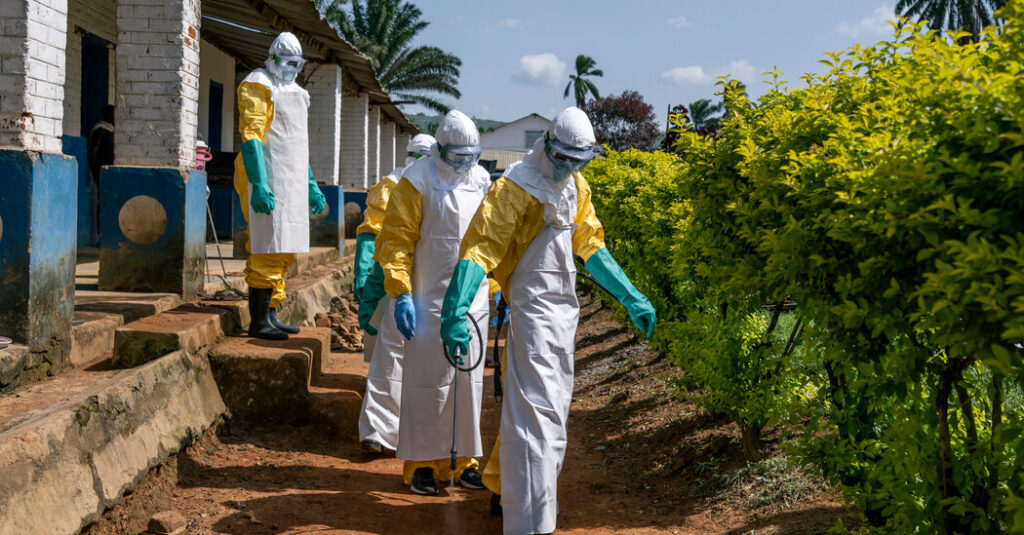
Now, on the ground, doctors are struggling to treat patients and stanch the outbreak as aid workers from Doctors Without Borders race to erect isolation tents and disinfection stations near hospitals where people are dead or dying.
Their relatives are going to care for them — or collect their bodies for burial — often without wearing protection against the highly contagious disease.
Here are some other sources of support:
-
The head of the U.N. humanitarian relief coordination agency said he had allocated $60 million for the response.
-
The W.H.O. said it had released $3.9 million from its contingency funds.
-
The European Union and Unicef said they were sending more than 100 tons of equipment.
-
South Africa’s government has pledged $2.5 million.
-
Congo’s government has set aside $20 million from its own budget to fight the outbreak, its health ministry said.
What is Ebola?
Ebola is an illness caused by a group of related viruses, known as orthoebolaviruses, first discovered in 1976 in the countries now known as South Sudan and the Democratic Republic of Congo, in a region near the Ebola River. Fruit bats are thought to carry the viruses without being sickened by them.
Ebola outbreaks have mostly occurred in sub-Saharan Africa. Last September, health officials in Congo officially declared the country’s 16th Ebola outbreak since 1976. The largest recorded Ebola epidemic began in 2014, with cases in southeastern Guinea, Liberia and Sierra Leone, and lasted two years.
Four of the six known species of Ebola viruses cause illness in humans and can be fatal.
People stricken with Ebola may first experience so-called dry symptoms such as fever, aches, pains and fatigue before progressing to wet symptoms, including diarrhea, vomiting and bleeding, according to the C.D.C.
Ebola can be contracted through contact with the bodily fluids of an infected, sick or dead person and through contact with contaminated objects like clothing, bedding, needles or medical equipment.
The incubation period for the Bundibugyo species of the Ebola virus ranges from two to 21 days, and individuals are usually not infectious until symptoms manifest. But because the early symptoms — like fever and fatigue — resemble those of other illnesses, including malaria, early detection can be difficult.
Are there vaccines?
Vaccines and an antiviral drug have been approved for the Zaire species of Ebola, the most common one. But there is no vaccine or specific treatment for the Bundibugyo species.
The Bundibugyo virus was first identified in 2007 after a mysterious illness broke out in the Bundibugyo District in Uganda, which borders Congo. In 2012, another such outbreak was identified in Congo.
Fatality rates during the last two outbreaks of this form of Ebola have ranged from 30 percent to 50 percent of those infected, according to the W.H.O.
There has not been much research done on this species of virus, according to Dr. Jean-Jacques Muyembe, who leads Congo’s national institute of biomedical research and has been a pioneer in Ebola research and treatment. Speaking at a briefing on Tuesday, Dr. Muyembe suggested that vaccine candidates would probably be proposed in the coming days.
Brian Otieno contributed reporting from Nairobi, Kenya.
Amelia Nierenberg is a Times reporter covering international news from London.
The post What to Know About the Ebola Outbreak appeared first on New York Times.