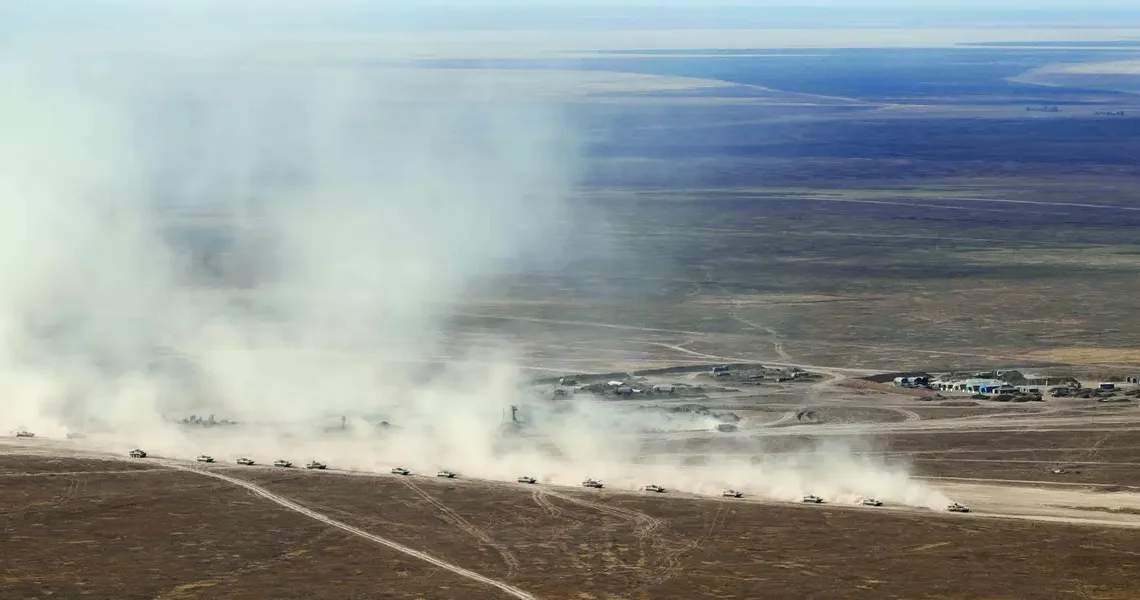
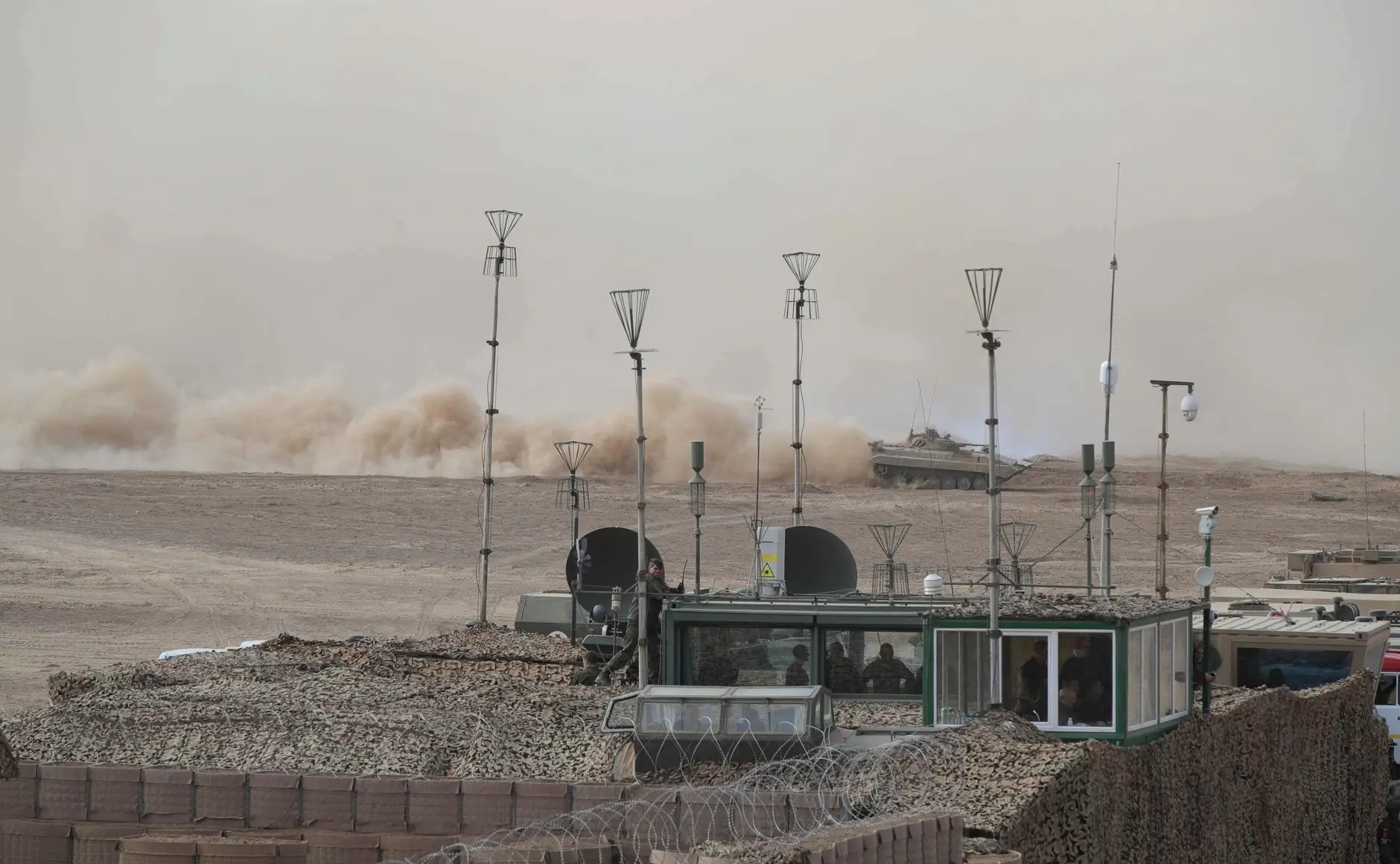
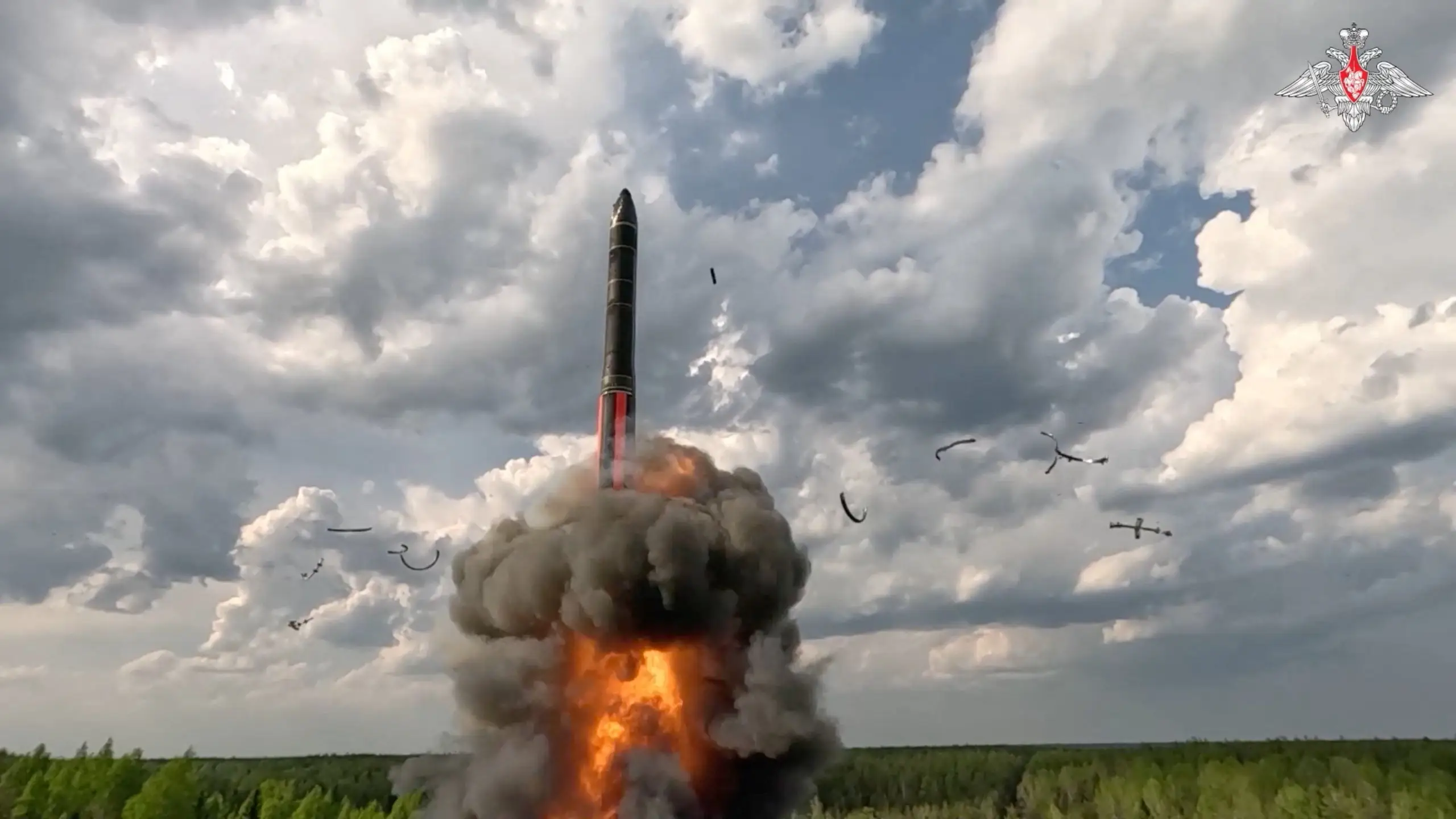
Russian leader Vladimir Putin has ordered Oreshnik ballistic missiles to be fired at Ukraine, and each time they came from a restricted area in the barren steppe of southeastern Russia.
The most recent Oreshnik attack came on Sunday amid a massive barrage that killed four people and injured many more, according to Ukrainian media. Strangely, the powerful $40 million ballistic missile caused only a smattering of damage to a garage complex near Kyiv. That may be due to the missile’s armament and Russia’s intent.
A clue about the missile’s use is its name: the Russian word Oreshnik means “hazel bush.” In Russia, hazel bushes have been used for hundreds of years to make rods for corporal punishment, a Russian lawmaker recently said.
The damage from the May 24 attack was largely caused by 90 missiles and hundreds of drones heading toward Kyiv. Speaking to the Russian outlet Vot Tak, political scientist Oleg Saakyan estimated that Russia used weapons worth about $1 billion that night.
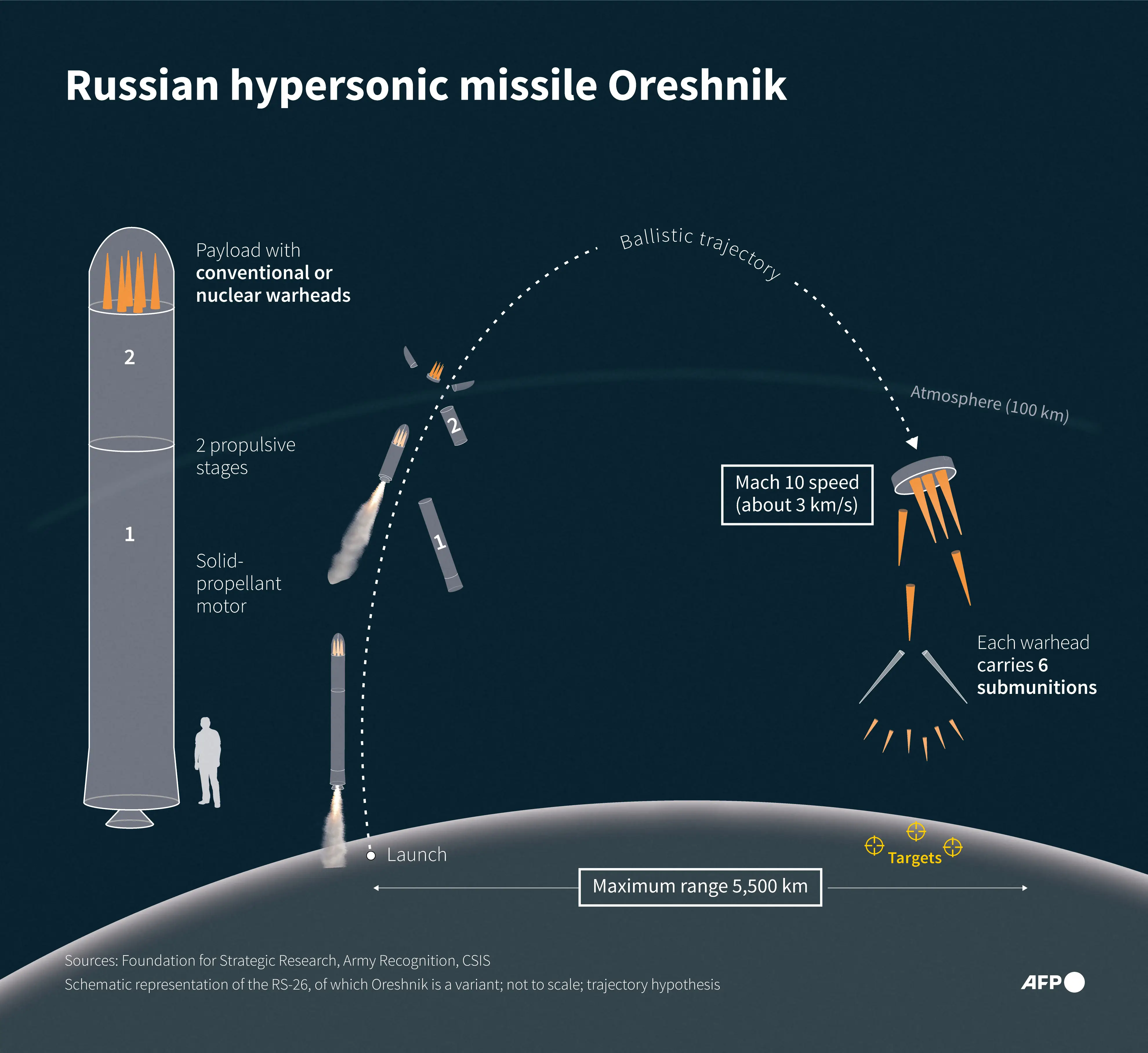
The Oreshnik missile struck in approximately six clusters, the absence of explosive flashes showing it was likely armed with inert warheads. It appears to be a demonstration of raw power.
“It appears that none of those projectiles have any explosive in them,” said Pavel Podvig, a senior researcher with the United Nations Institute for Disarmament Research. “All the attacks happened at night. Even a relatively small explosive charge would produce visible flashes.”
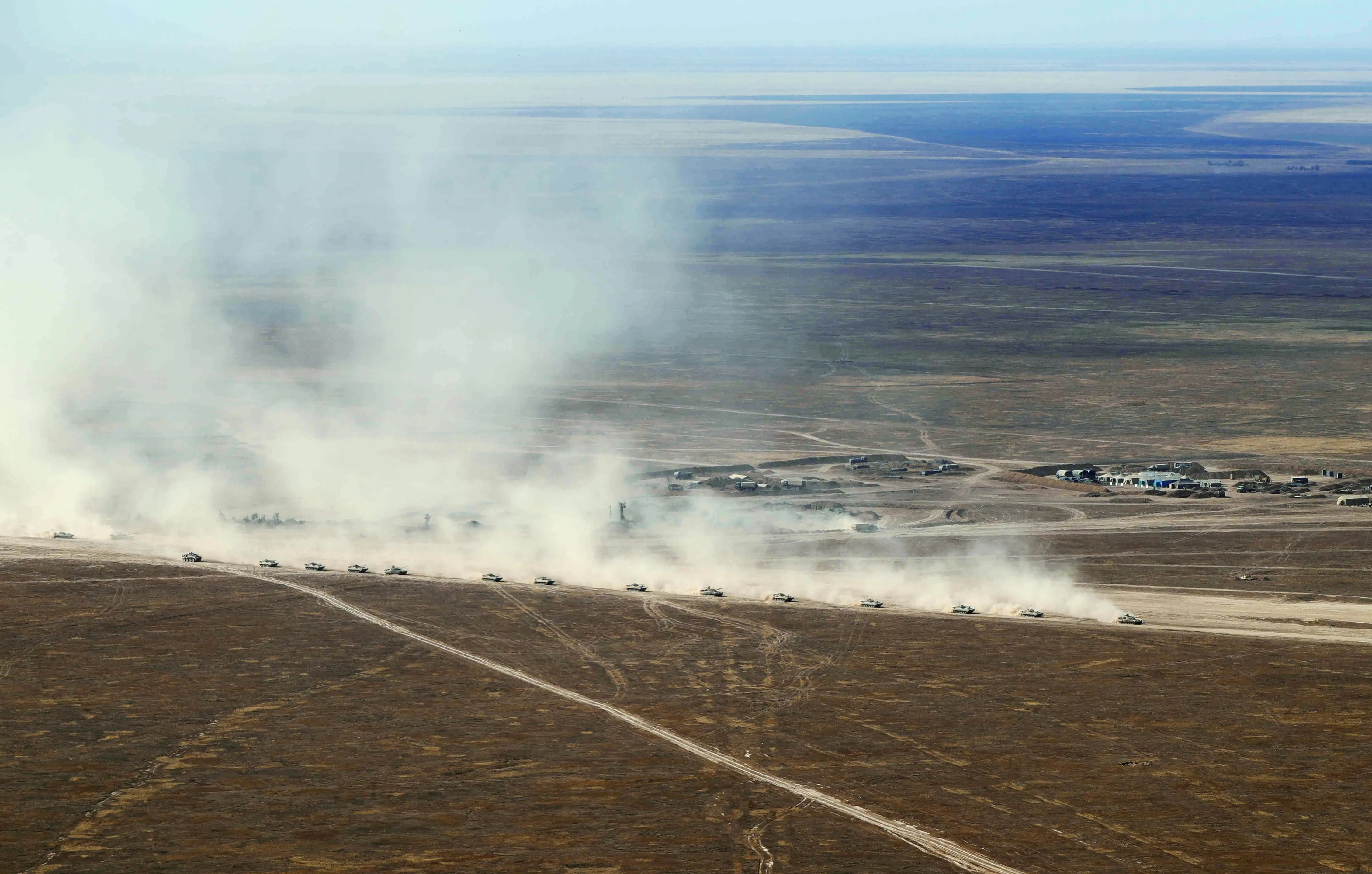
All three Oreshnik missiles that have struck Ukraine were launched from Kapustin Yar, a historic missile test range near Znamensk. The small town, with just under 30,000 inhabitants, lies about 700 miles east of Kyiv and not far from the Kazakhstan border. Surrounded by barren steppe and a reinforced-concrete fence, the town is a so-called “closed administrative-territorial area.”
To protect Russian military secrets, no one may enter the town unless they are registered there, have been expressly invited, or have undergone an elaborate advance registration process. Anyone with a permanent residence in the town receives a pass from the authorities, featuring, among other things, an ascending rocket.
The dilapidated state of this small town is in stark contrast with the advanced and expensive missiles Russia develops there.
A run-down rocket-town
On social networks such as X and Instagram, several unflattering images of Znamensk can be found. They show completely run-down wooden huts, unpaved roads, apparently abandoned houses with smashed windows, and a Lenin statue standing in front of sagging power cables.
In Russia, mockery erupted in January after the second launch. Firing an Oreshnik costs at least the equivalent of $40 million; other sources put the figure at $60 or even $80 million. Users fantasized about what a handsome town the Russians could turn Znamensk into if they invested that sum into proper roads, new facades and modern infrastructure.
“Whether this is the 19th or the 21st century? No idea,” one user wrote. Another, after the January attack, juxtaposed images of Kapustin Yar with Lviv’s beautiful old town in western Ukraine. The Russians, he wrote, supposedly wanted to “liberate” Ukraine and Lviv. “How absurd: perhaps Kapustin Yar should be liberated from the Russians instead.”
Another X user wrote: “This is exactly where the Russians fire their ‘hazelnuts’ at Ukraine from — to demonstrate vividly to Ukrainians and the whole world the greatness of so-called Russian civilization. A civilization that considers firing rockets at residential cities the highest form of cultural expression. So that everyone will be envious.”
Nevertheless, Znamensk is a proud place. Since 1946, almost every Soviet and Russian missile program has been tested at the range, formally designated Military Unit 15644. A wide variety of missiles and more than a hundred satellites have been sent into orbit from here.
And today, war is being waged from here. Ukraine keeps the test range under constant observation: it is enough for the Russians merely to simulate activity at the training ground to trigger an air alert across Ukraine.
Ukraine has repeatedly tried to damage the site with drone attacks. Apart from a few fires, it has so far failed. The site lies several hundred kilometers from the Ukrainian border, leaving Ukrainians mere minutes to take cover.
For the residents of Znamensk, the test range is of great importance. It secures jobs and brings life to the town. Every May 13, for example, the anniversary of the missile range is celebrated with military parades and ceremonial speeches. The municipal “Museum of the Strategic Missile Forces” organizes tours and festivities. Children and teenagers from the “Young Army” also visit regularly — a kind of nationwide Russian leisure club under the patronage of the Defense Ministry, which puts adolescents in uniforms, has them dance in videos for the fighters of the “special operation” (the official term for the Ukraine war), or write greeting letters to the “liberated” children of Donetsk.
‘They do their own thing’
The consequences for the residents of Znamensk are limited. In a Telegram chat with a local resident, it was said that the local population is involved in military activities as little as possible.
“Everything is quiet here,” said one businesswoman. “Nothing reaches us.” Even when Ukrainian drones come, she said, “They turn on the alarm and notify all of us by phone. No reason to worry.”
She said she couldn’t say what happens with the Oreshnik missiles. “That is a military secret. Nobody knows where they are stationed.” And even if someone did know something, no one would ever talk about it.
Another resident, speaking about the night of the missile launch, said: “I didn’t hear anything. They do their own thing there.”
It is entirely possible that residents do not notice the missile launches. The test range covers many hundreds of square kilometers; residents of Znamensk probably hear little more than a distant, thunder-like rumble when an Oreshnik is launched, and which couldn’t be distinguished from test launches.
The missiles are also quickly out of sight: they typically climb to an altitude of several hundred miles and reach speeds of 13,000 kilometers per hour, roughly 10 times the speed of sound. It therefore takes only a few minutes to reach their target. Other states learn of the launch via satellite surveillance, monitoring the Earth’s surface. On infrared scans, the exhaust plume, several thousand degrees Celsius hot and rising from the ground into orbit, is immediately visible.
The Russians in Znamensk can lead quiet lives. They play in volleyball tournaments in the sports hall attached to the administrative wing of the test range. They can walk in the “Fairy-Tale Glade” park, where several life-sized rocket-shaped monuments are arranged around a fountain.
The victims of the missiles manufactured here are primarily Ukrainians. But neighbors in Kazakhstan are also severely affected. Russia has leased parts of western Kazakhstan as an extension of the test range — the contract currently runs until 2030.
For local Kazakhs, the lease of the land has serious consequences. As the Russian newspaper Novaya Gazeta reported in 2024, Russia prefers to test its missiles over Kazakh territory.
As a result, missile parts and fuel fall into the steppe, causing fires, killing livestock, and contaminating soil and water. The steppe is littered with craters; no recultivation takes place.
Researchers have now found that cancer rates in the region are above average. Neurological damage and disabilities among children are strikingly common. State assistance from Kazakhstan is practically nonexistent.
Julius Fitzke, a trainee at WELT in the foreign affairs department since July 2025, lived in Russia for three years.
Read the original article on Business Insider
The post This run-down town is the launchpad for the superweapon Putin used to attack Ukraine appeared first on Business Insider.