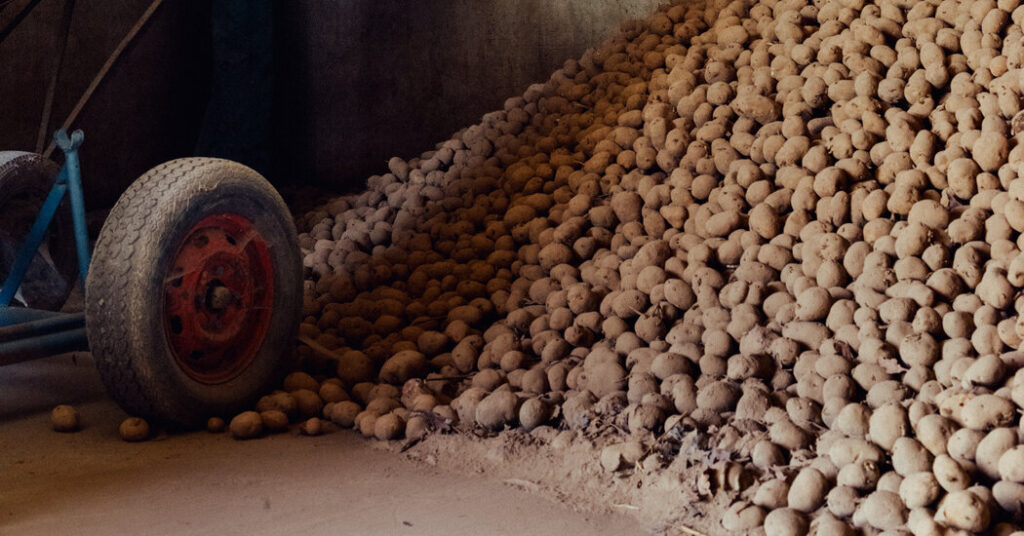
A thousand tons of potatoes were stacked 15 feet high in a warehouse on Kris D’haeyere’s farm for months. Even though he offered to sell them for just a couple of euros per ton, no one wanted to buy them.
So Mr. D’haeyere did the unthinkable: This month, he dumped the crop back into his fields in eastern Belgium, the cheapest way to dispose of enough potatoes to make 200 million French fries.
Other farmers are doing the same, as Europe faces a surplus of five million metric tons of the type of potato used for fries.
For months, the price of a metric ton of potatoes on the spot market in Belgium, the world’s biggest exporter of frozen fries, has languished at precisely zero. It was nearly 600 euros ($690) three years ago.
The great potato glut of 2026 is the result of several factors, some meteorological and others geopolitical.
Good weather produced the biggest European potato harvest in eight years, just as farmers were struggling to sell their crops because the Trump administration’s tariffs hit their exports and new competitors from Asia took market share. More recently, the war in Iran has pushed up prices for energy and fertilizer and made consumers cut back, shrinking profit margins that were already as thin as a shoestring fry.
“Of course it’s bad,” Mr. D’haeyere, 58, said, “but that’s life.” His unsold potatoes had started to sprout, making them impossible to offload. It hit him with a loss of €160,000 on soil, seedlings, fertilizer, labor and other costs and forced him to dip into his savings, he said.
Mr. D’haeyere planted 17 acres of potatoes for next season, a fraction of the 170 acres he usually plants on his 370-acre farm in Hermalle-sous-Huy, Belgium.
In Germany, another major potato producer, a farmer with 4,000 tons of unwanted potatoes arranged a series of giveaways in Berlin, which locals refer to as the “Kartoffel-Flut,” or potato flood.
But nowhere has a mismatch in potato supply and demand been more acutely felt than in Belgium, the world’s biggest exporter of frozen fries.
Frites are a national symbol, and friteries — what French-speaking Belgians call the stands that sell cardboard cones stuffed with fries — are ubiquitous in public squares across the country. Belgians smother their frites in a variety of elaborate sauces, including andalouse, a mayonnaise blend with tomato paste and bell peppers, and dallas, which has fried onion, tomato and herbs.
Belgium exported $3.3 billion of cooked, frozen potatoes in 2025, nearly triple the amount a decade earlier, according to the European Union’s statistics agency.
Maintaining that pace of growth will be difficult.
The war in Iran is the latest source of strain on the supply chain for frozen fries, said Christophe Vermeulen, the chief executive of Belgapom, Belgium’s potato processing association. Higher energy costs make refrigeration and transport more expensive. Skyrocketing fertilizer costs also make farming more expensive, with ships carrying fertilizer ingredients unable to exit the Persian Gulf because of a blockade on the Strait of Hormuz.
The blockade has also made it harder to export fries to countries including Qatar, the United Arab Emirates and Saudi Arabia, all major French fry consumers. Gulf countries are likely to need fewer fries anyway, with fewer tourists staying at resorts and eating at restaurants, Mr. Vermeulen said.
Closer to home, rising inflation has forced many Europeans to think twice about going out to restaurants, where most fries are consumed, said Niels van der Boom, an analyst at DCA Market Intelligence, which specializes in commodity markets.
These challenges come as U.S. tariffs on imports have made European fries more expensive in the United States, their second-largest market after Britain. Exports of frozen fries from the European Union to the United States were down 8 percent over the 12 months ending Feb. 28, according to World Potato Markets, a magazine. Sales to Saudi Arabia, the third-largest market for European fries, were down 11 percent in that same period, and they have probably fallen further since the start of the Iran war.
Imports of European fries in the Middle East as a whole have been tracking toward a double-digit percentage drop since the war began, estimated Cedric Porter, the editor of World Potato Markets.
“It hurts us,” Mr. Vermeulen said, “especially in a sector that has small margins.”
Margins are modest in part because farmers in Europe, compared with producers in other regions, adhere to much stricter regulations, said Jean-Pierre Van Puymbrouck, a farmer in Walhain, Belgium. Agricultural chemicals banned in Europe for more than a decade are still authorized in some other countries, he said.
“That clearly complicates fair competition,” said Mr. Van Puymbrouck, 52, who is also a vice president of Belpotato, a trade group. “When exporting to another country that doesn’t have the same constraints as us, we’re not on the same level.” While he said he was insulated from the recent fall in potato prices because he locked in prices on multiyear contracts in advance, the glut may ultimately mean lower prices in the future for him, too.
The potato industry is also grappling with what could be a longer-term issue: Consumers are choosing healthier snacks over fries.
In the United States, one in eight adults reported taking GLP-1 weight-loss medications like Ozempic and Wegovy. These medicines often lead people to significantly cut back not just their caloric intake but also their desire for processed and fried foods, like potato chips and fries.
Global demand for frozen fries is still growing, but at a recent rate of 2.5 percent a year, compared with 5 percent growth five years ago, Mr. Porter said.
European potato producers are also facing competition from China, India and Egypt, which have recently begun selling frozen fries at much cheaper prices. The volume of frozen French fries exported from China and India is less than 10 percent of what Europe exports, but it doubled last year from the previous year.
But can potatoes from these upstart exporters compete on taste? Mr. Porter sampled fries from Europe, China and India last year and said there was not a clear winner. “If you’ve got a restaurant where your margins are tight and you want fries,” he said, “you’ll be looking for the best-value ones.”
Mr. Van Puymbrouck took over his farm from his parents, and one day plans to pass it on to his 20-year-old daughter. “She is the one continuing,” he said, “so it has to be good.”
Mr. D’haeyere, however, did not share his optimism. “I think the good years are over,” he said.
Jenny Gross writes about business and economics for The New York Times and is based in London.
The post The World Capital of French Fries Has a Problem: Too Many Potatoes appeared first on New York Times.