As he sat in his restaurant in the Lithuanian capital, Liutauras Ceprackas, a chef, said he was one of the many Lithuanians who worry about a Russian invasion. He is not sure, he said, that his country’s 15,000-soldier army is big enough to stop one. Increasingly, he is not certain an American-led NATO would, either.
That is why, three generations after Nazi Germany brutally occupied his country in World War II, Mr. Ceprackas, 51, is glad that Berlin has permanently stationed thousands of German soldiers in Lithuania.
“If they kill just one German,” Mr. Ceprackas said, referring to the Russian Army, “it’s going to be a war with Germany.” That possibility, he added, “will keep us safe.”
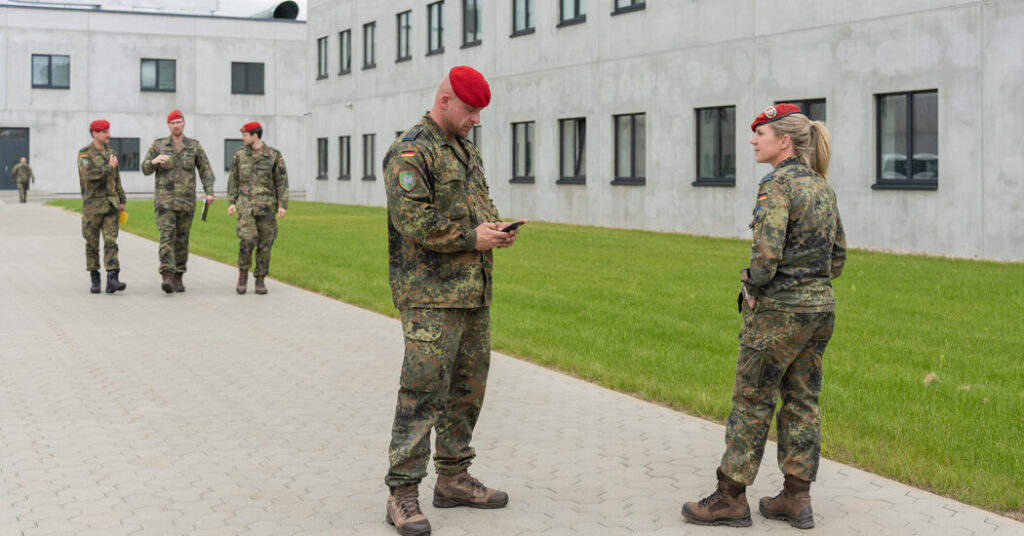
Germany’s 45th Armored Brigade is the first full battle brigade to be permanently based outside the country since the fall of Nazi Germany more than eight decades ago. Its deployment in Lithuania is a symbol of how fast Europe is changing amid fears of increased Russian aggression in the continent’s east.
The brigade’s deployment also reflects Germany’s increased willingness to act as Europe’s shield amid wavering support from President Trump and the United States, which for eight decades guaranteed the safety of American allies in Europe. It was during the brigade’s investiture ceremony on the central square in the capital, Vilnius, last year, that Chancellor Friedrich Merz of Germany first vowed to build Europe’s largest conventional army.
The warm reception from Lithuanians for the brigade, which will reach its full complement of 4,800 troops in 2027, also reflects a changing attitude among Germany’s neighbors to Berlin’s growing leadership role.
Some of Germany’s big European allies remain wary, but smaller, more exposed partners, like Lithuania, view Berlin’s rearmament as a welcome new security guarantee, even if that means a German presence in countries that were victim to Nazi brutality in the 1940s. Lithuania, with a population under three million, borders the Russian territory of Kaliningrad and Belarus, a Russian ally.
“This brigade is so strong and so well equipped that it’s like we have a second army in Lithuania,” Laurynas Kasciunas, a Lithuanian former defense minister, said in an interview.
The gratitude has been good news for the German soldiers stationed around Vilnius.
Last year, Andrius Tapinas, a Lithuanian television anchor, told viewers that when they saw German soldiers, they should buy them a beer. It was not a contentious request. In a poll commissioned by the Lithuanian Defense Department in December 2024, a large majority of Lithuanian adults supported the presence of the German brigade.
Businesses have also hopped on the bandwagon, with a coffee chain and a national supermarket chain giving discounts to German personnel showing their military ID.
The German soldiers themselves, new to foreign deployments, expressed surprise at the cordial treatment.
One major, who under German military regulations could be identified only by his rank, told a typical story. He was recently marching with dozens of his men, he said, on a weekly 7.5-mile training exercise, when a jogger approached the column from the opposite direction.
“She thanked us — in halting German — for being here,” the major said.
Other German soldiers based in Lithuania described entire school classes waving at them and older men shaking their hands or saluting. They also said they had been thanked many times when appearing in uniform in public.
That good will may seem surprising given the past.
Lithuania was twice occupied by German soldiers — once during World War I, when the country was still part of the Russian empire, and later for three years during World War II, when the Nazis oversaw the killing of almost the entire Lithuanian Jewish population.
Germany’s leadership is clearly sensitive to that history. Last year, Boris Pistorius, the German defense minister, laid a wreath at a memorial in Paneriai, a district on the edge of Vilnius. At a killing site in the area, German Nazis and Lithuanian collaborators massacred up to 75,000 people in three years, most of them Jews, according to the U.S. Holocaust Memorial Museum.
Still, in Vilnius, the traces of Nazi occupation are less visible than the imprint of nearly five decades of Soviet control, which followed World War II. The Soviet presence endures not only in the city’s museums and memorials, but also in the public consciousness.
For many Lithuanians, Moscow’s occupation, which technically lasted until the last Soviet troops left in 1993, evokes more vivid fears than the Nazi occupation, the terrors of which many Lithuanians learned about only after their country regained independence three decades ago.
Nowadays, to most Lithuanians, Germany is representative of a democratic and open Europe, while Russia is more likely to elicit fears of an invasion, particularly considering the war in Ukraine.
According to Rimvydas Petrauskas, one of Lithuania’s leading historians and the rector of Vilnius University, “The Germans learned from their past; the Russians have ignored the lessons.”
For German soldiers, the reception in Lithuania contrasts with the experience many report back home. Since World War II, a desire to avoid a return to the militarism of the Nazi era has fueled a strong anti-military sentiment in Germany. As a result, soldiers in uniform in the country are often the subject of rude gestures or comments.
“I don’t like going out in uniform in Germany because of the unpleasant looks you get,” said one sergeant. “But here I’ll go out to dinner without changing because I’ve stopped thinking about it,” she added.
Another sergeant, who recently moved into a house on Vilnius’s edge, said that he happily biked to work in uniform — something he avoided doing in Germany during much of his 14-year military career.
The wall of Vilnius’s centuries-old City Hall signals where Lithuania looks for protection, with two plaques displaying pledges by two Western leaders, 23 years apart.
The first, made by President George W. Bush two years before Lithuania joined NATO in 2004, promised that any enemy of the country would be an enemy of the United States. The second, delivered by Mr. Merz in Vilnius in 2025, declared that defending Vilnius was equivalent to defending Berlin.
Dr. Vladas Gaidys, a well-known Lithuanian pollster said, “At this moment, the United States does not feel like a guarantee.”
“The German forces — they’re here and now,” he added.
Tomas Dapkus contributed reporting.
Christopher F. Schuetze is a reporter for The Times based in Berlin, covering politics, society and culture in Germany, Austria and Switzerland.
The post Lithuania, Once Occupied by Germany, Is Glad German Troops Are Back appeared first on New York Times.