The announcer’s voice broke the silence that had fallen over the racetrack: “Here comes Spunky!”
As a white, fluffy object, supposed to look like a hare, shot past the starting box, a line of eight greyhounds burst out, a blur of canine energy rocketing down the straightaway.
Such races were once a familiar sight across the country, as bettors flocked to tracks in 19 states, from Florida to Massachusetts to California. At its height, in the 1980s and early 1990s, dog racing drew tens of millions of spectators, routinely posting higher yearly attendance figures than hockey or tennis. Spectator bets totaled roughly $3.5 billion every year.
But today only two dog tracks remain, down from more than 60. Both are in West Virginia, the only state where commercial races still take place. Attendance has waned as pressure from animal rights groups led many states to ban dog tracks and as the legalization of sports betting nationwide gave people a bounty of new gambling options.
Now a bill is making its way through Congress that would ban dog racing altogether. Fans and critics agree that the sport is on its final lap.
“I know at some point, it’s going to end,” said Ronald Welch, who was sitting at a picnic table last month at the track in Wheeling, W.Va. “But still I’d be heartbroken if it did.”
Public sentiment about greyhound racing had already started shifting by the early 2000s, due in part to the efforts of Carey Theil and Christine Dorchak.
Through their Boston-based nonprofit, GREY2K USA Worldwide, the couple has led lobbying to end dog racing over concerns about animal welfare.
The industry has faced criticism for killing dogs that could no longer race, though many of the documented cases took place before adoption programs became common in the 2000s. Critics also draw attention to confined living spaces in the kennels where most of the dogs live, along with reports of performance enhancing drugs, and diets of low-quality meat.
The New York Times reached out to five kennels associated with the Wheeling racetrack. They did not respond or declined to comment.
The efforts by GREY2K and other organizations have yielded changes, with 44 states banning greyhound racing. When voters in Florida, once a stronghold, approved a ban in 2018, it was a gut punch to the industry.
“We’ve been in the endgame phase since,” Mr. Theil said.
But in West Virginia, a law passed nearly two decades ago has made it harder to land the final blow. In an effort to keep gamblers from taking their betting dollars to neighboring Pennsylvania, which had just legalized slot machines, West Virginia in 2007 said casinos could sweeten the pot by offering table games — so long as they also were operating a track with live racing.
It also diverts a percentage of slot machine and table game revenue to a fund that pays race purses. This provision comes out to roughly $15 million to $22 million a year, accounting for about 95 percent of payouts.
“Without the subsidy, this industry wouldn’t exist,” Mr. Theil said.
A 2017 state bill would have allowed the casinos to operate without a live track, and done away with the subsidy. In a sign that support was fading even in West Virginia, it passed in both the state House and Senate. But then-Gov. Jim Justice vetoed it, saying “eliminating support for the greyhounds is a job killer.”
Mr. Theil has focused on rebutting assertions that the industry benefits the local economy. This year, a study by Ball State University commissioned by GREY2K found that apart from providing minimal low-paying jobs, the industry was buoyed almost entirely by the subsidy and provided nearly nonexistent economic benefit.
The concerns have made their way to Capitol Hill, where a bill being considered by Congress could spell the end of greyhound racing. The Greyhound Protection Act would make it illegal to train or possess greyhounds for racing and to bet on the races in-person or via simulcast.
The legislation was incorporated into the Farm Bill, a huge legislative package, which reauthorizes major food and agriculture programs roughly once every five years. The Farm Bill, which totals $390 billion in proposed spending, passed the House in April and is awaiting a Senate vote.
The act now looks like GREY2K’s best bet.
“Greyhound racing is going to end in the United States,” Mr. Theil said. “The real question is how.”
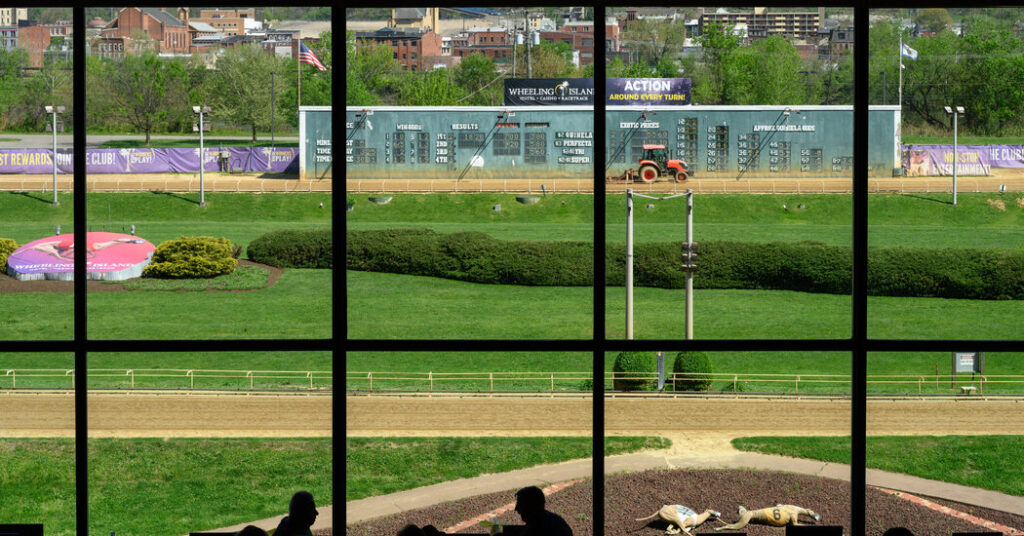
One hour southwest of Pittsburgh, the Wheeling Island Hotel, Casino & Racetrack sits at the southern tip of the most populated isle in the Ohio River. “The Island,” as locals called it, was once the home of wealthy industrialist families. Now, it is lined with dilapidated Victorian houses and beset by flooding and opioids.
But it is still home to the racetrack, which has welcomed locals and out-of-staters from Ohio, Pennsylvania and even Canada, since 1937.
In the 1940s, when horses raced there, the track was nicknamed “Little Churchill Downs,” after the storied Kentucky venue. The track transitioned to greyhounds in the 1970s.
Nearly 40 years ago, Delaware North, a food service and hospitality company based in Buffalo, purchased the track and added a full casino. Now, the course stages around 500 races a year.
In-person attendance is down about 60 percent over the last decade, according to Delaware North. But many of those who still come are fiercely loyal.
With the third race of the day about to begin, Donna and Dennis Kennedy lounged at a table in the betting area overlooking the track.
The couple, both former teachers from Bridgeport, Ohio, often hit the track together. It wasn’t always that way; for years, she refused to join her husband because of concerns about the dogs’ welfare.
“I’m an animal person,” she said.
But when the track was raffling off a free car, Ms. Kennedy couldn’t resist. “The first thing I did was march up to the adoption center,” she said, referring to a spot at the track where people can take in retired racing dogs. She ended up volunteering for a decade and adopting four dogs of her own.
Mr. Kennedy, 84, had the likeness of one of them, Fancy, inked on his forearm two years ago. It was his first and only tattoo. “If those were my dogs, I’m not going to allow anyone to abuse it because that’s an investment — and we love them,” he said.
Chuck Galloway has been betting at the track since greyhounds started racing there in 1976. On the small screen in front of him, race lineups showed dogs with names like Gonz Megatron, Loyal Duck, Bulldozer Mozer and Venus.
The races are simulcast so patrons in other states and countries can bet remotely — about 95 percent of bets placed on Wheeling races are made this way.
But even with lots of the bets coming from elsewhere, there’s a certain camaraderie at the track, Mr. Galloway said. He likened it to his time campaigning for Barack Obama. “I got to know people that I never would have crossed paths with,” he said.
Several track patrons pointed to what they said was a double standard — horse racing, a sport with a blue-blood pedigree, can still capture a mass audience, while dog racing is on the verge of extinction.
Mr. Welch, 60, the man who was sitting at the picnic table, had a theory.
“Horse racing is like apple pie. Like baseball, the Wild West,” he said. “But the dogs, they aren’t part of that American mystique.”
Mr. Welch grew up attending races in Iowa before the state banned the sport. In need of an anchor in his life after his mother passed away, he moved to Wheeling to live near the track.
“When I see them run,” he said, “it’s a spiritual experience.”
In downtown Wheeling, many people seemed to have at least a tangential connection to the racetrack — an uncle who trained dogs, a friend who worked there one summer. But not everyone knew that greyhound racing’s days could be coming to an end. Some said they were ready to see it go.
Outside Coleman’s Fish Market, Mitchell Visnic, 40, was adamant about his distaste for any animal-related sport. “I don’t even like the zoo,” he said.
Others were disappointed but not surprised. Michael Mudrak, 42, who was sitting nearby on his lunch break, said it was emblematic.
“Take another thing away from West Virginia,” he said.
Alain Delaquérière contributed research.
Stefano Montali is a news assistant at The Times who contributes reporting across various sections.
The post In a Quiet Corner of America, Greyhound Racing Hangs On. For Now. appeared first on New York Times.