The federal prosecutor overseeing a criminal investigation related to E. Jean Carroll, a former magazine writer who accused Donald J. Trump of sexual assault, has presided over a Chicago office marked by high-profile prosecutorial failures and a deluge of staff resignations.
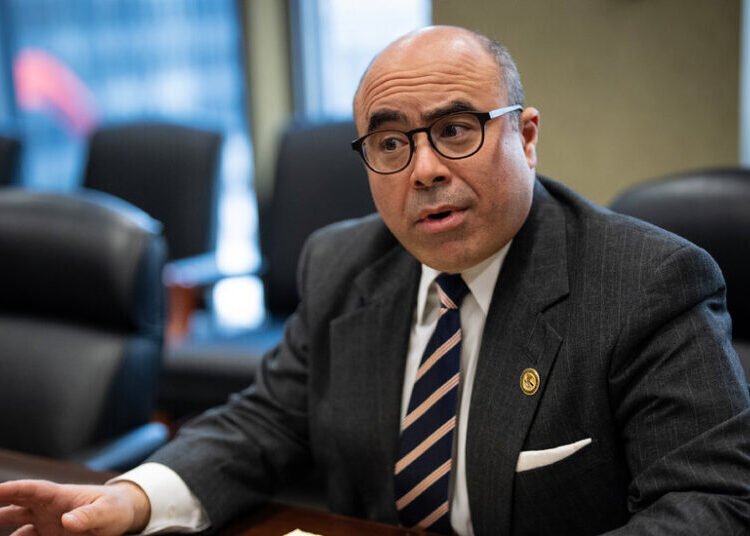
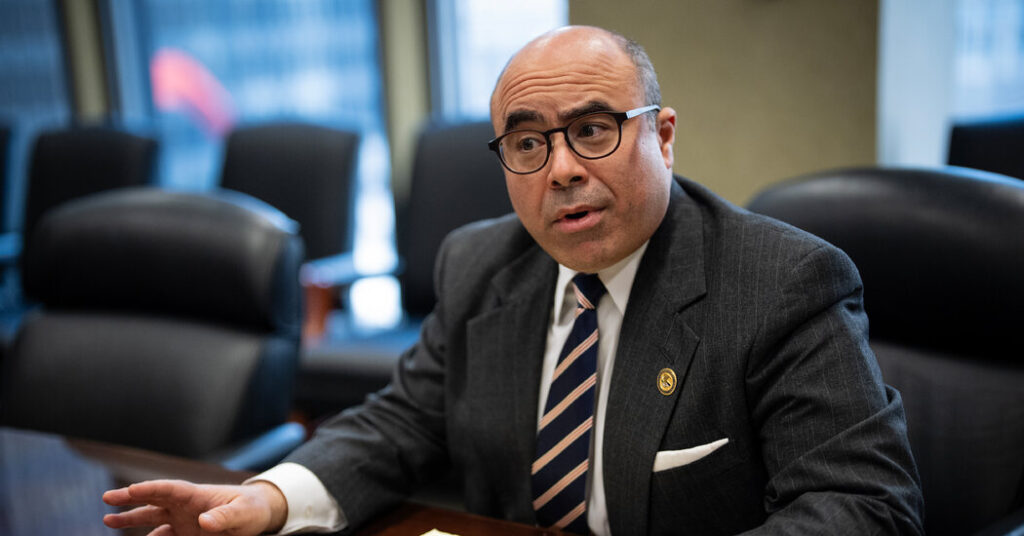
The prosecutor, Andrew S. Boutros, was appointed by the Trump administration as the U.S. attorney for the Northern District of Illinois just over a year ago. On paper, his experience seemed suited to the role: a former federal prosecutor for the Northern District who had handled cases of drug trafficking, white-collar crimes and money laundering, followed by a period as a lawyer in private practice.
Since taking on the job as U.S. attorney in Chicago, Mr. Boutros, 48, has pursued cases of financial fraud, firearm possession, robbery and threats of violence, while also diverting resources to prosecute cases that are more overtly political. He has emerged as a prosecutor closely aligned with Mr. Trump’s agenda, apparently undeterred by repeated pushback from judges and juries in recent months.
“I’m concerned that Andrew Boutros is willing to take down all of the credibility of the U.S. attorney’s office to serve Donald Trump,” said Christopher V. Parente, a former deputy chief in the Chicago office who has represented a defendant in a case Mr. Boutros’s office brought against protesters of the Trump administration’s immigration crackdown in the Chicago area.
Last week, Mr. Boutros was admonished by Judge April M. Perry in her courtroom after the judge found that prosecutors in his office had acted improperly before a grand jury.
“Your sole goal is to do justice,” Judge Perry said. “Your client is justice itself. I do believe deeply in the presumption of regularity and that most government attorneys are doing the best they can to do the right thing. That trust has been broken.”
The charges in that case, whose defendants, including Mr. Parente’s client, became known as the Broadview Six, were dismissed. That ended one of the Trump administration’s most highly publicized prosecutions of protesters during Operation Midway Blitz, the immigration crackdown.
Other cases tied to the crackdown have fizzled.
Earlier this year, prosecutors in Mr. Boutros’s office accused a man of putting a bounty on the head of Greg Bovino, a former top Border Patrol official, but presented scant evidence at trial and withdrew assertions that the defendant, Juan Espinoza Martinez, was a high ranking gang member. A Chicago jury acquitted Mr. Espinoza Martinez.
On several occasions, grand juries have rejected the office’s attempts to bring charges, a once-rare rebuke that has grown more common in the Trump Justice Department.
In November, the office dropped charges against two motorists who were accused of using their cars to “assault, impede and interfere with the work of federal agents” during Operation Midway Blitz.
The office has also seen so many high-level departures that Mr. Boutros sent out a letter to retirees last year. “We recognize that some of you have moved on and are not in a position to return,” Mr. Boutros wrote, but added a link to a jobs portal for those who might consider returning. Veterans of the office have expressed dismay about what they see as a shift away from serious work toward more politically pointed prosecutions that appeared designed to please the Trump administration.
As reports emerged this week of an investigation into the funding behind E. Jean Carroll’s lawsuits against President Trump, Mr. Boutros said Thursday evening in a written statement that there was no criminal investigation into Ms. Carroll.
“In light of widespread reporting and intense media and public interest into the E. Jean Carroll matter in New York, the Chicago U.S. attorney’s office can confirm that it has not opened — and has never opened — a criminal investigation into E. Jean Carroll,” he said.
Mr. Boutros did not respond to a request for an interview for this article.
The investigation involves donations made by a nonprofit founded by Reid Hoffman, the billionaire co-founder of LinkedIn, to pay for Ms. Carroll’s legal bills, according to people with knowledge of the matter who spoke on the condition of anonymity to discuss an ongoing inquiry.
As part of that inquiry, prosecutors are examining the veracity of her responses to questions about the donation during the civil proceedings over her accusations that Mr. Trump assaulted her decades ago. Mr. Hoffman’s nonprofit, American Future Republic — and not Ms. Carroll — is currently the subject of the criminal inquiry, although that could change, a person with direct knowledge of the situation said. It was not immediately clear what, if any, illegal conduct might have occurred. Mr. Hoffman, in a social media post Friday, said “the premise of the investigation would be laughable if the subject matter weren’t so serious.”
Ms. Carroll won two separate but related civil judgments — one for $5 million, the other for $83.3 million — against Mr. Trump, both stemming from her accusation that the president sexually abused her in a Bergdorf Goodman dressing room in the mid-1990s. It’s likely that the Supreme Court will have the final word on both cases.
Veterans of the office said that the new inquiry tied to Ms. Carroll’s lawsuits was highly unusual.
“This is not the kind of case that the office takes for a half-dozen reasons,” said Ronald S. Safer, the former head of the criminal division in the Chicago office who left in 1999 and now works as a defense lawyer.
He said that it was highly unusual for the federal prosecutor’s office to take on a case involving possible perjury claims from a matter litigated in civil court. Given the number of civil cases, federal prosecutors would need to build “a thousand new courthouses” if they were going to begin searching for false statements in such cases.
What’s more, Mr. Safer said,“it is clearly politically driven, and the Department of Justice, notwithstanding everything that has gone on for the past year plus, should be independent of politics and is not a vehicle to settle personal grievances of the president or anybody else.”
Mr. Boutros, a graduate of the University of Virginia School of Law, took the oath of office in April 2025. Though his appointment surprised some lawyers who had worked with him before, several said in interviews that they had hoped that he would steward an office known for its sophisticated investigations through a tumultuous period.
Seeking to shore up his office’s flagging credibility, Mr. Boutros announced on Wednesday that there would be “sweeping internal reforms” to the grand jury process, but offered few details about the changes.
Julie Bosman is the Chicago bureau chief for The Times, writing and reporting stories from around the Midwest.
The post Who Is the Prosecutor Investigating E. Jean Carroll’s Lawsuits? appeared first on New York Times.