By 2005, when Allen Toussaint fled Hurricane Katrina and took up residency at Joe’s Pub in New York, he had produced and written hundreds of hits, such as LaBelle’s “Lady Marmalade,” Lee Dorsey’s “Working in the Coal Mine,” Benny Spellman’s “Fortune Teller” and the Pointer Sisters’ “Yes We Can Can.” He’d never been a national star himself.
“My dad wasn’t really comfortable onstage a lot, one way or another,” said Clarence Reginald Toussaint, his son and manager. “He really preferred to stay in the studio and never be the focal point. That was never his objective.”
“But,” he added, “once he sat at the piano, he’s comfortable.”
During more than 40 appearances at Joe’s Pub through 2009, Toussaint allowed memories and songs to spew out of him, covering Paul Simon’s “American Tune,” dedicating his “Hi Lee Hi” to the Grateful Dead frontman Jerry Garcia and expanding his 1975 song “Southern Nights” into a 13-minute childhood rumination about feeling “warm and safe and very much loved” while visiting relatives on the outskirts of New Orleans. Slowly, in front of star-studded crowds that included the rockers Elvis Costello, Bonnie Raitt and Boz Scaggs, Toussaint reinvented himself.
“All of a sudden, that idea that Allen was a brilliant songwriter but not a performer — that changed,” said Bill Bragin, then the talent booker for the 180-seat club. “He found this way to play with the audience and to give Mardi Gras beads and give gifts and sign autographs for an hour after the show and really connect with his fans.”
Toussaint, who died in 2015 at the age of 77, is the subject of an expanded reissue of “Songbook” (2013), an album documenting the Joe’s Pub performances. The new version includes eight previously unreleased songs from those shows, plus 12 tracks from interviews recorded in 2009 — in which Toussaint declared the great New Orleans pianist Professor Longhair’s artistic evolution much faster than that of Bach, and accompanied himself on a new version of his much-covered hit “Freedom for the Stallion” as well as Steve Goodman’s “City of New Orleans.”
“We got to about three hours,” said Paul Siegel, the album’s producer. “I looked at my watch. I thought, ‘I just can’t believe how long we’ve been going.’ We then went for another half an hour.”
Born in a section of New Orleans known as Gert Town, Toussaint took up piano as a teenager and collaborated with the blues guitarist Snooks Eaglin and the regional hitmaker Huey Piano Smith. He spent the 1960s as the primary songwriter, producer and arranger for the local label Minit Records, where he oversaw New Orleans R&B classics like Jessie Hill’s “Ooh Poo Pah Doo,” Ernie K-Doe’s “Mother-in-Law” and Dorsey’s “Ya Ya,” and was the head of a regional music production empire that included a publishing company and two labels. Toussaint had “style, flair, dash,” Patti LaBelle wrote in an autobiography, fashioning himself “like he just stepped out of a magazine,” driving his Rolls-Royce to the French Quarter and indulging in daily pedicures.
“He wrote songs specifically tailored to the voices he was recording,” said Scott Billington, a consultant for Craft Recordings, which reissued “Songbook.” “It’s hard to think of anyone else in the last century who had such a grasp of so many different aspects of making music and of making records.”
When Hurricane Katrina hit New Orleans in August 2005, the producer, like many of the area’s residents, initially tried to wait out the storm at home. Much of his family evacuated to Houston, including Clarence Reginald, who called to convince him to leave. Toussaint declined, having withstood major hurricanes in the ’60s. “He came up through Betsy and Camille and we didn’t do evacuations then.”
Toussaint wound up decamping to a high floor of a hotel near his home, where he left behind a Steinway piano as well as records and memorabilia. When the flood set in, he had to escape through water up to his calves, while, as he told The New York Times afterward, “shaking a fist at the hurricane.” A friend arranged a ride for him to Baton Rouge “for a fee,” he said then, and from there he flew to New York. “His sister lived in New York before she passed,” Clarence Reginald Toussaint said. “That was the ideal place to go.”
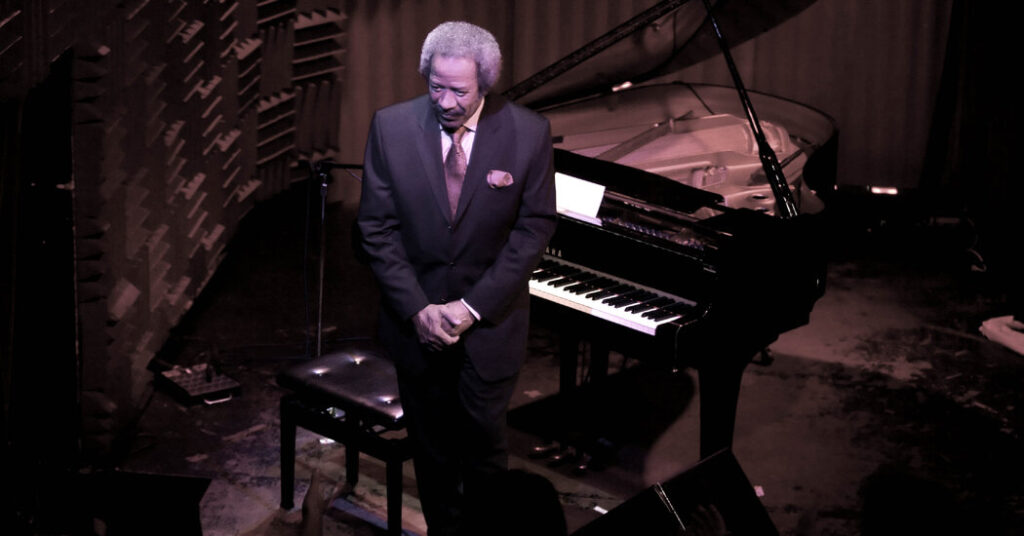
In New York, Toussaint hooked up with a friend, Joshua Feigenbaum, a longtime record executive who had been his partner in an independent label, NYNO. Feigenbaum took him shopping at Barneys. “Allen was a very dapper guy,” Feigenbaum said of the hitmaker who appears on the cover of “Songbook” in a pinstriped suit with a pocket square matching his tie. “He literally showed up with a bunch of hard drives, what he had on his back and that was about it.”
Toussaint wanted to work so Feigenbaum hosted him and Bragin, of Joe’s Pub, at his house in the Hamptons. “He had a camcorder with him,” Bragin remembered of Toussaint. “He was asking me and my wife about how we got together, and turning the camera on us — turning the camera on anybody else but him, as, clearly, he was going through this strong trauma.”
That first Joe’s Pub performance, a Sunday brunch benefit for hurricane survivors in September 2005, turned into a long run. Toussaint charmed audiences with his deep voice, endless song catalog, easygoing command of New Orleans boogie-woogie piano turnarounds and unexpected vulnerability in spoken-word stories about his roots and family. “He didn’t have to worry about if the bass player knew the song,” Siegel said. “He could just sit down by himself and sing anything he felt like.”
Costello and Toussaint later connected after performing at a Madison Square Garden benefit concert, collaborating on an album, “The River in Reverse” (2006), and a subsequent tour. “That was really the beginning of the renewal of his career,” Feigenbaum said of the Joe’s Pub shows.
Toussaint returned to New Orleans for good in roughly 2008. His flooded home was unsalvageable, so he moved to the city’s Lakeview neighborhood, onto a street named for the Confederate general Robert E. Lee. It was renamed Allen Toussaint Boulevard by unanimous City Council vote seven years after his death.
“Songbook” documents Toussaint’s crucial New York period. “He would talk about how, when he walked around, which he did a lot, he would hear things,” Siegel remembered. “A symphony would come from the different sounds he was hearing as he walked around New York City. He was very inspired by New York.”
The post When a Reluctant Songwriting Star Found Refuge on a New York Stage appeared first on New York Times.