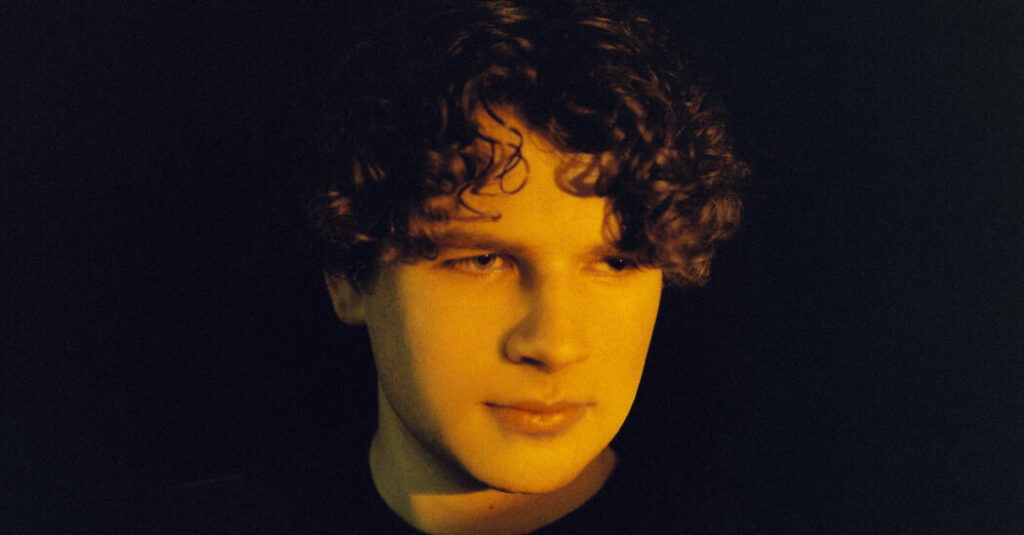
At 16, an age when most teenagers are concerned with driving tests and prom dates, Kane Parsons made a nine-minute short called “The Backrooms (Found Footage),” about a man trapped in an unnerving realm of mazelike hallways.
The film and its follow-ups became such a YouTube sensation that, just months after Parsons turned 17, A24 signed him to direct a feature-length adaptation of “Backrooms,” making him the youngest director in the studio’s history. Two years of development followed, meaning Parsons was a wizened 19 when he cast the Oscar nominees Renate Reinsve and Chiwetel Ejiofor as his leads, and 20 when I met him in Los Angeles a few weeks before the film’s release.
“Age has never not been part of the conversation with me,” said Parsons, who has the rosy cheeks and brushed-forward curls of a teenage TikToker. Before production began on “Backrooms” (in theaters), he worried whether people would take him seriously as the director of a feature film.
“That was the thing that was eating me the most: How much do I have to do to counterbalance the bias that anyone’s going to have?” he said.
At the same time, he feared alienating the online audience he had worked so hard to build. Parsons is part of a new wave of horror filmmakers who first emerged on YouTube, including Mark Fischbach, 36, whose “Iron Lung” became an unexpected success earlier this year, and Curry Barker, 26, who segued from sketch comedy to directing this month’s “Obsession,” also a surprise hit.
Parsons is the youngest of the group and, in some ways, the most unlikely to have made the leap to the big screen. He freely admitted that his artistic approach has been shaped more by web series and video games like Portal and Half-Life than by traditional Hollywood moviemaking.
“I don’t watch a lot of films,” he said, though he has binged the TV series “Mr. Robot” at least eight times.
Still, Parsons is no dilettante. As we walked along the Los Angeles River in early May, I found him to be unusually thoughtful and self-possessed, with the stolid authority of a college professor. Pondering why the “Backrooms” concept caught on, Parsons brushed past the creep factor of all those abandoned hallways to reach for something much larger.
“There’s a lot of simplicity in the setup that preys on the anxiety people have around the stage of industrialization we’re at,” he said. “The world is becoming increasingly atomized and sort of lonely. We have so much available to us now — at least in this part of the world — yet it feels like all the stuff we have means less and less.”
On a video call, Reinsve praised Parsons for his ability to ground big philosophical concepts in our lived reality.
“I was fascinated by him,” she said. “Even though I’ve dipped my toes into liminal spaces or quantum physics or stuff that we have common interests, he is way beyond. And I was very intrigued by how existential he would want to go in something that was a genre movie.”
In the film, Reinsve plays Dr. Mary Kline, a therapist whose client Clark (Ejiofor) claims to have found a portal to a strange realm inside the furniture store he owns. When Clark disappears days later, Mary must venture into the labyrinthine Backrooms to investigate.
But there’s something deeper at play in that plot, Parsons said. Just as Mary tries to chart the human mind as a therapist, Clark attempts to map the Backrooms, with both people thwarted by systems whose internal logic remains stubbornly out of reach.
“It’s a movie mostly about the biological imperative of needing to make maps of everything to have some form of control, to explain your circumstances so you can escape the emotional burden of them,” Parsons said.
But what if we are problems that can’t be solved, and the corridors of our minds stretch on to infinity? To Parsons, that notion is what makes the Backrooms so scary.
“It’s being on the brink of being able to peer around the corner,” he said, “and there’s another corner that’s beyond it.”
PARSONS GREW UP on the outskirts of Silicon Valley in Northern California’s Petaluma Valley, beside rolling green hills he likened to the default wallpaper of Windows XP. “The fields are nice because some people with a lot of resources want to keep it that way, and you can hear the distant hum of data centers,” he said.
Armed with a hand-me-down digital camera from his parents, he spent much of his childhood making short films, from creature features starring his younger brother to stop-motion movies made with Play-Doh and Legos. But as he entered his teenage years, Parsons developed severe leg pain that took nearly two years to diagnose.
“Arthritis for a 13-year-old didn’t make sense,” he says now of the condition, which he manages with a weekly autoimmune injection. At times he could barely walk, and during that period he immersed himself in the craft of visual effects, using the 3-D modeling suite Blender to build virtual sets that could be explored even while immobile.
It was in that spirit that Parsons made his first “Backrooms” short in early 2022, inspired by a viral image of an abandoned office space bathed in a strangely malevolent shade of yellow. Cobbled together in Blender over three weeks, Parsons says he mostly regarded the project as a tech demo. But its seamless effects and eerie mood were so striking that the short spread like wildfire, earning 10 million views within its first two weeks online.
And then Hollywood came calling. As Parsons continued his “Backrooms” series with more shorts that consistently drew millions of views, he says that he was besieged with emails from producers who hoped to turn his fledgling property into a generic slasher franchise.
They may have expected a starry-eyed teenager eager to sell out. But after movie misfires like 2018’s “Slender Man,” which was also derived from an eerie internet meme, Parsons was wary about Hollywood attempting to exploit another online sensation: “It was the norm, not the exception, for that to fail,” he said.
He also resisted the idea that YouTube was seen as a steppingstone on the way to Hollywood. Couldn’t it be the main event?
“I get a perfectly adequate level of financial security from YouTube and a perfectly fulfilling level of creative gratification from it,” he said, adding, “Trying to jump mediums on certain projects will take away something intrinsically valuable about the original idea.”
That’s why, even though he eventually signed with A24, he considers the new movie to be just a supersized installment of his web series. “I did this film for a specific personal creative reason, and I don’t think it needs to be the end goal,” he said.
Shot over nine weeks last summer in Vancouver, the production built 30,000 square feet of the Backrooms on a soundstage, making real what had previously existed only on Parsons’s computer. “It was really surreal,” he said, though the thing that surprised him most was how natural it all felt.
“I found that there’s no true correct way to direct,” he said. “I couldn’t help but wonder, ‘Is this right? Why does this feel so normal? But we’re making the movie and it’s working.’”
Reinsve said that Parsons was firm when he needed to be, though always willing to adapt.
“I’ve worked with a lot of first-time directors, and I enjoy it because they are searching for their style and you learn something together,” said Reinsve. “But he was so certain, and then every day after we finished, he would ask, ‘Could I have done something better today?’”
Still, the process wasn’t without challenges. In addition to directing, Parsons composed the score with Edo Van Breeman and continued working on the visual effects, modeling the sets in Blender just as he had back when “Backrooms” was still a one-man job. Late last year, when the postproduction schedule was shortened by several weeks, those responsibilities demanded even more of him.
“I ended up getting a little bit too much on my plate,” said Parsons, who began pulling “self-imposed” 21-hour workdays to make sure the film was as polished and detailed as he’d envisioned. “I definitely abused my nervous system to the fullest degree I possibly could.”
In January, while Parsons was still mired in the postproduction crunch in Vancouver, the firmware for his autoimmune injector stopped working, leaving him bedridden for two weeks until the production team made a border run to secure a replacement. With another director, setbacks like those could have brought things to a standstill, but Parsons has been there before, albeit with fewer colleagues by his side.
“I didn’t burn out on this movie — if anything, it was positive burnout,” he said. “I feel very happy with where it ended up getting, but it certainly was not leisurely by any means. Everyone gave it their all.”
PARSONS IS OPEN to big-screen sequels if “Backrooms” succeeds, and advance tracking indicates the movie could open to over $40 million, which would make him the youngest director to make such a hit. (Josh Trank, who was 27 when “Chronicle” opened to $22 million, is currently the youngest filmmaker to direct a number-one movie at the box office.)
Still, Parsons’ main goal for the project has always been to turn it into a television series. For years, he has carried around several seasons’ worth of story in his head.
“I feel like I’m going to go insane if I don’t get this out of my system,” he said. “The reason I do ‘Backrooms’ at all is for stuff that hasn’t quite happened yet.”
And though he would like to branch out into other projects — a feature-film adaptation of Portal would be his dream, he said — Parsons doesn’t feel like he can truly move on until “Backrooms” reaches its conclusion.
“It’s been a few years since I first started the YouTube series and it’s like, ‘Come on, just finish the thing already, guy,’” he said. “But I counter that by saying I deeply enjoy working on it.”
And that’s where youth works to his advantage.
“I don’t plan on dying in the next five years,” he said, “so I don’t see a problem with taking a bit of time on it.”
Kyle Buchanan is a pop culture reporter and also serves as The Projectionist, the awards season columnist for The Times.
The post From YouTube Sensation to A24’s Youngest Director appeared first on New York Times.