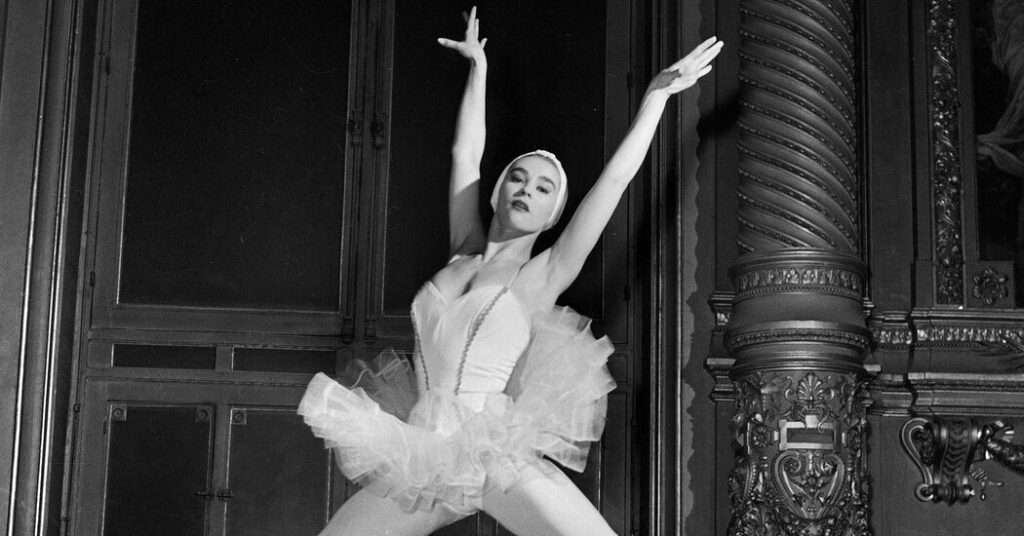
Claude Bessy, a graceful French ballet star whose firm hand at the helm of the Paris Opera Ballet School for three decades made it one of the world’s top dance institutions, though her rigorous methods eventually drew stinging criticism, died on April 23 at her home in Chatou, a suburb of Paris. She was 93.
Her death was announced by the Paris Opera, whose resident ballet company performs in both opera and dance productions. In a tribute, President Emmanuel Macron of France said that Ms. Bessy “forged, through her talent and force of will, a unique career in service to dance.”
Tall, blonde and commanding, Ms. Bessy was sometimes called the “Brigitte Bardot of ballet,” and she shared something of that movie star’s cool temperament and striking appearance. She executed her leaps in “Giselle” and “Swan Lake” with icy precision.
The dance critic of Le Figaro newspaper, Ariane Bavelier, described her after her death as having “devastating beauty, an iron will and a generous spirit.”
For over 30 years, Ms. Bessy ruled the Paris Opera’s acclaimed in-house ballet school. Questions about her methods eventually led to a scathing 2002 report, which concluded that “psychological terror” reigned among the students. Ms. Bessy retired two years later.
But before that, the school was known for producing dancers who dazzled critics on both sides of the Atlantic. They “performed with stunning brio and purity,” the New York Times critic Anna Kisselgoff wrote of a 1988 New York visit.
The year before, Ms. Kisselgoff had written, “What is the secret of the outstanding clarity and exciting leaps with which French dancers amazed audiences here last year, aspects special to the Paris style?”
The answer lay largely in Ms. Bessy’s rigorous training style. “The line has got to be absolutely pure, especially in the back,” she says as she leans over and straightens a young girl in a 1988 video.
Speaking of the dancers’ apparently effortless, spontaneous leaps, she had told Ms. Kisselgoff: “We try to have the preparation unseen. You need a vertical axis, a cement back. You use your muscles to jump and a back that does not move at all.”
Ms. Bessy had been schooled in this style from the age of 10, when she first entered the Paris Opera Ballet School as a “little rat,” as the young inductees were known. It was 1942, and the city was under German occupation. In a 2024 radio interview with France Musique, Ms. Bessy recalled that soldiers would sometimes walk her and her fellow students home from late rehearsals at the Palais Garnier.
The school taught her “a movement of attack, vivacity, speed,” she wrote in her 2004 autobiography, “Passion For Dance,” adding that it was a “difficult style for tall dancers like me.”
After World War II was over, she was quickly recruited into the Paris Opera Ballet’s depleted ranks, and made her debut as a soloist in 1947, when she was still a teenager, appearing in ballets by choreographers like George Balanchine and Serge Lifar.
In 1956, at 24, she was named to the company’s top rank of “étoiles.” That year, she appeared in Gene Kelly’s experimental all-dance, no-dialogue film “Invitation to the Dance.”
“She is long of leg and of line,” an unnamed critic for The Times wrote when she appeared in New York with American Ballet Theater in 1958, “high and strong in extensions, easy and straight in pirouettes, and altogether well placed and in command of the situation.”
A serious car accident in 1967 helped shorten Ms. Bessy’s stage career, which was over by 1975. At that point, she had already spent two years running the company’s ballet school. In 1992, the Times critic Jennifer Dunning reported that Ms. Bessy had a quotation from Charles de Gaulle on the wall of her office: “No illusion sweetens my bitter serenity.”
Claude Jean Andrée Durand was born in Paris on Oct. 21, 1932; her father was an employee of the Crédit Lyonnais bank. She later adopted the last name of her grandfather Paul Bessy, who had been an actor; the stage was in her blood, as one grandmother had been a singer and an aunt was raised by the renowned actress Sarah Bernhardt.
She grew up in Paris’s Ninth Arrondissement, in a neighborhood that had been known since the 19th century as “New Athens,” for the many artists who lived there. One of her neighbors, Gustave Ricaux, a former Paris Opera Ballet dancer, gave Ms. Bessy her first lessons when she was 9.
She was briefly director of the Paris Opera Ballet in the early 1970s, before taking charge of the company’s school. She campaigned for a new school building, aided by the politician Bernadette Chirac, the wife of the future French president Jacques Chirac. Designed by Christian de Portzamparc, it was inaugurated in the suburb of Nanterre in 1987.
Ms. Bessy had a teenage crush on the dancer Serge Golovine, who, decades later, in 1981, began to teach at the Paris Opera Ballet School. They married in 1996, after several previous marriages for each; he died in 1998. She leaves no immediate survivors.
The 2002 report on conditions at the school, organized by an outside consultancy and commissioned after brutal accounts from former students had appeared in the French press, was unequivocal. The report said that complaints from students of pain and injury were routinely rejected and mocked, that Ms. Bessy’s direction was “authoritarian” and that there was a general “assault on the dignity” of the students.
Changes were made to the school’s operations, including more assiduous monitoring of the dancers’ mental and physical well-being.
But Ms. Bessy never apologized for her methods, and rejected the report’s conclusions, saying, “As for myself, I was brought up with the stick.”
Earlier in 2002, before the release of the report, she told the Times correspondent Alan Riding: “If you have no desire to exhaust yourself, if you have no desire to do with your body something it is not made for, you can’t be a dancer. But the physical effort is very satisfying. It’s close to sensuality.”
Adam Nossiter has been bureau chief in Kabul, Paris, West Africa and New Orleans and is now a writer on the Obituaries desk.
The post Claude Bessy, Who Ruled Paris Opera Ballet School, Dies at 93 appeared first on New York Times.