For years, Jeff Bezos’ Blue Origin rocket company operated in secrecy, overshadowed by the success of Elon Musk’s SpaceX.
But in the past year, it was gaining momentum, getting closer to reliably launching a gigantic rocket, called New Glenn. It was supposed to give the entire space industry much-needed capacity to lift satellites and other equipment into space.
NASA gave the rocket a vote of confidence earlier this week with a bigger role in the agency’s Artemis return-to-the-moon program, and Amazon had 48 of its satellites ready to hitch a ride into orbit in its race to compete with SpaceX’s Starlink internet service.
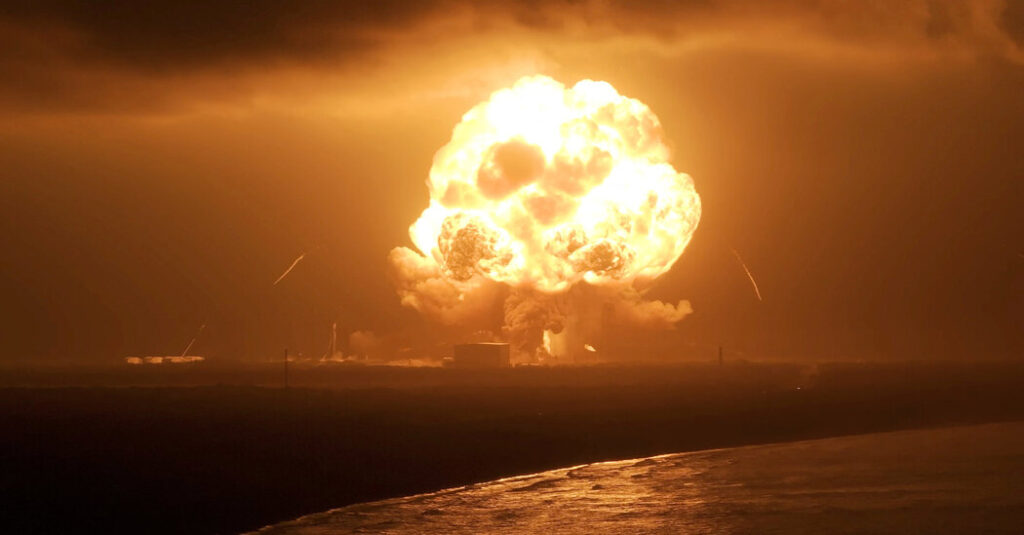
Then, around 9 p.m. on Thursday, New Glenn erupted into a fireball on its launchpad during a test.
“This is a big, collective gasp and setback,” said Chad Anderson, a start-up investor at the venture capital firm Space Capital.
The delays from the explosion will hit Blue Origin and its customers, including Amazon and NASA, just as SpaceX is nearing a much-hyped initial public offering that could value the company at more than $1.25 trillion.
Had the rocket exploded in the air, the failure could have been almost routine, but the explosion badly damaged the launchpad. At least one massive steel tower appeared to be essentially gone, and there are questions about the state of the tangle of hydraulics and fueling systems that run below the concrete pad and through the area.
Blue Origin did not return a request for comment. In a social media post on Thursday evening, it called the blowup an “anomaly” and said all personnel were safe. Amazon did not have an immediate comment.
New Glenn has only one launchpad: Launch Complex 36 at Cape Canaveral Space Force Station in Florida. Blue Origin spent several years and more than $1 billion to rebuild the 1960s-era launch site.
That means Blue Origin not only needs to figure out what went wrong and how to fix it but also has to rebuild the launch infrastructure, creating the potential for major delays before the company can start testing New Glenn again.
The delays will affect Blue Origin when it was otherwise hitting its stride, said Carissa Christensen, chief executive of BryceTech, a space analytics and engineering firm. “I don’t think it’s game ending, or even game changing, but it is disappointing,” she said.
Industry watchers say Mr. Bezos will stick with his ambitions. He is worth more than $290 billion, and he views Blue Origin as a cornerstone of his legacy. Blue Origin’s resources are limited only by his appetite to spend.
“Very rough day, but we’ll rebuild whatever needs rebuilding and get back to flying,” he wrote on social media on Thursday night. “It’s worth it.”
Delays with Blue Origin further box Amazon into a corner as it looks to begin commercial operations of its satellite constellation, Amazon Leo, which aims to compete with Starlink.
Amazon built its launch strategy to rely largely on a next generation of rockets that can haul dozens of satellites into space at once. New Glenn, for example, can hold 48 of Amazon’s satellites. The rockets that have ferried the Leo satellites into orbit so far can hold 24 to 32 each.
Amazon is falling victim to a crisis of launch capacity in the industry that the New Glenn explosion will make worse, according to Quilty Space, a research firm.
“The entire space economy has to squeeze through the same gate,” said Kim Burke, director of government affairs at Quilty Space. “So when a rocket fails, no matter what team you are rooting for, we all take the hit.”
A third of the almost 3,500 remaining satellites that Amazon has contracted to launch were set to ride on New Glenn, according to Quilty Space’s analysis. Even more are slated for the new Vulcan Centaur rocket from United Launch Alliance (a joint venture of Boeing and Lockheed Martin), which is also working to resolve an issue with its solid rocket boosters.
If the issue with New Glenn ends up being Blue Origin’s engines, the Vulcan Centaur launch vehicle could be at further risk, too, because its rockets use the same engines.
Amazon Leo was making headway in playing catch-up to Starlink. After a year of launches, it had more than 300 satellites in orbit. Starlink has more than 10,000, according to a tracker run by an astrophysicist, Jonathan McDowell.
Amazon’s satellites were ferried by smaller rockets from SpaceX, the United Launch Alliance and Arianespace, an company based in France. It had signed major customers, including Delta Air Lines, and made a deal with Apple to power satellite services for iPhones and Apple Watches.
“When we launch that service commercially, it will be one of two offerings that are on the current technology edge,” Andy Jassy, Amazon’s chief executive, said last month.
Amazon has three launches scheduled on the smaller rockets in the coming weeks, including one slated for as early as Friday evening. It said Amazon Leo was still on track to begin commercial services in the fall, letting the company finally bank revenue against the billions it has spent building the network.
But New Glenn’s delays could affect how fast it can grow from there.
“It removes the acceleration and backup just as Amazon needs it,” Mr. Anderson said.
Kenneth Chang contributed reporting.
Karen Weise writes about technology for The Times and is based in Seattle. Her coverage focuses on Amazon and Microsoft, two of the most powerful companies in America.
The post Blue Origin and Amazon Had Momentum. Then Came the Fireball. appeared first on New York Times.