NEW YORK — Hila Ashkenazi has proudly flown Israeli and American flags atop her bagel shop in eastern Queens for 25 years.
For most of that time, Ashkenazi felt the neighborhood valued her business and its Jewish identity.
But twice over the past month, a man has walked up to Bagels & Co.’s outdoor patio and toppled flower pots filled with lilies, pansies and petunias. During the most recent incident, at night on May 22, the man picked up a metal chair and hurled it at the store’s window, according to video footage viewed by The Washington Post.
“Everything was smashed and all over the floor and all over the street,” Ashkenazi, 44, said in an interview after she cleaned up the mess. “I fear for the safety of my customers and my employees. … New York is just getting scary and changing a lot.”
Police are investigating the incident as a possible hate crime. Ashkenazi said she has no doubt it is linked to a surge in antisemitism and violent outbursts in New York City that have rattled Jewish residents’ sense of security in a place where they have historically sought safety.
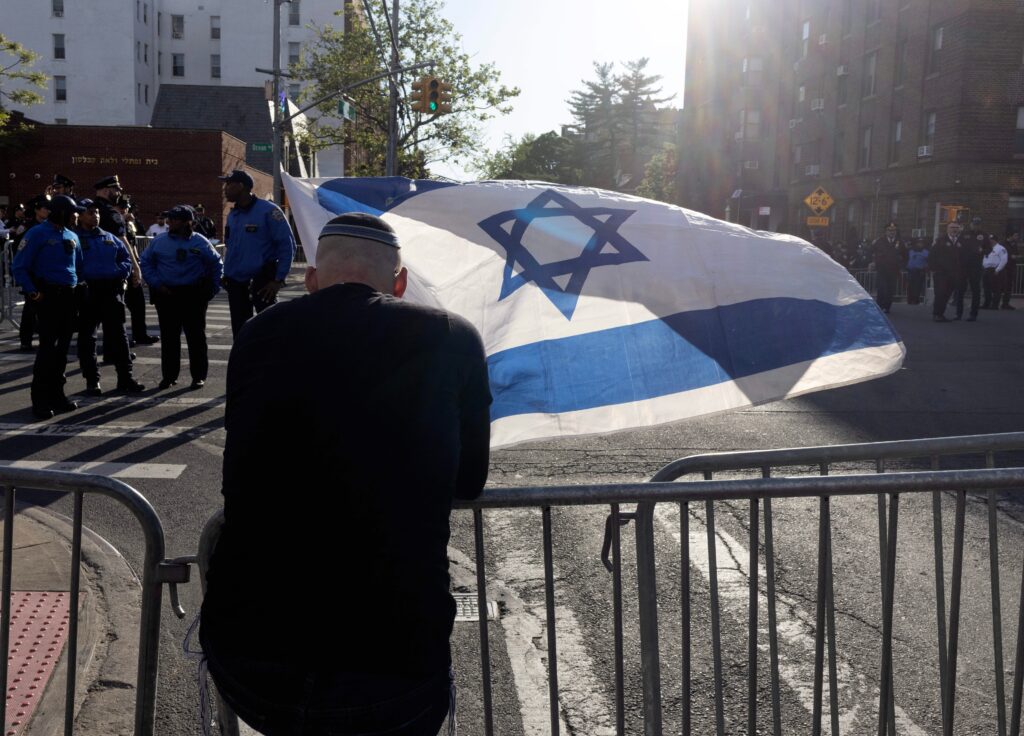
The tensions threaten to cloud this weekend’s Israel Day Parade, an annual event that began in 1964 to celebrate the nation as well as accomplishments of Jews from around the world.
Adding to the unease for some members of the New York Jewish community are the actions of Mayor Zohran Mamdani, a self-proclaimed “anti-Zionist” who in his first year has taken steps to distance the city from Israel and announced this month that he will not attend the parade.
“People are fearful. They are unnerved. And they have worries,” said Ammiel Hirsch, president of the New York Board of Rabbis. “There is real concern something bad can happen, and many people are changing their behavior.”
In Brooklyn in January, a man rammed his vehicle into the headquarters of a Hasidic Jewish organization. This month, federal officials said they disrupted a terrorist plot to attack a prominent New York synagogue. Days earlier, a flag containing a swastika was briefly raised from a building on New York University’s campus. Swastikas have also been found scrawled in parks, on people’s homes and vehicles, and at a train station.
Jewish community leaders say people are also unnerved by a wave of anti-Israel protests outside synagogues and in Jewish neighborhoods, where such demonstrations until now had been rare.
Antisemitic violence and threats also have risen elsewhere in the country since the Oct. 7, 2023, Hamas attack on southern Israel and the Israeli invasion of Gaza that followed. And there has been a spate of high-profile attacks on U.S. synagogues, mosques and churches in recent years.
Jeffrey S. Gurock, a history professor at Yeshiva University, said the fear and alienation being felt in New York’s Jewish community rivals some earlier fraught periods: the 1991 Crown Heights riot, when Black residents in Brooklyn attacked Jewish homes and businesses, and the pro-Nazi demonstrations in the 1930s.
But Gurock said a growing number of Jewish leaders worry that there is a major difference between those past eras and the current political climate.
“Fortunately for us, in the 1930s, we had a mayor who has very pro-Jewish, [Fiorello La Guardia], who was very effective at fighting the German American Bund,” he said. “That is a little bit different than what is going on today.”
Mamdani became New York’s first Muslim mayor after he cobbled together a broad coalition that included many liberal Jews, including those who consider themselves anti-Zionist or deeply critical of the current government of Israel. He won about a third of the Jewish vote, according to exit polls, and maintains strong ties to liberal and secular Jewish organizations.
Rabbi Margo Hughes-Robinson, the incoming director of New York Jewish Agenda, a group she says represents the “large normative middle” of the city’s Jewish population, said Mamdani cannot be blamed for an “anxiety about safety” that began building years before he took office.
“It is unwise to put this on any single elected official,” said Hughes-Robinson. “This is a systemwide problem that predates his candidacy, and we are missing the wider conversation that has been going on since the first Trump administration.”
Since taking office in January, the mayor has repeatedly found himself navigating the Israel-Palestinian conflict. It is an issue that is especially potent in New York City, which is home to about 1 million Jews as well as a rapidly growing Muslim population.
Mamdani signed two executive orders that were viewed as weakening ties between his city and Israel. He recently vetoed a bill that would have allowed police to create buffer zones to keep protesters away from schools — a policy Jewish organizations lobbied for in response to recent campus protests.
Earlier this month, Mamdani posted a social media video marking Nakba Day, a commemoration of the mass displacement and expulsion of Palestinians that accompanied the birth of the state of Israel in 1948. The word nakba is Arabic for catastrophe, the video says. The video featured a New York woman who was among the displaced.
Several Jewish leaders said it offered a one-sided view of historically complicated events.
“It’s making the atmosphere worse and it’s increasing threats against individual Jews and Jewish institutions,” said Hirsch, of the board of rabbis.
Mark Treyger, the chief executive of the Jewish Community Relations Council of New York, was one of several prominent leaders who decided to boycott a Jewish Heritage Month reception the mayor held at Gracie Mansion.
“We desperately need leadership that lowers the temperature and brings folks together,” Treyger said. “The video did not deepen understanding. It deepened division.”
A spokesman for Mamdani said the mayor believes strongly in recognizing the experiences and perspective of Palestinians and educating New Yorkers about “painful or complicated chapters of history.”
“I firmly believe that acknowledging any one people’s pain does not preclude you from the acknowledgment of another people’s,” Mamdani said at a recent news conference.
His spokesperson pointed to past statements the mayor has made “condemning antisemitism in all of its forms.” Mamdani denounced a recent rash of swastika graffiti and proposed an eightfold increase in funding for the city’s Office for the Prevention of Hate Crimes.
“My message to New York Jewish leaders is my door is always open,” Mamdani said last week.
Jewish leaders said they could not recall another mayor skipping the Israel Day Parade. Treyger, whose organization oversees the event, estimates that more than 50,000 people could attend the procession down Fifth Avenue in Manhattan on Sunday. The New York Police Department and private groups will be providing tight security.
“We are delivering on not just keeping Jewish New Yorkers safe but ensuring that Jewish New Yorkers understand they belong in the city,” Mamdani said while detailing security procedures this week.
The Anti-Defamation League, which tracks antisemitism, recorded a big jump since 2021 in both violent and nonviolent incidents in New York state, concentrated in New York City. Jonathan Greenblatt, the ADL’s chief executive, said he has been disappointed that Mamdani has not done more to condemn pro-Palestinian protests, which at times include participants holding flags in support of militant groups such as Hezbollah or Hamas.
“I don’t think you have ever had another moment where the Jewish community feels so alienated from the mayor of this city,” Greenblatt said.
But Sophie Ellman-Golan, the communications director for Jews for Racial & Economic Justice (JFREJ), accused more conservative Jewish organizations of “perpetuating fear” about Mamdani because they do not agree with his policies.
Many Jewish New Yorkers, Ellman-Golan said, believe their challenges are closely linked to other forms of “hate violence” including Islamophobia, racism and homophobia. Mamdani, she said, is an inspiring and unifying voice against those struggles.
Rebecca Kobrin, a history professor at Columbia University, said Jewish New Yorkers have migrated to the state seeking a sense of security since at least the start of the 20th century.
In 1902, Kobrin notes, a riot erupted on Manhattan’s Lower East Side when a mob threw garbage on mourners during the funeral procession for Jacob Joseph, a prominent rabbi.
In response to the upheaval, then-Mayor Seth Low established a commission to investigate the incident, Kobrin said.
“Even if the commission did not create the long-lasting change that the Jewish community wanted, it signaled to them that the mayor of New York saw that they were fearful and that they have a place in New York,” she said.
Kobrin said Low’s commission could serve as a model for how Mamdani could soothe Jewish concerns amid what she calls “unprecedented” demonstrations targeting synagogues, which in the past were considered sacred spaces safe from protests.
But Yaacov Behrman, a local leader from the Hasidic Chabad Lubavitch organization, said Jewish leaders’ concerns about the future extend well beyond Mamdani and his views. Behrman said his father was attacked by a mob during the Crown Heights riots, and he fears the city is entering into a similarly dark period of history.
“I think the mayor is a symptom of the mood,” said Behrman, who noted that polls show that Mamdani remains popular and that antisemitism has been rising nationwide on both “the right and the left.”
“It used to be that those visibly Jewish suffered the most antisemitism,” Behrman said. “Now, for the first time in a long time, being Jewish alone is enough … and a lot more people are feeling the hate.”
The post Attacks on Jewish sites stir fear ahead of New York’s Israel Day Parade appeared first on Washington Post.