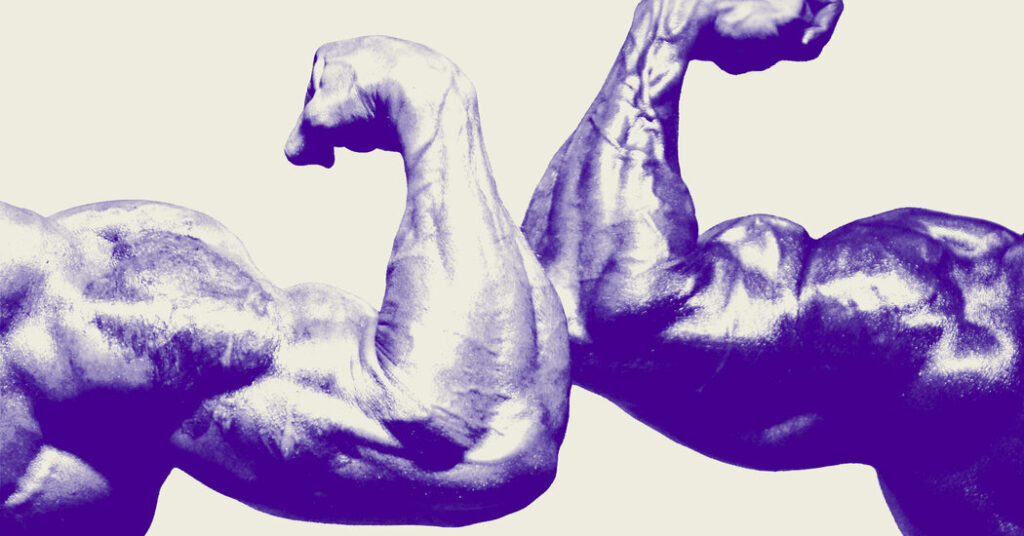
Young men are in crisis. While the left tells men to stay in their lane, members of the manosphere and the far right are welcoming them with open arms. In a conversation about masculinity in a post-#MeToo world, the Opinion culture editor Nadja Spiegelman talks to the authors Ruth Whippman and Frederick Joseph about what a healthier version of manhood could look like — and how we can get there.
Below is a transcript of an episode of “The Opinions.” We recommend listening to it in its original form for the full effect. You can do so using the player above or on the NYTimes app, Apple, Spotify, Amazon Music, YouTube, iHeartRadio or wherever you get your podcasts.
The transcript has been lightly edited for length and clarity.
Nadja Spiegelman: I wanted to have a conversation about masculinity in a post-#MeToo world.
So today I’m talking to Ruth Whippman, the author of “BoyMom,” a book about raising young men, and Frederick Joseph, the author of “Patriarchy Blues.”
Frederick, Ruth — thank you so much for being here with me today to talk about masculinity. First, a little table setting. Where are we now? How would you describe the state of young men in this country right now?
Frederick Joseph: I think that we are in an abysmal state.
I think the reality is that we’ve always had patriarchy at the intersection of capitalism and white supremacy, and how those things feast on one another and lift one another. But I think right now, more times than not, the role models that these young boys and young men have are not only divisive and toxic but insidious and heinous, disgusting. Truly, I mean, the president of the United States is an alleged rapist. What does that mean? You know, the popular thing that boys are watching is largely M.M.A., right? So I think we’re in a horrible place.
Ruth Whippman: Yeah, I would agree. I feel like young men are kind of caught between these two competing but harmful narratives. Like, one of them is this — what you’re describing, this caricatured masculinity. These things that have always been in existence — this tough guy, bulletproof man — but just taken to this caricatured extreme.
And you’re seeing it almost on the left as well as on the right. But then, on the other extreme — more from the progressive left — I think you’ve got this “shut up” narrative, which is like: Your problems aren’t real. They don’t matter. You have so much privilege, you know. You have everything. Time for everybody else to have a voice and for you to be quiet. And I think it’s just really hard to navigate. I think they feel shut down from all directions, honestly.
Spiegelman: Before we get deeper into things, I want to hear a little bit from each of you. Just the highlight reel/nut graph of how you would approach a conversation about masculinity. Ruth, you’ve done a lot of reporting on the subject, and you also wrote a book about raising sons. Can you tell us where you’re coming from when you’re talking about masculinity?
Whippman: I think, when we talk about masculinity, we have to talk about the patriarchy. And I think we see this as this system which harms everyone, including men. I think often people take a gender studies class in college or whatever, and they learn, like, “Patriarchy harms men,” and then they’re like, “Well, great. OK, put that aside and then move on. Forget about it.” And I know that when we’re triaging these issues, like, is harm to men the worst abuse of patriarchy? No, probably harm to women and trans people and people of other genders is more urgent. But I think if we can see ourselves as part of a system of patriarchy that harms all of us, and we are allies in this fight rather than men versus women, men oppressing women, then I think we can have a more productive conversation.
Spiegelman: Frederick, you wrote a book of essays and poems called “Patriarchy Blues.” You also spend a lot of time talking to men in the world. Where are you coming from when you’re talking about masculinity?
Joseph: I think, for me, I look at patriarchy in the same way that many people during the 2020 moment were looking at racism and white supremacy. You can’t dismantle patriarchy without an anti-patriarchy movement, right? And the thing that we were telling people was largely that there was a return on investment for dismantling white supremacy.
There was a return on investment for dismantling racism, and that’s my argument as well for the patriarchy. I tell young men all the time: You’re not, in these systems, allowed to be a whole human being. You know, the thing that you are entitled to, they teach you, is your rage, and then even that you’re not really entitled to. They don’t teach you how to cry. They don’t teach you how to laugh. They don’t want you laughing. They don’t want you crying because they actually do, in capitalism, want to monetize that rage of yours. That’s how you get the manosphere. And I think we often teach it as a sort of charity. This isn’t charity that you’re doing for women by dismantling patriarchy, and it’s not charity by dismantling misogyny. This is actually the work of self. You know?
Spiegelman: I really relate to that. I mean, as you were saying, in my own thinking around white supremacy, I had to come to, like — this is just being a narcissistic millennial in the world — but what do I stand to gain from dismantling white supremacy, a system that seems to benefit me in so many ways? And for me, the answer to that is the fullness of my humanity. And I really was thinking a lot, when approaching this conversation, about: How do we do the same thing for patriarchy?
Because one of the questions I think a lot of young men have is, what does positive masculinity look like? I know the image that the manosphere posits for masculinity, and I think it’s one that also encompasses a lot of misogynistic ideas. And I know so many men who are not misogynists, and who want to be living in a gender-equal world, but who are still men, who still need an idea of masculinity that feels positive to them. Have you thought about this question and how to answer it, and how do we get to a place where there are so few answers for it?
Whippman: Positive masculinity as a sort of framework is not my preferred framework for thinking about this issue, or like, what to do for young men. In the same way that if someone was trying to sell any hypothetical daughter positive femininity instead of feminism, I think I would push back on that as well, because I think it’s already setting the terms in quite a restrictive way that ends up slightly reinforcing gender stereotypes.
So I think I would rather that we sort of move toward giving boys and men a vision of being a full person, a full human. And rather than gendering qualities and being like, “These qualities are masculine and these qualities are feminine,” and how do we navigate and pick and choose between those — and what’s the minimum amount of femininity that we can choose in order to not emasculate ourselves totally — I’d rather we’re just like, “OK, just be a person,” you know? These are minimum standards and minimum qualities that we expect from every adult, and they don’t need to be different ones for men than for women.
Joseph: I hear that, and I think, for me, you have to have a sense of positive masculinity only because we do live in the boxes of the society that we currently live in. I think that this vision would be beautiful if it wasn’t for the fact that we have femicide and all these different things.
And I think there is so much toxic masculinity, and I hear boys all the time say, “I literally do not know what it means to be a good boy or man.” Because I think, on the one hand, all you see is these terrible role models who aren’t role models at all. On the other hand, you have people saying what isn’t good, but you have to tell people what can be good, right? Looking at race, right? And they’re not a one-for-one, but you actually have to have positive ideas of what it means to be a decent white person, right? And that was one of the things in my first book that I pushed heavily — that you can be a decent white person, and being a decent white person is not going to be the same as being a decent Persian or a decent Black person or a decent Asian person, because the systems and institutions prop up and lift and are owned by — run by and controlled by — white people.
So while, again, you’re 100 percent right, patriarchy impacts us all in various ways, but men are the issue, in large part, with patriarchy. So I do think that we have to show what a decent man is.
Spiegelman: One of the things that made me really want to have this conversation is that I just feel like everyone is siloed into their own social media spaces, but for me, when I’m looking at social media, so much of what I see online and so much of what I hear women say is, “Men are trash.”
Sabrina Carpenter said that the key to her songwriting is just to call men stupid in as many ways as you can. I really understand where women’s anger comes from. I have lived it. But I also feel so much tenderness for my brother, for other men I know. And if I were hearing the same kinds of messages in reverse that were just, “Women are trash,” I wouldn’t know how to begin to approach the world. And so I wonder how — specifically on the left, because I think that there are different answers to this on the right — specifically on the left, which is where I hear men are trashed the most loudly, what effect is this having on boys? Do they hear it? Do they feel it? Is it empowering for women? Is there another way to approach this?
Whippman: I have three boys, and I hear this all the time. We live in a very progressive community, and “Men are trash,” “Men suck” is just in the water, and it’s really, really hard when you’re raising sons. And they’re young. They don’t know the entire history of patriarchy, nor do you want to explain that in every single moment.
And it’s the justification, you know. In a way, it’s supposed to be punching up, isn’t it? Like, men have all the power, men have all the privilege, so it’s OK to call them trash because it’s not the same as a man calling a woman trash, which is punching down.
But those distinctions are getting more and more abstract, especially when you’re 12 years old and you’ve never heard “Women are trash” and you’ve heard a lot of “Men and boys are trash.” And I don’t think this is helpful. I think it’s really harmful. It’s not equivalent to misogyny. They’re not the same. But it is still, I think, a real problem. It’s really a terrible negative. And I think it’s incredibly psychologically harmful for this generation of boys to just go around hearing that over and over and over again.
Joseph: I think the reality is that women are entitled to a righteous and rightful rage. And this makes sense to me, right? I’m not a woman. I’ve never lived in the throes of the worst iterations of patriarchy. I don’t have to deal with certain things, and so I just want to name that to begin with. What it reminds me of, though, is a lot of parents not wanting young white children to hear about the issues with whiteness.
And the argument became — and I’m one of the people who made the argument — if Black and brown children are old enough at any age to have to suffer racism, then I think white children should have to learn and understand their place within racism. And I guess that’s the same way I feel about the idea of misandry and whatnot. I have a younger brother; he’s 14. We have a huge age gap, obviously. And I’ve been having conversations with him about who boys and men are in relation to women since he was probably about 6 years old. Because I do know he’s going to hear and see on the internet: “Men are trash. Men are trash. Men are trash.”
And I guess my answer or my response to that is, “I’m going to tell you why,” right? And so, as opposed to putting the onus on women and whatnot, I’m placing it on myself. And I suppose other men as well. I don’t think that the onus should ever be on the victim. I get, conceptually, how we got here. And so I just sort of look at it like: I’ll see the videos. This is not about me, right? This is not about me. You’re not talking about me. I’m trying my best to be a decent man. I’m going to try my best to make a generation of decent boys.
Spiegelman: To go back just a step to, if, on the left, what men are hearing is “Men are trash” — this is actually related to what we were just saying. But if on the left what men are hearing is “Men are trash,” doesn’t it make sense, then, that the right is their safe space? And it makes me wonder, I mean, clearly there is an increasing gender divide about how people’s politics fall left or right.
Men are moving more to the right, women are moving more to the left, and it’s only exacerbating these problems. And I think part of what I’m really interested in is, how does the left bring men back into the fold?
Whippman: I mean, when I was reporting for my book, I talked to incels in these incel communities, and they absolutely felt like that. I mean, they really felt like, “There is nothing for me outside of this. I’m lonely and I’m lost.” And one guy that I went quite deep with in particular, he was really like, “I would like to leave this community. I would like to seek help. I would like to find a therapist or talk to another person, but I’m just so scared of hearing: ‘Your problems don’t matter. You’re a white man. Everything’s great for you.’”
And I think part of that was self-justification, but I think there was something really real in that, and I think that he had been hearing those messages. And it’s like, yes, it’s not the same, but it’s also very real, and I think it is pushing young men toward the right, for sure.
Joseph: Yeah, I mean, the right wing — they’re an intelligent collective of people. And I think that they understand human nature better than the left. There isn’t really a pipeline on the left to lead you to the left. You don’t have an Andrew Tate on the left. You don’t have someone similar to a Dana White on the left, Conor McGregor, all these different people. And so I don’t think that the left has created a strategy at all for: We have lost generations of boys and men. How do we get them back? What do we give them to believe in? And who do we give them to believe in? Because I think that’s also really important.
Spiegelman: My friends who have very young kids have told me that — and this is so different from how it was when I was growing up — when they’re reading books to their sons, a lot of the narratives of these books is that there was a very brave, courageous girl and a dumb, dumb boy. And these are progressive books, and I understand where they’re coming from. When I was growing up, I would only write stories with male characters because a male character was a blank slate, whereas a girl had so much to overcome just to begin to enter the story. But things have swung really far the other way. There are now a lot of books that promote feminism at the expense of young boys.
Whippman: I don’t know if you know the movie franchise “Inside Out.” That was a really good example. I was watching them with my son, and it’s like this really complex story of this young girl’s interiority and her emotional life, and it’s this great portrayal of a young girl’s emotions. And then you go inside her mom’s head.
And they have this complex interaction. And she’s tracking her mom’s emotions and her mom’s tracking her emotions, and it’s incredibly sophisticated. I don’t know if it was every time or if it just felt like every time that a male character appeared onscreen in that movie, they were an emotional idiot. It’s like you go inside the dad’s head and he’s like, “Uh.”
And all the emotion avatars have got their feet up on the desk, and they’re checked out and watching the game, and that’s the joke. And I’m watching this with my, at the time, 6-year-old son and thinking: What are we telling him here? Like, everyone has a rich emotional life apart from you, and you’re an idiot? And I was like, that would never pass if that was a mainstream Disney or Pixar movie that had a sexist stereotype about a girl, you know, we would not stand for it culturally.
Joseph: I think that some of the issue goes to this idea of a pendulum swing. Because when you’re saying that, I’m like, you know what’s so interesting? Because as a Disney buff, we did have “Snow White” and we did have “Sleeping Beauty” — not only misogyny, but the rape culture of something like “Sleeping Beauty,” even.
And so I think now, what has happened is, instead of us having a conversation in our society about how we create something equitable, I think a lot of people are interested in: OK, I’m going to swing the pendulum the complete opposite way. It’s like: You hurt me; I’m going to hurt you. And that, you can see directly in how the father or the boys are represented. You’re like, “Well, yeah, I can represent you this way because look what they did with ‘Sleeping Beauty.’”
Spiegelman: Yeah. Speaking of the pendulum swing and thinking about how we got here, one of the things I really want to talk about is the legacy of #MeToo, which was, for me personally, an incredibly important movement. I was working at The Paris Review when #MeToo happened. The editor left at that moment. The culture of the workplace where I was working changed drastically. I have felt an enormous benefit from that movement, in terms of my ability to be taken seriously at work and to move through professional spaces.
And I also think that there are a lot of things that we’re feeling now, in the culture, that are the long tail of #MeToo. And we’re almost 10 years out, and I think it’s worth talking about, because I think that this is also the moment when women began to feel — and I’m absolutely guilty of this — very empowered to speak very loudly about the things that men had done that had harmed them to a degree that perhaps now has been sort of flattened down to just, “All men are trash.”
And I’m curious, Ruth, in your reporting — I know you’ve written quite specifically about this — how you think about the long tail of #MeToo.
Whippman: It’s a really complicated thing, because like you, I was thrilled at the #MeToo movement, and it absolutely named something that was so real in my experience, and this normalization of harassment and abuse and all the rest of it. And I think I understand it was just this groundswell of rage, but navigating that as a feminist while raising boys and thinking about how all we’re hearing — like, there’s this microgeneration of boys that were going through puberty around the time of the #MeToo movement, in 2016, 2017, who are now of voting age, of college age, and they have spent their entire adolescence in the shadow of this conversation, which has been framed very much as: Men are predators, men are harmful, men are trash. Much of which is true and so important to talk about.
But without a parallel conversation about how men are also harmed under the system, this isn’t serving you, either. There was this real piece missing in that conversation that has left a lot of boys feeling shut down, rageful, disenfranchised, and unable to really find how they’re going to make their way in the world, you know?
Joseph: It’s interesting. I think that listening to the two of you reminds me how important it is to understand our different spheres that we’re in. My sphere is very progressive, but also very Black-centered, very brown-centered.
I’ve been lucky enough to be very much welcomed by deeply intersectional feminists, womanists. And so I think a lot of times the conversations that were being had in a more mainstream sense were largely led by white women. And then there was a reckoning around that because of Tarana Burke, and Burke having been the person who had largely started a lot of this work in many senses of the word. I had been a part of those conversations. I went to Hunter College undergrad, where Audre Lorde went. I think Hunter College is 64 percent women, right?
So I’m just lucky to have been in these spaces where I’m not the dominating person. It was very much, in my experience, welcoming. And thoughts around not only how some men have been harmed, but how trans people have been harmed, how queer people have been harmed, and things like that.
Spiegelman: I think that the conversations that I was hearing happen around #MeToo, for me, were revelatory in the sense that I was realizing how universal the experience was of sexual harassment, of rape, of feeling held back at work based on the power dynamics around gender.
And I mean, I think that was the moment for me, in my life, when I realized I didn’t know any women who hadn’t experienced this — which is what #MeToo, the words, are about.
But that consciousness-raising of, like, this is not an individually isolated thing — this is happening so prevalently — was enormously useful. As I was saying, I worked at a workplace where my boss left around this moment, and the culture of the workplace changed.
But it left so many of my colleagues who were men — white men who I really respected, and who really, to me it was obvious, respected women — confused about how to act. I had one colleague who was like, “I always take the interns out for drinks. Every year I take the interns out for drinks. But I can’t take the interns out for drinks this year because it’ll look like I’m trying to get interns drunk, and I can’t get interns drunk.”
And he was also like, “And am I allowed to compliment your clothes? Because I like your clothes, but I don’t want to get in trouble.” And I could just see that he was really trying to figure it out, and I had real empathy for that, because we were defining new rules, and the new rules left very little room for nuance. They were very strict rules. But this was something that I feel like anyone who has experienced any form of societal oppression understands — that someone can compliment your clothes and you can know that they mean that they like your clothes, and they can compliment your clothes in a way that makes you feel small.
And it actually doesn’t matter what words they say; the intention behind how they say it matters. And I think, across different forms of oppressed identities, this general thing can be understood. But how do you explain it to cis straight white men who have never experienced this?
Whippman: Right. I mean, I would say, there’s this real fear among teenage boys at the moment. And I think it’s contributing to this sex recession, dating recession, whatever you want to call it, where teenage boys are feeling very fearful of approaching girls. And in some ways that’s good and right, and it’s a correction to a very real problem.
But I think it also does come back on boys of color as well, especially on Black boys. I found, in the university context — I did some reporting on these Title IX proceedings in colleges, and boys who’ve been accused of sexual violence. And often these are really, really complicated situations, and I think that Black men are disproportionately accused of sexual violence by white women on college campuses, and often these accusations are found to be, if not unfounded, then very complex.
There’s a lot of racist maneuvering going on, in that it’s not just the stereotype of, like, the white man can’t harass anyone he wants to anymore. But all this stuff is so layered and so complicated. But I really don’t envy a teenage boy trying to date in this environment, you know?
Joseph: It’s interesting. I agree with so much of that, and I think that there is definitely institutional racism that ties to much of this. But what I would say is, in terms of the white men at that time — especially as a cis het man — I’m not interested in infantilizing these people. Like, you can run a Fortune 500 company, but you can’t understand how to do something creative to take interns out who are women? I don’t know. I just feel like a lot of white men suddenly became childlike during that time. You took over the entire world. You can’t understand how to navigate the #MeToo movement?
Spiegelman: I agree with you, and also I just feel like there were moments at the height of this movement when I would want to talk about nuance, because I do think that there has to be nuance to this conversation, and the very word “nuance” was suspect.
Like, if I said the word “nuance,” it was as if I was being a rape apologist. And I felt really confused by that, because these don’t feel like conversations that can be, to me, solved by the extremes of black and white. My little brother was in college at that time, and he came home being like, “I’m really trying to get this right, but they’ve given us so many seminars, and they’ve said that if a woman is drinking, you shouldn’t make a move on her. But we are drinking all the time, and so everyone is drunk always. And so I don’t understand how to reconcile these two rules. How do I make this work?” And for me, I was like, it is so much about your intentions, and it’s very hard to put a very blanket rule on things.
You are smart enough to know if a woman is consenting or not, and we can really speak about what it looks like to have active consent. But instead, people were being given these very blanket rules that were not nuanced, and I feel like it has created a lot of confusion.
Joseph: Maybe just because I went to school for this — communication — I think, obviously, consent, so on and so forth, but I think we can’t assume intentions, necessarily, because I think intentions change depending upon geographic location, age, all sorts of demographic things, right?
Like, if I’m walking and I give a head nod to another man and he’s Black, we have an understanding of what that means. If I do it to a white guy, he’s like, “What the hell are you doing?” I communicate what I’m thinking. Again, I’m not going to infantilize some of these men, but I’m also not going to infantilize women.
Like, even as we’re sitting here across from each other, from the beginning of the conversation, I originally said to you, “I think you should go first.” And you can tell me, “I don’t think I should go first.”
And so in many instances, you have gone first, but I hope that in my communicating that gave you the latitude to say, “I agree or disagree.” And I think that that’s the sort of interactions that I would want people to have.
So it’s not just consent; it’s so much more than consent. It’s also an active conversation.
Whippman: I mean, one thing that I will say, I think that we give boys in general a very, very poor grounding in relational education, in communication, in social skills, in emotional nuance, in picking up signals. And that is something that starts from birth. There’s a real difference in the way that we socialize girls to really track other people’s emotions, to understand body language, to understand what someone might be feeling, to see it as their role to act on what somebody else might be feeling.
And these are things that are sort of baked in so early that then, I think, by the time that kids get to college, girls have this huge head start on this communication, these relationships, and understanding and caring what another person thinks, and seeing it as their responsibility to track that and respond to it. And so, yeah, it’s something that has to start much younger. And I think patriarchy robs boys and men of that, of those skills.
Spiegelman: Christine Emba wrote this really wonderful article in The Washington Post, called “Men Are Lost. Here’s a Map Out of the Wilderness.” If people listening to this conversation are interested, I would highly recommend it as further reading.
And part of what she talks about is, specifically, how do we create a leftist counterpart to the manosphere, and what does that model of masculinity look like? And I know you both have thought about this a lot. Ruth, what do you think?
Whippman: I mean, I think it’s many, many different things. I don’t think it’s possible to just say, “OK, here’s the answer,” you know, get a Joe Rogan of the left or an Andrew Tate of the left, because I think those attempts often don’t really feel authentic. I think it’s many conversations and individual acts and people coming together to talk about these things. And I think it’s possible. I was just thinking, you know, you look back at pretty much any movie from the ’80s or ’90s, and you look at the things that they could get away with as completely normal when it came to, like, racism, sexism, homophobia, transphobia, which were just completely normal and that are not normal anymore.
We have moved on as a culture when it comes to those issues. It’s by no means perfect. There’s so much work to do, but we have moved on, and I think we can do the same for the way we think about boys and men, but I think it’s lots and lots of little things all the time — lots of people doing the work, lots of people thinking, lots of conversations like this, lots of work like the kind Frederick does. It’s bit by bit by bit. I don’t think there’s one single solution to it.
Spiegelman: I also want to just follow up on something that you were saying earlier, about how you think about raising your sons to be good humans, and how you want them to have tenderness, softness — these qualities that we generally associate as feminine traits.
And I really want that for men, too. I want them to have friends. I want them to feel like it’s valorous to cry or be vulnerable. And at the same time, I think — if we’re fully honest — we don’t really want a society where men are just like women. There is value to having a society where there are men and there are women, and they are able to be, in the grand scheme of things, different from one another.
And so I’m thinking really hard about what other messages we can give men that aren’t just: Be more like women. I wonder if you’ve thought about that.
Joseph: Yeah, I mean, there are things that exist socially, conditioned within men and women, but I think that, again, they are socialized and conditioned, right?
For example, tears. I cried during “Hamnet,” just like the two women next to me cried during “Hamnet.” And I think that what we have been taught is that me crying during “Hamnet” is some oddity. And that’s what I rail against. And I don’t think that we have done a good job of propping up the people who rail against that.
Like, I’ll give you a phenomenal example: There was a conversation recently about people going to this website, right? And it was, like, all these men — and I think we’re all very familiar with it — all these men going to this website, and it was teaching them how to rape their wives. And I was wondering — just as I’m watching all these proper grievances by women and people — I’m like, “All these men are garbage, absolutely.” And I was also like, “Where’s the counter?” I see all the rightful rage. What is the actionable thing here? Where are we leading people to? Because it’s not enough to stop at the point of just saying: “These men are dangerous.” Absolutely. “These men are frightening.” Absolutely. “These men are disgusting.” Absolutely. What are we doing?
Spiegelman: Yeah, what are we doing?
Joseph: But if you just keep people in this perpetual state of anger, you can keep on writing about it. You can keep on making videos about it. You can keep on selling things pertaining to it, and people will click, and people will talk — you’re feeding the beast. You do not want people getting healthy. It’s the same thing with patriarchy. It’s the same thing with white supremacy. It all feeds capitalism. If white people are not great and they keep on doing racist things, more people sell books, more people click on articles, more people go to websites, et cetera. It’s a perpetual cycle of bigotry.
Whippman: And also the whole Jeffrey Epstein commentary — there was no real mainstream discussion of patriarchy and how that informs that. There were a lot of people talking about class and about wealth and about money and about power, but there was very little naming of this systemic force and just talking about it, you know?
Joseph: And to that point, even with Epstein and everything that’s transpired over the last few years — and maybe you’ve seen something different — I’ve not seen a major push to dismantle or unpack patriarchy, to your point. And that’s the thing I’m saying: Oh, we are so angry and frustrated and in disbelief and harmed and hurt by what these men did to these girls. So where are the conversations? Because this is not just wealthy white men flying girls to an island. This is happening in your neighborhood.
Whippman: Right, this is the whole system. Why aren’t we talking about it? Right. I completely agree.
Spiegelman: Yeah. So I know we’ve talked about this quite a bit in various ways in this conversation, but I wonder if we can just quickly run through what are things, what are traits and qualities, if not of positive masculinity, then of the kind of masculinity the left should be promoting as a counterpart to what’s in the manosphere?
One of my colleagues has gotten really interested in the subreddit “r/bald,” where men just compliment each other. Men are like, “Shave it off. It’ll look better.” And then they’re like, “Bro, you look great. You look amazing.” And it’s just like a very sweet corner of the internet, because it’s one in which men just support and compliment each other through a difficult transition time in their appearance.
And I’m curious. What are those other qualities and traits of something that the left could be promoting as a vision for boys?
Whippman: Yeah. I think that male friendship and male bonding — it’s got such a bad name because it’s become associated with locker room talk and gross things. But I think you’re right. It’s just that sort of brotherhood, that loyalty and courage and support for one another — it’s something that’s really lovely.
I’m from the U.K., and I think there is a real culture of male friendship there in a way that I don’t see quite so much in the States. Maybe some of it is because of alcohol and drinking and those kinds of things, which obviously brings up a whole new range of problems. And I think some of it comes about from trauma, like boys being sent off to boarding school and that sort of thing.
But I think there is this real culture of male friendship and male bonding, which is very lovely, that I’d like to see.
Joseph: I’ll give you a good example, actually. Right now — and I can’t stand this team for various reasons — but the Oklahoma City Thunder, who are in the Western Conference Finals of the N.B.A. playoffs, comprises a lot of Gen Z young men.
And the ways in which they love on each other is such a positive embracing of brotherhood, friendship and love for each other. I’ve literally heard them say: “I love you. Thank you for showing up for me tonight. Thank you for this. Thank you for that.” And I think that we could be promoting that more, that there are great examples of young men — and men in general — who are not afraid to love on each other.
Spiegelman: Before we wrap, I want to know one traditionally masculine quality you’d want your sons or your younger brother to take on, and one that you wish they wouldn’t.
Whippman: I mean, look, there’s so many great qualities associated with masculinity, like courage and protection and strength and all the rest of it. But I think I’m going to go for fixing stuff. So I would love for my kids to be able to have those skills, those old-school masculine skills. And then what I wish they really wouldn’t, I think it’s got to be emotional suppression. Just that feeling that you cannot connect with your own emotions. I think that’s so unhealthy and harmful, and I really hope that my boys will be able to connect with their own emotions and those of other people.
Spiegelman: I love that answer.
Joseph: I’d say I think the first one would be being actionable. I think that we have this idea of men in our society, historically, like: This thing is happening. I’m going to jump in and try to do something. Can you be actionable about somebody saying, “You harmed me”? Can you be actionable about someone saying, “I felt unsafe in this moment”? So that sort of ability to, like, jump in and do the thing. I’d love to see that in, say, maybe more emotional and social ways.
And then, in terms of not passing down — stubbornness, right? I think that a lot of men have been taught this personal manifest destiny, if you would. Like, the entire world belongs to you, and you’ve just got to go out and seize it. And I just want you to stop and listen to other people. Just stop. The only thing I think that you’re promised in this world is the person in the mirror and what you do with that. And so, you know, just stop and listen. Stop and listen.
Spiegelman: That’s beautifully said. Ruth, Frederick, thank you so much for being here with me today.
Joseph: Thank you. This was a wonderful conversation. I really appreciate it.
Whippman: It was such a pleasure. Thank you.
Thoughts? Email us at [email protected].
This episode of “The Opinions” was produced by Vishakha Darbha. It was edited by Kaari Pitkin and Jasmine Romero. Mixing by Daniel Ramirez. Video editing by Steph Khoury. The postproduction manager is Mike Puretz. Original music by Pat McCusker, Isaac Jones and Aman Sahota. Fact-checking by Mary Marge Locker. Audience strategy by Shannon Busta and Kristina Samulewski. The director of Opinion Video is Jonah M. Kessel. The deputy director of Opinion Shows is Alison Bruzek. The director of Opinion Shows is Annie-Rose Strasser.
The Times is committed to publishing a diversity of letters to the editor. We’d like to hear what you think about this or any of our articles. Here are some tips. And here’s our email: [email protected].
Follow the New York Times Opinion section on Facebook, Instagram, TikTok, Bluesky, WhatsApp and Threads.
The post America Has a Masculinity Crisis appeared first on New York Times.