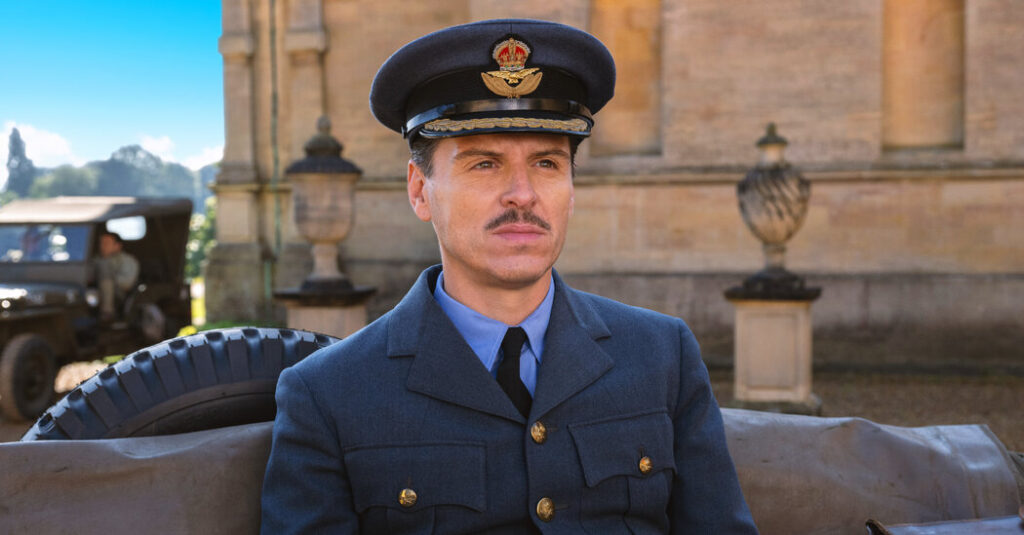
“Well, for a start, he is shorter than my father, considerably,” said Peter Stagg of the actor Andrew Scott, who portrays his father, Group Capt. James Stagg, in the new film “Pressure.”
“He was 6-foot-4,” Mr. Stagg added. “Which, in those days, was very tall.”
A whole 3.93 inches, or 10 centimeters, separates Scott from the elder Stagg. It’s a small and faintly amusing discrepancy, and one of the few liberties taken in a film that is otherwise strikingly committed to historical detail. Because beyond the question of height, “Pressure” is a careful retelling of one of the most pivotal weather forecasts in history.
Set during the tense 72 hours leading up to D-Day, the film follows Stagg, the quietly burdened meteorologist tasked with advising Gen. Dwight D. Eisenhower on when the weather conditions would allow the Allied invasion of Nazi-occupied France to proceed.
The criteria for such weather conditions were extraordinarily precise. The invasion needed to take place during a low tide, in order to expose German defenses, and it needed to be just one day before or up to four days after a full moon. It also had to align with a Soviet summer offensive from the east, to maximize pressure on German forces.
There were other strict requirements:
-
Before the landings, the weather needed to have been calm for 48 hours.
-
Parachutists and other air support needed less than 30 percent cloud cover below 8,000 feet, with a cloud base no lower than 2,500 feet and visibility over three miles.
-
For the three days after, the wind needed to stay below a moderate breeze, to keep the landing craft from capsizing while crossing the English Channel.
Stagg was also responsible for producing a unified forecast based on input from three independent groups, two British and one American, who often clashed in both methodology and interpretation.
In 1944, forecasting was an evolving science, and even Allied countries approached it differently. The American team, part of the newly formed U.S. Strategic Air Forces, employed analogue forecasting, comparing current conditions to historical weather patterns. The British teams, by contrast, relied on hand-drawn charts, observational data and newer understandings of upper-atmosphere patterns.
I came to “Pressure” being somewhat familiar with this story, having spent time last year reporting on the real events behind Stagg and the integral D-Day forecast. I watched the film with a particular focus on how it handled the tension between fact and drama.
Weather films based on real events often take liberties with the facts, and the science. “The Perfect Storm,” for example, was based on the real 1991 storm that led to the loss of the Andrea Gail, a 72-foot fishing vessel whose six-man crew died at sea. With no survivors, no one knows what actually happened on the boat during its final hours, meaning much of the drama had to be imagined. Even the storm itself was portrayed as more intense than it had actually been.
Both “Twister” and its follow up film, “Twisters,” were inspired by real storm chasers — an inherently dramatic job — but they simplified and exaggerated how tornadoes behave in reality. Forecasting and storm-chasing technology in both films is shown to be far more precise and advanced than it is in real life.
But for the most part, “Pressure” takes care to hew closely to the facts.
The film’s attention to detail is no accident. Dr. Catherine Ross, a library and archive manager at the Met Office, Britain’s weather service, said the filmmakers had spent a day with her examining the archives, including original hand-drawn weather charts and Stagg’s own diary.
“They really went to town,” she said. “They even had somebody color matching the charts to make sure that when they were printed off, they were the right shade of green.”
Bill Shieldods, a senior Met Office forecaster who works with the military at R.A.F. Leeming, was brought onto the production because of his experience in hand plotting charts, and he even appeared briefly as an extra.
He described the set as “Disneyland for a Met forecaster,” saying he felt as if he had stepped into a time machine. He began his career in the 1980s in a manual forecasting environment that, he recalled, was still remarkably similar to that of 1944, before computerization fully took hold in operational meteorology.
Charts at the time, as depicted in the film, were painstakingly drawn by hand, sometimes taking hours to complete. Mr. Shieldods described a level of detail on set that had gone far beyond what most viewers would see.
“In the forecast room were folders, they looked the part, really vintage,” he said. “I expected there would be nothing in them, but I opened one and there was documentation about the D-Day landings, the sort of weather criteria and stuff specific to that era.”
However, like any dramatization, “Pressure” inevitably shapes history to fit its narrative. One of the most notable compressions concerns the timeline of Stagg’s involvement. In real life, his role in planning the D-Day forecast began months before the invasion, but the film put it just days before.
Appointed in early November 1943, Stagg and his team of forecasters from the United States Army Air Forces, the Met Office and the Royal Navy spent months running practice forecasts. These exercises were crucial in building Eisenhower’s trust as well as demonstrating that a reliable and unified forecast was possible. Dr. Ross said that Stagg had also played a key role in determining the precise list of weather parameters required for a successful invasion.
The film, however, suggests that Stagg first meets Eisenhower and the team of forecasters in early June.
In reality, as Stagg recounts in his book, “Forecast for Overlord,” Eisenhower had already initiated weekly in-person meetings by mid-April, attended by an array of high rank officers that Stagg initially found daunting.
The film also compresses elements of Stagg’s personal life. In it, his wife gives birth to their second son immediately after D-Day. Peter Stagg said that while his mother had been pregnant at the time, his younger brother was born a few months later, in November.
Eisenhower once described Stagg as a “dour but canny Scot,” and his son Peter said his father had been “very polite.” But, he added, “if somebody deserved a rollicking, my father would give it to him.”
And despite that small matter of a 3.93 inch height difference, Peter Stagg said, reflecting on what his father might have thought of the film, “I would hope that he’d feel honored and pleased.” He said he was glad his father was “now getting the recognition he deserved to have had” over 80 years ago.
Nazaneen Ghaffar is a Times reporter on the Weather team.
The post The Forecast That Saved the World, and the Movie That Tells the Story appeared first on New York Times.