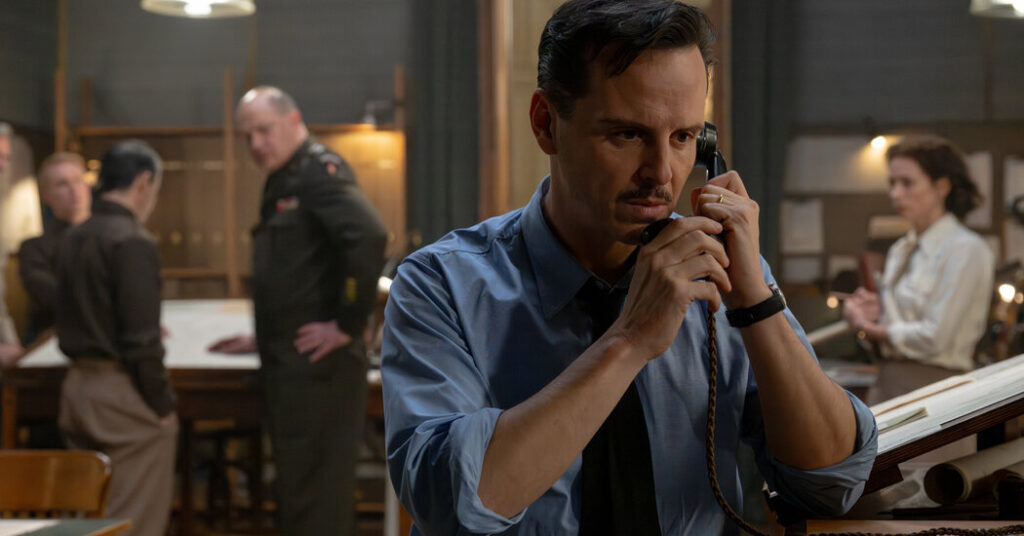
In many disaster movies, there is that moment when the scientist reluctantly stands before politicians and five-star generals, and gives a technical spiel about the brewing crisis. The men usually scowl and demand that he simplify his statements. Then, the expert takes a breath — but really this is for us, the audience — and explains in plain and sober terms: Cataclysm is on its way.
“Pressure,” directed by Anthony Maras, is like dragging out that kind of stakes-setting scene to a full-length film, then sapping it of its drama. That’s because in this case, the promised disaster — the assumed arrival of which any tension is predicated upon — never comes. The potential catastrophe? The possibility of intense, stormy conditions that would sabotage the Allies’ D-Day operation during World War II.
Of course, the broader stakes are real, but the premise here amounts to an overdramatized tidbit of trivia. There are many staid films that rely on the backdrop of our bloodiest war to prop up a dull story, but “Pressure” pushes the bounds, focusing on, in all that human chaos, the dueling weather reports of two meteorologists. The fate of the world rests on the outcome of D-Day, Gen. Dwight Eisenhower (Brendan Fraser) tells the chief meteorologist, James Stagg (Andrew Scott). And so, the general declares: “I need a forecast.”
Of the weather on the day of the invasion, that is. Drama here is found in calls to gather data on salinity levels and upper and lower air, and to send off weather balloons in the sky. There’s also the crudely contrived danger befalling Stagg’s pregnant wife (Tamsin Topolski), who’s off in a hospital that is bombed while he’s stuck in the war rooms. But the main conflict is between Stagg and his fellow meteorologist, Irving Krick (Chris Messina), each offering a different prediction of weather conditions (Stagg: stormy, Krick: sunny) and putting Eisenhower in a tight spot. Postponing the invasion would likely thwart the Allies’ surprise attack.
As the general and the meteorologists go around in circles about data and dates, it all amounts to an empty idea masquerading as a prestige war film that a sturdy cast can’t save. Fraser, though, is a glaring miscast. General Eisenhower, or any leader whose decision constitutes the tension of the entire film, requires a certain gravitas that is, for better or worse, not in Fraser’s tool kit. The actor is defined by a goofball sensitivity that can be touching when used properly; here, those qualities translate mostly to cartoonish blustering for a general with the weight of the world on his shoulders.
But Fraser’s performance partly reads as silly because the entire drama around him is. It’s strange to find yourself briefly comforted, when the invasion eventually arrives, by the spectacle of war and bloodshed, if only because an actual conflict is occurring. It’s the standard stuff of war movies, as men charge the beaches of Normandy, but at least we’ve moved on from the weather reports.
Pressure Rated PG-13 for war violence, bloody images, some strong language and smoking. Running time: 1 hour 40 minutes. In theaters.
The post ‘Pressure’ Review: The Weather of War appeared first on New York Times.