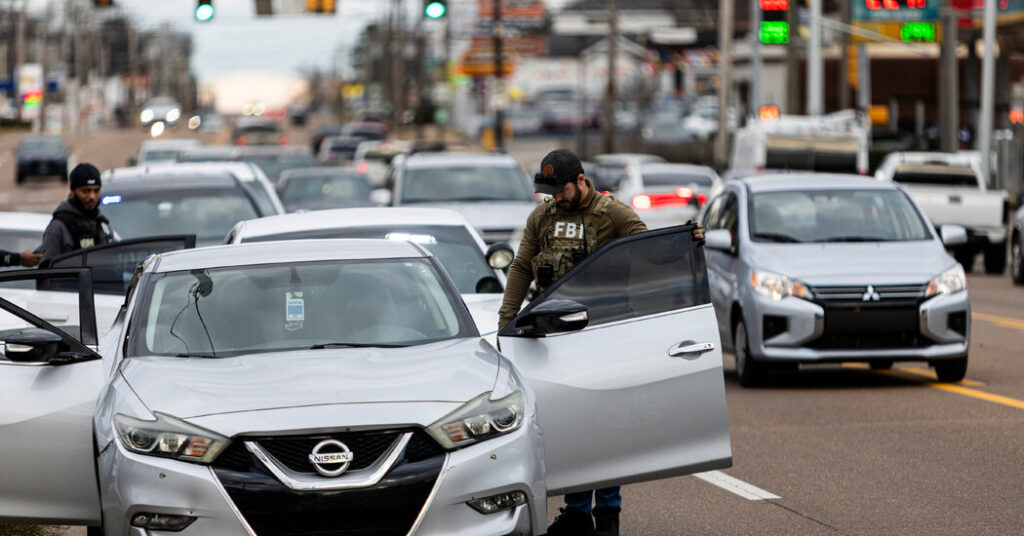
The interactions seem to follow a pattern, some residents say: Whenever they try to document federal agents in Memphis making arrests, they are taunted, threatened with arrest, photographed or trailed by unmarked cars near their homes.
Now those residents, backed by the American Civil Liberties Union, have become the latest in the country to sue the federal government over its tactics toward observers. On Thursday, they filed a series of sworn declarations in court, including photos and videos that they said proved that their constitutional rights were being violated.
“I’m not trying to get in the middle of any action,” said Melissa Peeler, 58, who joined the lawsuit. “I’m just there with a camera and eyeballs, and it’s important because we have got to have some accountability.”
Wiping away tears, she added in an interview: “If I’m not out there, I’m just putting my head in the sand, and that’s not right either.”
Similar First Amendment cases are underway in Minnesota, Los Angeles, Portland and Chicago, other Democratic-led cities where federal agents have mounted sweeping operations as part of the Trump administration’s crackdown on crime and immigration.
While many of those operations have wound down, the Memphis task force — which President Trump created last fall to focus on crime — continues on. Gov. Bill Lee, a Republican, and the Republican supermajority in Tennessee’s legislature have embraced the task force, and Mayor Paul Young, a Democrat, has agreed to allow city police officers to collaborate with them.
Natalie Baldassarre, a spokeswoman for the Justice Department, said that the agency disagreed with the allegations and that it would not “tolerate any action that puts our law enforcement officers at risk.”
Pointing to the thousands of arrests made by the task force since it began work in October, Ms. Baldassarre said the Justice Department remained “committed to fair, impartial and professional law enforcement practices to keep Memphians and the American people safe.”
Given the city’s struggles with crime, the presence of hundreds of federal agents working in tandem with local and state officers has been welcomed by some. The crime rate had already been dropping before the task force arrived, but it has continued to plummet. And Mr. Trump and top government officials have celebrated Memphis as an ideal collaboration between state, city and federal officers.
But others, like those who joined the lawsuit, have argued that the task force has acted aggressively and done little to make immigrants and the city’s predominately Black residents feel safe.
In their declarations on Thursday, the residents accused agents of trailing them home in unmarked cars, taunting them by name and threatening them with arrest while they record traffic stops or other law enforcement activity. Their work, they said, is not just about documenting how federal agents are conducting themselves in Memphis neighborhoods, but also about helping inform the relatives of those who are detained.
The interactions have been complicated by a Tennessee law that passed last year, which requires people to move at least 25 feet away from police officers if they are told to back up. (News outlets have separately sued over the law, arguing that it is vague and could interfere with reporting.)
Hunter Demster, a longtime Memphis activist who filed a declaration on Thursday, estimated that the law had been invoked at least 40 times against him, and said that he was often given conflicting instructions on how far back to move. It has made it difficult to record, he said, infringing on his constitutional rights.
Scarlet Kim, a senior staff attorney with the A.C.L.U., said that “a lot of times the narrative that the government is telling is not correct, and we’ve been relying a lot on people on the street lifting up their phones and recording what’s happening for the public to really understand what federal agents are doing.”
To prevent that, she said, “has an enormous chilling impact.”
Jessica Chodor, 36, recounted being arrested in late October after arguing with officers that she had been in compliance with the 25-foot distance and did not have to remain in her car while they responded to a traffic stop. She was pinned to the ground, she said, and charged with resisting official detention. (The case was dropped just over a month later, she said.)
”I am doing this work to try to make my community more safe,” she said, “and I sincerely believe that this task force is doing a lot of damage that can’t just be erased or dismissed in court.”
The lawsuit comes as Steve Mulroy, the district attorney for Shelby County, has separately challenged a new state law that applies only to his jurisdiction and requires him to inform state leaders whenever a case related to the task force has been dismissed, ended with a plea agreement or led to reduced charges.
Mr. Mulroy has faced political pressure from Republicans who have accused him of failing to aggressively prosecute cases.
Emily Cochrane is a national reporter for The Times covering the American South, based in Nashville.
The post Memphis Residents Are Latest to Sue Over Federal Agents’ Arrest Tactics appeared first on New York Times.