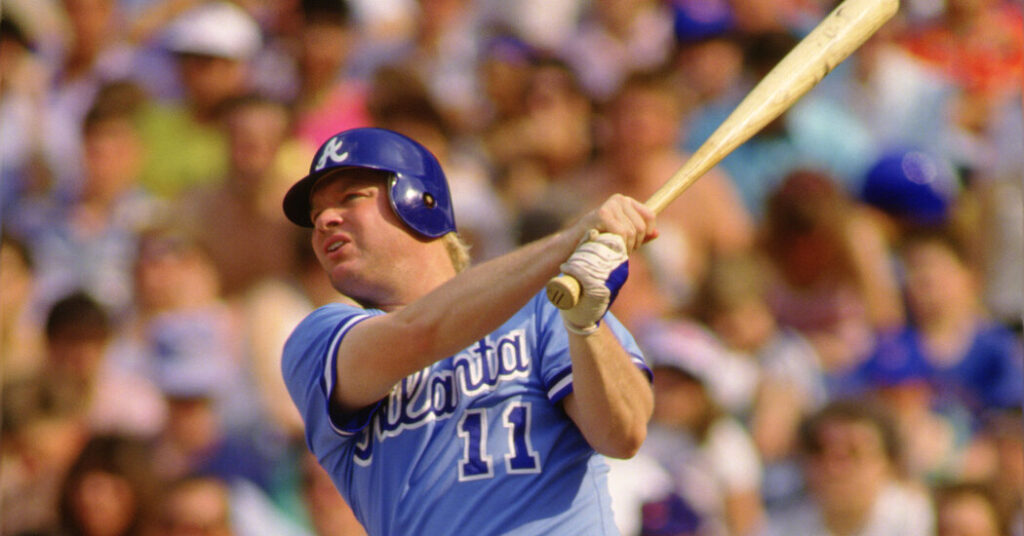
Bob Horner, a powerful third baseman for the Atlanta Braves who hit a home run in his major league debut and later whacked four home runs in a game, a rarity, has died at 68.
The Braves confirmed the death on Tuesday but provided no further details. Horner’s death follows those in recent weeks of Bobby Cox, the team’s Hall of Fame former manager, and Ted Turner, its former owner.
Only 10 players — including Willie Mays, Mike Schmidt, Lou Gehrig, Gil Hodges and Chuck Klein — had slugged four home runs in a game before the 6-foot-1, 195-pound Horner stepped to the plate on July 6, 1986, against the Montreal Expos at Atlanta-Fulton County Stadium.
Facing the right-hander Andy McGaffigan, Horner hit solo home runs in the second and fourth innings and a three-run blast in the fifth. In the ninth inning, against the reliever Jeff Reardon, Horner hit a line drive solo shot for his fourth homer.
“You never plan for anything like that to happen in your career,” he told reporters afterward, then added, “They made some mistakes to me the whole game.”
His six runs batted in were not enough to beat the Expos, who won 11-8. (Since then, 10 more players have hit four home runs in a game.)
The 1986 season — when he hit 27 home runs, drove in 87 runs and had a batting average of .273 — was Horner’s last in Atlanta after nine seasons. (He also played a significant number of games at first base.) He rejected the team’s offer of a three-year contract worth a reported $3.9 million and became a free agent.
The San Diego Padres showed interest in signing him, as did the minor league Charlotte O’s. But in 1987, Horner signed a one-year deal worth as much as $2 million with the Tokyo Yakult Swallows of the Central League.
He was the first major league star in his prime to play in Japan, and he quickly got that country’s attention. After hitting four home runs in his first two games — and six over his first four — he was lionized by fans as “Kami-sama Hoh-ma Hoh-na,” or “Horner, God of Homers.” One Japanese journalist called him “our Superman in Japan.”
“The amazing part — the shock — has been going in two weeks’ time from completely unknown in this country to being somebody everybody knows,” he told The Atlanta Journal-Constitution early in his season in Japan. “At home, baseball is a popular game. Here, baseball is an absolute obsession with the people.”
“To the Japanese,” Robert Whiting wrote in “You Gotta Have Wa,” his 1989 book about baseball in Japan, “this bona fide major leaguer from Atlanta was the ultimate status symbol, for he gave their game a credibility it lacked and, at two million dollars a year, was also by far the most expensive player they had ever acquired.”
With expectations so high, some disappointment was inevitable after those sensational early games. Newspapers called Horner “The Red Devil” and “Blond Ogre” and raised his history of injuries and weight problems while with the Braves. Despite his uneasy adjustment to the frenzy he caused in Japan, he had 31 homers, 73 R.B.I. and a .327 batting average.
He considered playing a second season in Japan but told The Journal-Constitution in late 1987: “You grow up with an idea of what baseball should be. Then you’re forced to go halfway around the world to play something that isn’t baseball.”
James Robert Horner was born on Aug. 6, 1957, in Junction City, Kan., to Jim and Elaine Horner. The family later moved to Southern California. After high school in Glendale, Calif., he was drafted by the Oakland A’s but chose to go to Arizona State University. In three seasons there, he had a batting average of .383 and hit 56 home runs, then an N.C.A.A. career record.
He also led the Sun Devils to the 1977 national championship and was named the outstanding player of the College World Series. In 1978, after batting .412, he was drafted first overall by the cellar-dwelling Braves. Desperately needing offensive punch, the Braves scuttled an early plan to start Horner with their Double-A minor league team in Savannah, Ga., and started him in the big leagues. He was 20.
Ten days after being drafted, and in the third at-bat of his career, Horner unleashed his short, compact swing to crush a two-run homer against the Pittsburgh Pirates’ right-hander Bert Blyleven in a 9-4 loss.
Although he played only 89 games, Horner won the 1978 National League Rookie of the Year Award, and had a strong 1979 season, hitting .314 with 33 homers and 98 R.B.I.
His batting average dipped to .059 early in the 1980 season, and the Braves demoted him to their Triple-A team in Richmond, Va. Horner refused to go, initiating a days-long standoff with Turner that led to his reinstatement.
“All the last 10 days accomplished was to hurt and humiliate me,” Horner told reporters.
Although he did not get his wish to be traded, he ended up having another good season, with 35 homers, 89 R.B.I. and a .268 batting average.
Horner played with another slugger, Dale Murphy, through his time with the Braves. But the Braves lost more than they won in that era and only reached the postseason once, when they were swept in the 1982 National League Championship Series by the St. Louis Cardinals. Horner had one hit in 11 at-bats.
In 1987, after a final productive season with the Braves, he left for Japan.
When he returned to the United States, he signed a one-year deal with the Cardinals but was limited to 60 games by a shoulder injury that required season-ending surgery. He retired in early 1989 after a spring training tryout with the Baltimore Orioles. He later did public relations work in Japan, made investments and attended card shows.
In 2004, he received $7 million from Major League Baseball after arbitrators found that team owners had violated the collective bargaining agreement with the players’ union in the 1980s by colluding to prevent free agents from obtaining larger salaries.
His survivors include his wife, Chris (Berry) Horner, and two sons, Tyler and Trent.
Horner’s early flurry of home runs in Japan made some traditionalists worry that the single-season Japanese home run record — then 55, held by Sadaharu Oh — might be imperiled.
Playing only 93 games, Horner never got close. He suggested that Japanese umpires didn’t want him to break Oh’s record.
“What happens is the strike zone mysteriously gets bigger” and balls were often called strikes, he told The Chicago Tribune in 1987. “You’re playing in their league, in their country. You either put up with it or don’t play.”
Richard Sandomir, an obituaries reporter, has been writing for The Times for more than three decades.
The post Bob Horner, Powerful Slugger in Atlanta and Japan, Dies at 68 appeared first on New York Times.