Long before Pierre Paslier became an ocean entrepreneur, he was a plastics-packaging engineer, turning fossil fuels into the materials needed to ship and sell cosmetics. But he knew there had to be a better way. After taking a break from the corporate world, he went back to school and launched into an experimental phase with his co-founder Rodrigo Garcia Gonzalez. In a makeshift kitchen lab, they played around with food materials trying to figure out which would do the best job at mimicking plastics. Before long, they hit on a clue: imitation caviar, whose tiny membranes are made from seaweed, behaved in some ways like the packaging they were trying to invent.
The company they founded in 2014, Notpla (think “Not Plastic”), eventually expanded to build a product line including takeaway boxes, flexible films, rigid cutlery, and seaweed-based paper. Perhaps more importantly, it joined a growing ecosystem of startups committed to simultaneously making use of ocean resources and supporting their conservation. Inspired by companies like Notpla, the bank Standard Chartered in 2023 wrote a white paper on seaweed, declaring it an investable asset category. Suddenly, capital began to flow to seaweed startups.
Today, more than $780 million has been invested in seaweed ventures, according to Phyconomy, a seaweed-investment tracker. “I see Notpla as a good visible application to make the case for why it’s worth spending more of our attention, brains, and dollars to the ocean space,” says Paslier. “There are a lot of solutions that are going to come from it in the future.”
Those solutions couldn’t come fast enough. Oceans face continued and deepening threats from humans, from overfishing to plastic pollution. Coral reefs are dying at such a clip that scientists warn of irreversible loss. At the same time, oceans face the challenge of funding pullbacks from governments and nonprofits. The fractured geo-political landscape also hampers efforts to forge international conservation agreements, even though some big successes like the High Seas Treaty have moved forward. But some environmental advocates, alongside a growing number of entrepreneurs and investors, are coming around to a realization: position this threat slightly differently and it actually becomes an opportunity.
Last year, J.P. Morgan estimated the value of ocean-related activity, what it called the “annual gross marine product,” at $2.5 trillion annually. And it noted that ocean-climate startups have raised over $5 billion in venture funding over the past decade. Most is early-stage financing, meaning there may be much more to come as companies mature.
“We need to continue growing an asset class that is not just for impact investors or philanthropic investors, but something that people look at as part of their portfolio,” says Philippe Cousteau, founder of the ocean-tech company Voyacy Regen, and grandson of famed oceanographer Jacques Cousteau. This is easier said than done.
Oceans are a new investment category, and there’s no guarantee enough investors will buy into the thesis to make it more than just a niche. Even if they do, it will be difficult to reach finance levels required to meet the scale of the challenge. And some ocean advocates say the private sector is poorly positioned to decide which practices are actually sustainable, much less protect oceans equitably.
Though the first Law of the Sea dates to the Middle Ages, oceans are profoundly difficult to regulate and manage—especially as some governments abandon climate policy. Guy Standing, an economist whose book The Blue Commons is considered a landmark in ocean protection, describes it as a “Wild West situation” as President Donald Trump disrupts seemingly any intergovernmental collaboration. It’s in this gap that the private sector could determine the future. Its role in ocean protection may not have been the first-best option. But with oceans in worsening shape and governments occupied with other priorities, it would be foolish to ignore the possibilities.
At first blush, Notpla may not sound like an oceans company. While the key material input is seaweed, Paslier and his co-founder aren’t oceanographers or marine biologists. Much of the company’s work happens in London, far from the seaweed farms that supply its core ingredient. And its end use, namely packaging, is in some ways a more obvious categorization. But the company wears its ocean label proudly.

Right now, Notpla buys seaweed from suppliers that sell into medical supply chains, which is currently the most reliable source, but the company hopes soon to use seaweed overgrowth that washes ashore in the Caribbean, a problem caused by runoff from agricultural waste and exacerbated by climate change. If they can set up the infrastructure, local hotels will actually pay Notpla to take it away. Indeed, the raw material is its biggest selling point. And seaweed’s biodegradability keeps plastics out of the ocean. Paslier says that as of this year the company has successfully replaced 40 million single-use plastic products. Most fundamentally, the company rests on the premise that oceans have value worth protecting. “Life started in the ocean,” he says. “We’re really kind of like a massive step behind in terms of understanding, paying attention, and learning what can be done.”
Over the past several years, it’s been almost impossible to miss the proliferation of companies pitching a new product at the intersection of oceans and sustainability. No matter where I go, there they are. In Rio de Janeiro ahead of COP30, I met with the CEO of Matter, a company that makes filters to capture microplastics from washing machines and textile factories before they end up in rivers and eventually the ocean. At a clean-tech incubator in London, I met with Global OTEC, a company that uses ocean heat to generate electricity offshore. The company aims to provide small island countries with a reliable power source. And at this May’s Milken Conference, an influential business and finance gathering, I spoke with Cousteau about Voyacy Regen. The company builds coral-reef replicas to install in areas where reefs have been lost or are suffering. Cousteau roots his pitch in economics. “Do-goodery will never unlock that scale of capital,” Cousteau says—the goal is to build something that “meets all the criteria for any other infra-structure investment.”
There’s certainly plenty of that. Think of firms using oceans to remove carbon dioxide from the atmosphere or those selling solutions that help communities adapt to rising sea levels. It includes offshore wind companies and ventures to capture tidal energy. Pharma startups are hoping they might source ocean ingredients for the next big drug. The World Economic Forum counts more than 880 companies as part of its ocean-startups coalition, but it’s almost certainly an undercount. “This is not a small, niche, cute area,” Kate Danaher, managing director of oceans, at S2G, an investment platform. “You can’t look at the ocean as a sector. It’s more of a theme.”
In a way, taking this mindset is an advantage. Broadening the aperture means a wider universe of companies to fund, and protects against challenges in one technology or sector. But it also poses risks. Most investment firms lack teams with oceans expertise. Even those that do have them may not know about the specific part of the ocean that any given company is focused on. This will pose a growing challenge as companies mature and need to attract investment from a broader group that includes traditional private equity and major banks.
This disconnect will come to a head in the coming years as the first ocean investment funds, launched in the past decade amid urgent climate concern, reach maturity. Successful companies that either raise more money or stand on their own will give investors a sense of true opportunity. As with any company, the key is creating a business model that someone else will pay for. That means solving a problem or creating an opportunity for customers, not just advancing ocean protection. “When I go to speak to a textiles manufacturer, I am basically talking about how we’re going to save them money,” says Matter CEO Adam Root of the microplastics filter that cuts down on machinery wear and tear.
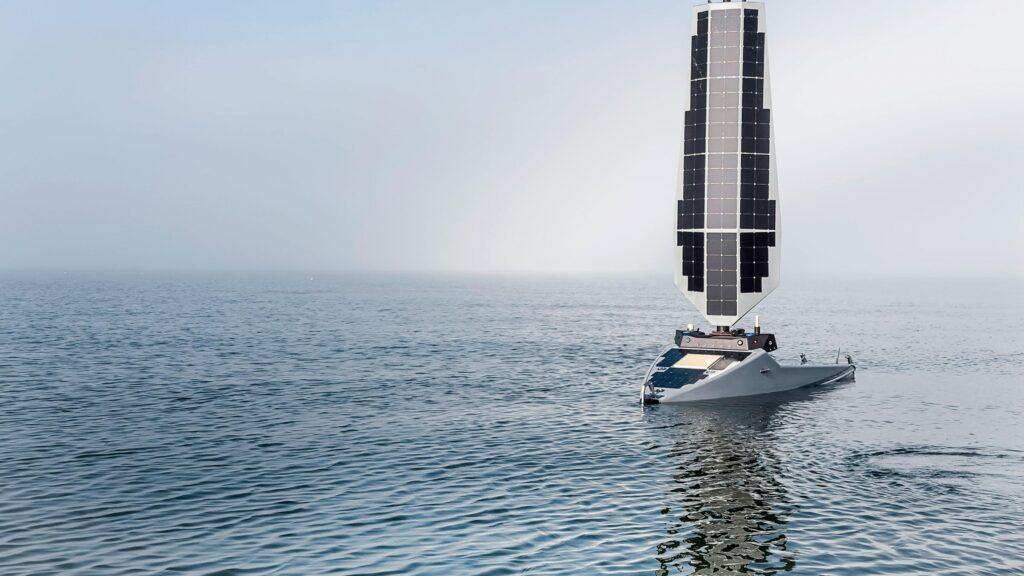
One group of companies that have seen particular success amid geopolitical tensions are those that can claim to be at the intersection of oceans and defense. Think of companies that monitor and map the seas. They were built, in many cases, to provide conservation data, but now serve another purpose entirely as the U.S. and Europe increase spending on technologies with military or intelligence applications. “The number of assets we have in the water, research and discovery, but also for [defense] intelligence is really low,” says Rodrigo Prudencio, managing partner at Propeller, an ocean-focused venture fund. “But we’re also at a time where the cost of deploying autonomy and these vessels in the ocean is really accelerating downward. We have companies in our portfolio that do that.”
But investors are not blindly optimistic, acknowledging that the shifting winds around emissions reduction have hit companies primarily offering decarbonization solutions, like those selling expensive carbon credits or producing offshore wind.
Corporations, of course, are just one part of the broader funding picture. For decades, financial firms have explored how boutique mechanisms can help fund nature protection, including oceans. Blue bonds provide money to countries at favorable rates, if the funds are used for ocean protection. And debt-for-nature swaps help alleviate national debt in exchange for nature protection. These financial mechanisms have had some success, but they have struggled to scale. Successful ocean companies could change the way the private sector thinks about what it means to invest in—and earn a return from—oceans.
Standing, the British labor economist, is best known for his advocacy around universal basic income and calling for governments to play a more robust role guaranteeing citizens financial security. In his 2022 The Blue Commons, he challenges the concept that many ocean entrepreneurs and like-minded advocates have termed the blue economy. Oceans underpin all of human society; purely financially motivated efforts to protect them are, he argues, destined to fail. When we spoke in April, Standing expressed dismay at how collective efforts at ocean protection have stumbled or even moved in reverse. That said, he doesn’t see private capital as the solution. “I don’t expect private equity to suddenly change and become pussycats and look after the environment,” he told me. “We need a new model to rescue the commons.”
It shouldn’t be controversial to say the private sector isn’t a replacement for public-sector action, particularly when it comes to setting the rules of the road. Investors and entrepreneurs are experts at thinking about how to solve market problems, not about the broader ethical and political questions lurking under the surface. In most of my conversations with them, my question about how they define sustainability remained largely unanswered. Some things do seem beyond the pale to this group. Think deep-sea mining or offshore oil drilling. But the technologies they tend to tout, from offshore wind to carbon capture, come with their own trade-offs.
In an ideal world, decisions about how best to balance these factors would be decided by governments after consulting with the best available science and considering the political, economic, and societal implications. Instead, official lack of consideration of the value of oceans may actually be slowing investment. Alfredo Giron, who heads the World Economic Forum’s Ocean Action Agenda, says governments can play a key role by emphasizing the economic necessity of ocean protection. “The big capital is not going to flow for real,” he says, “until [the] perception is changed.”
Big companies recognize the problem. They know their supply chains are threatened. They know many of their facilities face rising sea levels. But companies, by their very nature, are focused too narrowly to solve those global problems. We probably do need private-sector money to flow into oceans. But the irony is that the private sector may need government guidance just as much. Once the direction of travel is clear, the billions of dollars flowing into ventures today can turn into the trillions needed.
This story is supported by a partnership with Outrider Foundation and Journalism Funding Partners. TIME is solely responsible for the content
The post A New Wave of Investment Sees Profit in Ocean Conservation appeared first on TIME.