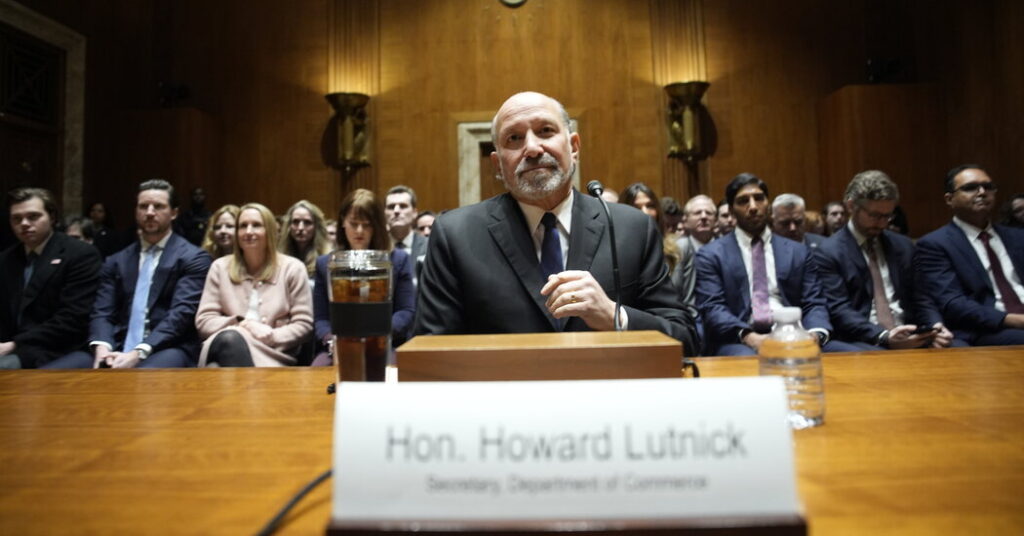
In his freewheeling first year in office, Howard Lutnick, a 64-year-old billionaire, has emerged as a commerce secretary unlike any other in recent memory. He has boasted of using the power of the federal government to benefit taxpayers at home and abroad.
The tactics Mr. Lutnick has used to pressure foreign governments and private companies alike were honed during his time on Wall Street. After decades at the helm of the investment firm Cantor Fitzgerald, he had earned a reputation as an intuitive deal maker with an appetite for risk and a willingness to walk up to ethical lines.
The New York Times examined 818 corporate entities that he reported leading in his financial disclosure form last year, reviewing thousands of pages of records and interviewing former employees, associates and others. Here are four takeaways from that review:
Even among billionaires, Lutnick had a lot of companies.
Most of the 818 companies that appeared in Mr. Lutnick’s disclosure last year were affiliated with Cantor Fitzgerald. They revealed how far he had taken it from its original mission as a bond broker into new investment areas — some traditional, such as real estate, and others risky, such as start-ups and gambling.
He used one firm to invest alongside Jeffrey Epstein, the convicted sex offender who was his neighbor on the Upper East Side of Manhattan, in an ill-fated advertising technology business. He used another to create an “entertainment stock market” that let customers trade “virtual shares” of movies and celebrities.
Mr. Lutnick also relied on shell companies in his personal life. He set one up in 2013 to buy a vintage Jaguar XKSS, a model made famous in the 1950s by the actor Steve McQueen. He used five other shell companies to buy properties in New York, Washington and Florida — in addition to the sprawling Manhattan townhouse he had purchased in his own name.
Mr. Lutnick amassed wealth and prominence, but he also left behind a trail of disputes, including more than $50 million in penalties for money-laundering, misleading disclosures and other offenses.
He has a history of financial disputes involving his personal properties.
In at least three cases, Mr. Lutnick withheld payments at luxury properties he had bought through shell companies.
At his waterfront condo in Miami Beach, he collected nearly $12 million from his insurer after a failed air-conditioning hose caused flooding in his unit. Yet he appears to have ignored requests to reimburse the building for $145,000 in damage to common areas and elevators.
Mr. Lutnick offered to pay for the damage if the building agreed to let him combine two vestibules outside his apartment into a single entryway, but he was eventually sued by the building and settled. (He ultimately was allowed to combine the vestibules.)
At the Pierre, a luxury building overlooking Central Park, he did not pay his monthly co-op maintenance fee of about $65,000 for months after his penthouse sustained water damage during a storm. A representative said Mr. Lutnick was following advice from his insurance company. He eventually reimbursed the co-op about $500,000.
And at his Long Island estate in Bridgehampton, a contractor put a $1 million lien on the property, saying Mr. Lutnick had not paid his full bill. Both parties said they were in negotiations to resolve the dispute.
He left negotiating partners feeling betrayed.
Mr. Lutnick has used his brash approach and the threat of tariffs to pressure companies and foreign countries, winning promises of hundreds of billions of dollars in investment.
But company executives and foreign officials have found him erratic, saying his aggressive style has made for rocky relations. Analysts have also questioned whether some of the investment promises he has extracted will materialize.
The investment Japan has promised before the end of Mr. Trump’s term — $550 billion — is equivalent to Japan’s total investment in the United States over the past 20 years. When the administration touted investments during Mr. Trump’s visit to Tokyo in October, some senior Japanese executives said they first learned the details of their purported commitments that evening.
Automakers also felt jilted last year, they said, after Mr. Lutnick and his aides told them they would be eligible for an exemption on tariffs on auto parts going back to May, and then changed the terms. Automakers later learned the credit would start six months later than they had been told.
The change would cost them hundreds of millions of dollars each — and nearly $1 billion in the case of Ford, which had to announce the change to its shareholders. A representative of Mr. Lutnick said he had never promised that tariff credits would be retroactive.
He handled money in unorthodox or opaque ways.
As commerce secretary, Mr. Lutnick has tried to squeeze money from unorthodox sources. He has promoted the “Trump Gold Card,” which expedites U.S. immigration applications for foreign citizens who pay a $1 million fee.
More recently, lawmakers have expressed concern that Mr. Lutnick could use funding that Congress had appropriated to establish a nationwide broadband system for other purposes.
Mr. Lutnick has also used his control of a semiconductor subsidy program to pressure funding recipients to renegotiate contracts signed under the Biden administration. He halted payments to companies as he pushed them to invest more in the United States or give stock to the government.
Chip companies have pledged substantial new investment. But tech industry executives say they have also counseled their colleagues against future meetings with the Commerce Department, for fear they would be exhorted to make other concessions.
Ana Swanson covers trade and international economics for The Times and is based in Washington. She has been a journalist for more than a decade.
The post 4 Takeaways From The Times’s Reporting on Howard Lutnick appeared first on New York Times.